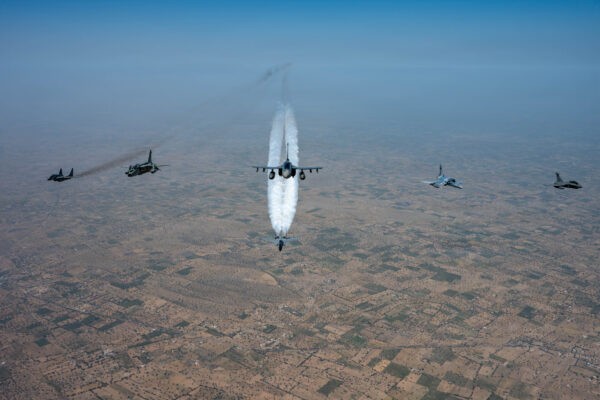
India’s Defence Minister Rajnath Singh said at an event and demonstration in Jodhpur on 10 October, as the multilateral Exercise Tarang Shakti drew to a close, that future defence relationships will be built on technology and trust rather than solely on platforms.
The subsequent fly‑past displayed an arrow‑shaped formation, with an Indian Air Force Su‑30MKI of Russian origin positioned at the centre and a United States aircraft on one flank.
The engagement pitted an F‑35 and an Indian Light Combat Aircraft (LCA) against a French‑built Rafale and an F‑16 operated by the United Arab Emirates Air Force.
This was an impressive formation; the technology and firepower they represented cannot be easily beaten.
The presence of an American fifth‑generation fighter aircraft operating alongside a Russian‑origin jet illustrates India’s multi‑pronged foreign policy and its diverse military engagements.
In addition to the Tarang Shakti exercise, a number of bilateral drills have already concluded while further ones are slated, underscoring the packed schedule of India’s military diplomacy and its military‑to‑military engagements.
The Indian and Russian navies are conducting their annual INDRA maritime exercise in Vladivostok, Russia, from 13 to 18 October.
Taken together, they illustrate two trends: first, the Indian armed forces are expanding joint operational capabilities on land, sea and air with key partner nations and like‑minded countries; second, India is pursuing a multi‑vectored foreign policy that aligns with its long‑stated commitment to strategic autonomy.
Thunder in the Skies A biennial exercise, Tarang Shakti is now in its second edition.
It was themed Power in Partnership and was held at Jodhpur near India’s western borders.
It commenced on September 26 and ended on October 12.
The event gathered the Indian Air Force (IAF) together with eight nations—Australia, Bangladesh, France, Germany, Sri Lanka, the United Arab Emirates and the United States—each of which deployed its aerial assets.
The true measure of an exercise’s usefulness lies not in the assets contributed by the host nation but in the contributions supplied by partner nations, which reflect the value they assign to the event. This view highlights the importance of multinational participation in gauging the overall benefit of the exercise.
The U.S. fifth-generation F-35 jets exercised over Indian skies for the first time, operating alongside the entire gamut of IAF fighters—the LCA, Rafale, SU-30MKI, Mirage 2000s, MiG-29s, Jaguars, French Rafales, and the UAE’s F-16s.
The missions were carried out by A‑400M and C‑130/C‑130J transport aircraft, supported by aerial refueling tankers, G‑6000 aircraft and other support platforms.
An Indian Air Force official, referencing a post‑exercise data brief, told The Diplomat that the Tarang Shakti exercise involved more than 800 sorties and accumulated over 600 flight hours.
The U.S. Pacific Air Forces deployed six F‑35A Lightning II fighter jets and one KC‑135R Stratotanker, accompanied by more than 200 personnel.
Speaking at the Bloomberg New Economy Forum, U.S.
Ambassador to India Sergio Gor said that their F‑35 aircraft are not deployed worldwide and described their presence at the Tarang Shakti exercise as “another example of trust” between the two countries.
France, a resident power in the Indian Ocean, deployed four Rafale fighter jets, three Airbus A330‑PHENIX aerial refuelling aircraft and two Airbus A400M transport planes. The deployment also included a contingent of 300 personnel.
The operation formed part of the broader Pegase26 mission, which launched on 8 September and has since moved across the Arctic, the Indo‑Pacific, the Middle East and North Africa. The mission’s itinerary spans those four regions.
The mission, which lasted more than 40 days, visited nine destinations and covered over 40,000 miles, demonstrating its capacity for long‑range deployment, sustenance and adaptability.
The exercises, which typically feature subject‑matter exchanges, were used by India as the host nation to brief visiting delegations on the outcomes of Operation Sindoor, conducted in May 2025. The operation has generated significant operational lessons for military planners.
Encapsulating this, Exercise Director Air Vice Marshal Raj Thakur noted that Operation Sindoor was one of the remarkable operations carried out by India, and there was a lot of interest in knowing about it. “And that's why in one of the subject matter expert exchanges, we briefed them about what exactly has happened in Operation Sindoor and our part of the story, and that was very well received,” Thakur said.
India has maintained back‑to‑back diplomatic and military engagements, reflecting a very busy diplo‑military calendar in recent years.
These were quite often simultaneous engagements with nations that are warring or adversaries.
The Indian military’s calendar has been exceptionally busy and its engagements highly diverse; a review of the notable operations undertaken since July highlights this range.
The bilateral Army exercise Yudh Abhyas between India and the United States was conducted from September 15 to September 27.
The exercise involved 600 personnel from each side operating in the high‑altitude area of Auli in Uttarakhand, followed by long‑range firepower drills, including U.S.
HIMARS, Indian Pinaka rocket systems and counter‑drone systems were demonstrated at the Mahajan Field Firing Range in Rajasthan. The exercises displayed the operational capabilities of the U.S.-made HIMARS alongside India’s indigenous Pinaka rockets and anti‑drone platforms.
The Yudh Abhyas exercise, launched in 2004 as a platoon‑level drill focused on peacekeeping operations, has since expanded markedly in both scope and complexity.
The same applies to other India‑U.S. military drills. The bilateral air exercise Cope India and Exercise Malabar—originally a two‑nation naval exercise—have both expanded into quadrilateral operations that involve submarines and aircraft carriers conducting highly complex scenarios.
Beyond the Yudh Abhyas exercises, the Indian Army has conducted bilateral war games with Thailand (Maitree‑XV), Mongolia (Nomadic Elephant), Kazakhstan (KAZIND) and the United Arab Emirates (Mountain Guardian). The UAE drill, whether incoming or outgoing, is slated to conclude on 18 October.
The Indian Navy has been the busiest with at least eight engagements.
Alongside the Indra operation, a three‑nation naval drill known as Exercise IBSAMAR, involving India, Brazil and South Africa, is presently being conducted in waters off South Africa.
The Quad grouping—India, Australia, Japan and the United States—conducted a tabletop exercise on 3 September and 4 September, hosted by Japan, to advance the Quad Indo‑Pacific Logistics Network.
At the end of September, the coast guards of the Quad nations conducted the second joint sail under the QUAD‑at‑Sea Ship Observer Mission.
The Indian Coast Guard vessel Shaunak departed Chennai on 25 September for Perth, Australia, with six sea riders aboard – two officers from India, two from Japan, and one officer each from Australia and the United States.
On 8 October, the Indian Coast Guard staged the twelfth national Maritime Search and Rescue Exercise (SAREX‑2026) in waters off Odisha. The drill involved all Indian stakeholders and hosted 32 observers representing 30 different countries.
It underscores the extent of deepening engagement, especially in the maritime domain, which has implications far and wide.
The IAF held two bilateral exercises with Japan (Veer Guardian) and Malaysia (Udara Shakti).
It also took part in the multilateral Pitch Black exercise, which was hosted by the Royal Australian Air Force and ran from 7 July to 7 August.
Operationalizing Interoperability The oft-repeated “interoperability” is more than just flying together in a fly past.
The task is highly complex, requiring a thorough grasp of tactics, techniques, procedures and cultural practices in order to integrate a wide array of equipment while safeguarding sensitive operational aspects.
F‑35 aircraft took part in the war games, yet they were concealed from observation, even by the nations participating in the exercises, underscoring the sensitivity of the fighter’s most advanced technology.
This prompted Air Chief Marshal Amar Preet Singh to take a friendly jibe at Gen.
At a press conference on 10 October, the chief of the Indian Air Force said: “Your people don’t even let us go near the aircraft, and you talk about selling it to us.” He added that while deepening engagements reflect the shifting balance and hedging strategies in the Indo‑Pacific, the purpose of the exercises is to prepare for evolving threats rather than to target any particular party.
Air Chief Singh emphasized the point during a press conference that was also attended by other chiefs and the heads of the participating forces.
Singh emphasized that, with respect to the Indo‑Pacific, the exercise was not intended to project any presence in any region.
What do these exercises translate to in real time?
Schneider succinctly put it, We don't know what the security situation holds or what the future holds.
Some of us may be called to do humanitarian assistance disaster relief, or there may be other challenges that we face.
When forces convene, they do so on a foundation of teamwork built during exercises such as Tarang Shakti, Pitch Black, Red Flag Alaska, and the many other drills conducted throughout the Indo‑Pacific region, rather than in a cold, ad‑hoc manner.
Exercise Tarang Shakti and Exercise Yudh Abhyas have acted as barometers of the degree of interoperability that India has developed over the years with its key strategic partners.
According to a handout issued at the event, the Tarang Shakti exercise is intended to deepen mutual understanding of tactical air‑power employment, strengthen interoperability among the participating air forces, and foster seamless multinational cooperation. The cooperation is to be achieved through integrated air operations, joint administration, logistics support and maintenance coordination.
From the feedback and observations of participants, the exercise seems to have achieved what it set out to do.
The passage underscores India’s ongoing expansion of military‑to‑military engagements, carried out in a range of formats and across multiple regions, in line with its strategic objectives and the resulting outcomes that further shape those goals.
Why it matters
Bangladesh’s participation in Tarang Shakti enhances its air‑force interoperability with major powers, bolstering regional security cooperation.