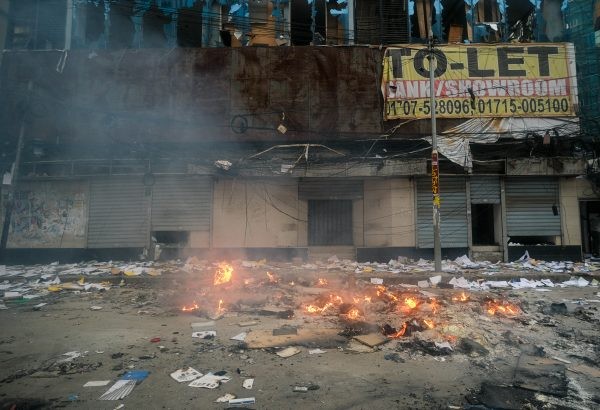
On the night of October 18, men chased Ripon Mia through Paiska in Bangladesh’s Narayanganj district and attacked him with sharp weapons.
His family took him to hospital, where doctors declared him dead.
Ripon served as a local leader of Jubo Dal, which functions as the youth wing of the ruling Bangladesh Nationalist Party (BNP).
Local BNP activists reported that tensions between two factions had recently intensified regarding the inclusion of specific names on the guest list for a religious event. "Several men chased my father and hacked him," his daughter, Shila, told the media.
The local BNP president linked the killing to a struggle for political dominance.
Earlier this year, two brothers died after supporters of the BNP and Jamaat-e-Islami (JI) clashed in the western district of Chuadanga on February 28.
Police said an argument after the evening meal breaking the Ramadan fast escalated into violence.
Hafizur Rahman died hours later, while his brother Mofizur Rahman, a local Jamaat-e-Islami (JI) leader, passed away in a Dhaka hospital on March 10.
The BNP and the JI blamed each other for the violence.
Police arrested three suspects after the family filed a murder complaint, including a local BNP official and a former leader of its volunteer wing.
The clash came less than two weeks after the BNP returned to government.
Records from the Bangladeshi human rights organization Ain o Salish Kendra (ASK), along with academic research and news reports, trace more than two decades of political violence in Bangladesh.
They show how clashes between rival parties, within their own ranks, and around elections have persisted through successive governments.
Between January and September of this year, ASK recorded 94 deaths and 3,587 injuries resulting from 467 incidents of political violence.
That includes 112 clashes classified as BNP against BNP.
Those clashes left 18 people dead and 1,215 injured.
The figures cover part of the interim administration as well as the elected government.
BNP chief Tarique Rahman took office as prime minister on February 17.
Bangladesh has changed a lot in recent years.
An uprising in the summer of 2024 toppled Prime Minister Sheikh Hasina after 15 years of authoritarian rule.
An interim administration, led mostly by non-politicians, took over.
Then came a national election and a political government.
Yet through every one of those shifts, one thing hasn’t changed: Bangladeshis are still dying in fights over who controls things at the local level.
This is not a problem that belongs to any one government.
Records extending back to 2002 show violence between rival parties, within the party in power, and around elections.
A party post, a business, a piece of land, or even a guest list for a social event can become the setting for a struggle over who commands a neighborhood.
The history also demonstrates why the issue cannot be attributed simply to hostility between the BNP and the Awami League (AL).
During the 2002–2006 period, which largely covered the previous government of the BNP, ASK recorded 284 internal BNP clashes and 55 deaths.
These figures appear in political scientist Rounaq Jahan’s 2014 study “Political Parties in Bangladesh.” Jamaat-e-Islami (JI), an Islamist party currently in opposition, served as a junior partner in the BNP-led government from 2001 to 2006, holding two positions in the Cabinet.
But the political alliance of the time did not prevent violence between party supporters.
Figures reproduced from ASK in a 2014 study by Jahan documented 134 clashes between the BNP and JI between 2002 and 2006, resulting in eight deaths.
During the same period, there were 42 clashes between the Awami League (AL) and the Jatiya Party (JP), resulting in seven deaths.
The military-backed caretaker years of 2007-2008 brought a sharp fall in recorded party clashes.
Inside the BNP, there were just eight clashes and two deaths.
Inside the AL, there was one clash and no deaths.
Clashes between rival parties also decreased to 32 incidents, resulting in seven deaths, all of which occurred during fights between the AL and the BNP.
In 2002-2006, by comparison, AL-BNP clashes alone caused 118 deaths.
The period of 2007-2008 saw nine deaths in total due to political violence.
Yet fewer party clashes did not mean freedom from political coercion.
Human Rights Watch documented arbitrary arrests, torture, and custodial killings.
The conditions under which parties could gather and fight were changed.
After the AL returned to government in 2009, internal violence rose again.
Between 2009 and 2012, 799 internal AL clashes killed 97 people.
The corresponding BNP figures were 229 clashes and 21 deaths.
Note that these totals cover unequal time periods.
The point is not to rank the various governments, but rather to highlight the recurrence of deadly conflict within the party currently holding national power.
While local disputes are a recurring issue, national political confrontations proved much more lethal.
In 2013, as Bangladesh approached a bitterly disputed election, ASK recorded 507 deaths from political violence.
Its annual sheet categorized 185 deaths under hartal (strike) violence and another 85 under blockades beginning on November 26.
Under the AL government, confrontations involving JI and security forces became particularly deadly in 2013.
According to ASK's original annual records, 37 deaths were recorded in clashes involving the JI, its student wing Shibir, and police.
Another 11 deaths were recorded separately in JI–police clashes.
Additional casualties are linked to rows naming Jamaat-e-Islami (JI) or Shibir: 13 deaths in clashes between the Awami League (AL), JI, and Shibir; nine deaths in AL-JI clashes; nine in Shibir-police clashes; and five in clashes involving the AL, the BNP, JI, and the police, alongside several smaller categories.
Taken together, rows involving Jamaat-e-Islami (JI) or its student wing, Islami Chhatra Shibir (Shibir), account for 96 of the year’s 507 deaths.
Notably, these categories describe the groups that participated in the fighting, without establishing who was responsible for causing the deaths.
The following years saw fewer separately identified incidents involving JI and Shibir.
In 2015, there were nine incidents and three deaths naming either group.
In 2016, two incidents were listed, with one death.
The 2017 table recorded one Shibir–police clash, leaving three people injured.
Neither JI nor Shibir was separately named in the 2018 and 2019 tables.
These gaps limit what the annual summaries can establish about the party’s involvement during those years.
Even when major political parties were not confronting each other in a national showdown, people could still die in contests among political allies.
In 2017, ASK recorded 52 deaths in political violence.
That figure did not include the separate rows for clashes involving the party’s student and youth organizations.
Local elections were another recurring source of deaths.
In 2016, ASK recorded 147 deaths resulting from violence associated with elections for rural local councils, which are known as union parishads and occur every five years.
That accounted for most of the 177 political violence deaths recorded that year.
In 2021, violence related to these council elections resulted in 113 deaths, accounting for 113 of the 157 total fatalities recorded across the country.
These numbers do not identify who carried out each killing.
They do show how much violence occurred around the distribution of local offices, not just around parliamentary elections.
Research into the motives for violence helps explain the connection.
A study by the BRAC Institute of Governance and Development examined reported political violence during the years 2008 to 2013.
Its analysis of causes during the period from 2008 to 2012 identified struggles for dominance as the largest listed category within political parties.
Disputes over contracts, property, land, and jobs were another category.
The study used its own dataset, so its totals cannot simply be joined to ASK’s.
Its findings nevertheless offer an explanation for the pattern in the longer record.
Political organizations provide ways to contest office and represent voters.
They can also give local figures access to people who control public decisions.
Where that access can be used to secure income or protect a business, competition inside a party carries stakes beyond the next election.
The uprising that brought down the government of Prime Minister Sheikh Hasina in August 2024 raised hopes for a different kind of politics.
Protesters and political leaders spoke of building a “new Bangladesh.” Yet the fall of the government did not end the struggles over local power and money.
The persistence of killings across governments does not make all governments, or all forms of violence, equivalent.
It is essential, for example, to distinguish the violence surrounding Hasina’s removal from routine factional fighting.
A United Nations human rights investigation has uncovered systematic abuses committed by the former government, its security services, and violent factions associated with the Awami League (AL).
Its February 2025 public findings estimated that as many as 1,400 people may have been killed during the July–August unrest.
It described an official policy of violently suppressing protesters.
ASK’s ordinary political violence table for 2024 records 100 deaths. The table provides a tally of fatalities attributed to ordinary political violence for the year.
That is not a count of the full uprising death toll.
ASK separately monitored deaths in the protest movement.
Treating the count of routine political violence as a complete measure would conceal the scale and character of the repression.
The 2024 uprising ended a long period of AL rule.
It also opened space for struggles over positions and businesses that local party networks had previously controlled.
In the port city of Chattogram, a dispute over a sports ground turned deadly.
On September 20, 2024, Zubayer Uddin Babu was stabbed to death during a clash between rival BNP groups in the Chandgaon area.
Police said the groups were fighting over control of an artificial turf field.
Prothom Alo, a Bangladeshi daily, examined 15 incidents involving killings, attacks, clashes and land grabbing in Chattogram.
Its investigation found that the change in government had shifted control over sources of illicit income.
The disputes involved transport, markets, land, and railway contracts.
Leaders and members of the BNP and its affiliated organizations were among those accused of taking over networks previously controlled by individuals linked to the AL.
This was occurring under the interim government led by Muhammad Yunus, prior to the return of the BNP to national office.
Following the loss of power by the AL, internal clashes within the BNP emerged as a significant source of political fatalities, even prior to the party's return to government.
In 2025, ASK recorded 192 clashes between BNP factions, leaving 40 people dead.
Another eight died in internal clashes within its youth wing, Jubo Dal.
Overall, the organization recorded 102 deaths in 401 incidents of political violence that year.
The National Citizen Party (NCP), launched in February 2025 by student leaders of the uprising that ousted Hasina, promised an alternative to politics long dominated by the AL and BNP.
Its appearance in the violence records shows that clashes have also involved a party born out of demands for political change.
Nine incidents involving the NCP in 2025 left 171 people injured and five dead.
During the period from January to September 2026, it recorded an additional 29 incidents and 220 injuries, which occurred primarily during clashes with the BNP.
Deadly clashes within the BNP began before it returned to government.
Local groups were heavily competing for influence and control over businesses previously dominated by AL supporters.
For some families, the danger came from people they had long regarded as political allies.
Rafiqul Islam, a former local organizing secretary of the BNP in Chuadanga, was killed on March 8, 2025, during a clash between factions of the party.
His wife, Nahida Khatun, worked at a local clinic.
She filed a case naming 36 people, including the union BNP president and general secretary.
She stated that her husband had spent years unable to return home as a result of legal cases pending against him.
Subsequently, she stated, "He died at the hands of his own party men." More recent records indicate ongoing violence between BNP and JI supporters, occurring both before and following the February 2026 elections.
In 2025, ASK recorded 33 clashes between the two parties, leaving three people dead and 520 injured.
In the period from January to September 2026, it recorded 137 such clashes, resulting in 10 deaths and 1,054 injuries.
Both the number of clashes and the death toll were higher, despite the shorter reporting period.
The same January–September 2026 table also records 51 deaths within a category designated as “Attack and Shoot by Miscreants.” The return of the BNP to office this February has placed direct responsibility for law enforcement upon the party’s government.
Party leaders have acknowledged the need to act.
During an October parliamentary party meeting, Rahman issued a warning against extortion and land grabbing, while also stating that members of parliament would face accountability.
Police have also rejected claims that political identity provides protection from the law.
Chattogram’s police commissioner stated that law enforcement officers were currently filing cases and making arrests regardless of political affiliation.
However, an investigation by Prothom Alo revealed instances where the dissolution of a committee or expulsion from a party position substituted for legal action.
A 2009 study titled “Party Politics and Political Violence in Bangladesh: Issues, Manifestation and Consequences” was authored by political scientist M.
Moniruzzaman, published in South Asian Survey, argued that political violence in Bangladesh follows a cycle.
Clashes deepen hostility between parties, making compromise harder.
Governments use state agencies to suppress opponents, while opposition parties respond with further agitation.
Violence therefore becomes both a result of political conflict and a reason for it to continue.
Repeated violence can teach new generations of activists to regard force as an accepted way of pursuing political demands.
Student and labor wings reproduce violence on campuses, in workplaces,and on the streets.
Moniruzzaman argued that this weakens the habits needed for democratic politics, including tolerance, accountability, and respect for opposing views.
In Bangladesh, political violence has taken different forms under successive governments.
National confrontations and election disputes generally produce sharp increases in deaths.
In other years, fighting within parties has accounted for a large share of the toll.
The persistence of these clashes, including under the interim administration, suggests that changes in national leadership alone do not resolve disputes over local office, businesses, and resources.
The BNP’s return to government has been followed by disputes within its own ranks, even as the party assumes responsibility for law enforcement.
Party expulsions and police arrests show that some incidents have prompted action.
However, while killings have persisted throughout the political transition, it remains more difficult to evaluate whether the official response has changed.
Why it matters
The persistence of factional and political violence across successive governments highlights ongoing challenges to law enforcement and internal stability in Bangladesh.