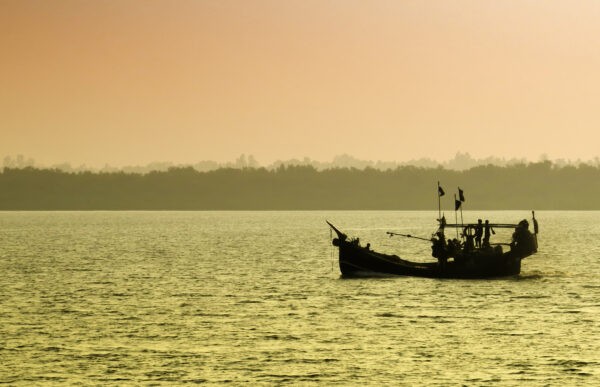
Bangladesh’s foreign policy has traditionally been encapsulated by the maxim “Friendship towards all, malice towards none.” In maritime affairs, Dhaka has largely adhered to this principle.
In 2008, Myanmar naval vessels escorted survey ships into waters claimed by both Myanmar and Bangladesh. In response, Dhaka dispatched warships to the disputed area.
The state ultimately opted for legal proceedings rather than direct confrontation, securing a victory in its maritime boundary dispute with Myanmar in 2012.
In 2014, two years after the dispute began, Bangladesh secured an arbitration ruling in its favour against India concerning their maritime boundary in the Bay of Bengal.
The court rulings provided Bangladesh with a legally secure maritime domain—a status it had not possessed since independence—and, consequently, a clear justification for building a navy to defend it.
Recent debate over the plan has focused on the widening capability gap in the air force, while the navy has delivered a considerably larger share of what it pledged.
More than 30 new warships have been added to the fleet since 2009, together with two refurbished Chinese submarines. A submarine base at Pekua has reportedly been constructed at a cost of $1.21 billion.
Following the 2008 standoff with Myanmar, analysts concluded that the most probable maritime threat would be the navy of another state.
Nevertheless, the maritime threat that has most directly impacted ordinary Bangladeshis has originated from an actor that Dhaka’s security planners had not anticipated.
On August 8, the Arakan Army detained three Bangladeshi fishermen near Shah Porir Dwip in Teknaf.
Eleven days later, a Border Guard Bangladesh (BGB) unit took custody of 24 additional fishermen from the same group at the zero‑line of the Naf River. The men had been arrested at various times beginning in early 2025.
BGB data indicate that between January 2025 and August 2026 the Arakan Army detained 434 fishermen, of whom 222 were Bangladeshi citizens and 212 were Rohingya refugees residing in Bangladesh; 86 of those detainees remain in custody. “Fishermen are always living in fear of the Arakan Army,” Abdul Gani, a boat‑landing committee leader on Shah Porir Dwip, told The Daily Observer.
Quite often, the abducted Bangladeshi fishermen have entered Myanmar waters, incursions that the BGB said were accidental.
The Arakan Army breached Bangladesh’s maritime border in April 2025, operating in Bangladeshi waters and detaining 23 fishermen off Saint Martin’s Island. The incident forced roughly 3,000 other fishermen to remain ashore for five days.
Bangladesh has recently made substantial investments in its navy, a step that reflects the legacy of maritime confrontations with Myanmar.
Dhaka needed to deter Myanmar, with its strong naval capabilities.
The recent incidents near the Naf River underscore that augmenting the Bangladesh Navy’s fleet with additional warships is unlikely to remedy its underlying weaknesses.
The Arakan Army’s deployment of fast boats in the shallow, unmarked sections of the Naf River clarifies why the navy has played only a limited role.
To counter such incursions, submarines provide little protection.
On the other hand, deploying frigates to monitor small boats in a shallow estuary would represent a waste of naval resources.
The navy should be deployed more effectively through regular patrols, reliable surveillance and the capacity to intervene swiftly in order to counter these unlawful activities.
The proposed solution is to accelerate the flow of information to authorities and to establish a clear chain of command for responding to crises.
Under the Coast Guard Act of 2016, the Bangladesh Coast Guard is legally tasked with monitoring coastal waters and safeguarding the country's maritime boundary along the Naf River.
The issue is that agencies securing the Naf answer to separate chains of command.
The Coast Guard operates under the Home Ministry, and all of its officers and enlisted personnel are seconded from the navy, which is part of the defence establishment.
The Border Guard Bangladesh (BGB) is taking the lead in securing the release of detained fishermen, a role that would ordinarily be performed by the Coast Guard.
Some observers express a degree of optimism—though it may be misplaced—following the recent investment in the Coast Guard.
Dhaka announced that Bangladesh will expand the Coast Guard’s personnel complement while also procuring additional patrol vessels and high‑speed boats.
Additionally, three surveillance drones have already been inducted.
Nevertheless, the recent capability boost does not resolve concerns voiced by a serving naval officer in a 2024 article in Navy Journal, who described the development of capabilities among coastal security agencies as piecemeal, “often resulting in gap or duplication,” and noted that ministries hold data “yet to be integrated for sharing.” The problem persists despite new equipment, as a coordinated body must still maintain a common operational picture of the NAF and organise the response when fishermen are taken.
Political motivations could also explain why some capabilities have garnered more eyeballs than others.
In 2017, then‑Prime Minister Sheikh Hasina commissioned two submarines. She later inaugurated the Pekua naval base during an official ceremony in 2023.
The projects are highly visible and politically rewarding, whereas the coastal radar network in Teknaf has attracted considerably less public interest, and promoting it is more difficult because responsibility for it is divided among several budgetary authorities.
Bangladesh’s Forces Goal 2030 programme is nearing completion, and the navy’s two submarines have received upgrades that extend their operational life to 2030, making the decision on whether to replace them or pursue further extensions increasingly urgent.
Prime Minister Tarique Rahman told journalists in June that a modern, secure, accurate and efficient exchange of ocean‑related information is closely linked to safeguarding national interests. However, it remains uncertain whether this rhetoric will shape the forthcoming plan.
Future naval procurement decisions may have diplomatic ramifications, as Washington has announced it will offer U.S. and allied systems as alternatives to Chinese equipment. In June, Dhaka and Beijing agreed to broaden their strategic ties, including a diplomatic and defence “2+2” dialogue.
A prospective deal for a submarine or frigate could attract attention beyond Bangladesh’s defence community, especially if it creates a new source of supplies.
However, Coast Guard ships and coastal radar hold less of this type of significance.
Bangladesh still needs a navy to contain Myanmar’s.
Even as the Forces Goal 2030 programme draws to a close, Dhaka could consider reorganising its allocation of resources among the various maritime authorities.
The Coast Guard may be assigned to establish a presence in the estuary, while the navy and the Border Guard Bangladesh (BGB) could be mandated to exchange radar footage and intelligence through a mutually agreed system, supported by sustainable budgets for patrolling and rapid‑response operations.
A model outlined in the Navy Journal calls for the creation of a Maritime Information Coordination Centre, though the author notes that there is disagreement over which institution should assume leadership of the centre.
For fishermen, a more conspicuous boundary and inexpensive geolocators could discourage accidental crossings, but markings would need to span the boundary and would have little effect on deliberate crossings.
Better capabilities will only partially address the issue.
Although surveillance can track the fishermen’s boats, Dhaka is unable to prevent Arakan Army patrols from detaining them across the border. Because Dhaka lacks standard state-to-state channels to engage with a non-state actor, the principle of "friendship for all" must be applied flexibly.
One Border Guard Bangladesh (BGB) commander has attributed a higher number of fishermen returning to what he termed "professional, cordial, and effective coordinated efforts." In practice, this means that the Arakan Army determines when the fishermen are permitted to return.
Ideally, Dhaka should seek benefits from predictable rules of engagement, such as the sharing of information on arrests and clear criteria for the release of fishermen, without recognizing the Arakan Army.
The International Crisis Group recommended that Dhaka step up its engagement with the Arakan Army.
Taking everything into account, now that Bangladesh has successfully settled both of its maritime disputes with Myanmar and India through international courts, its subsequent maritime modernization strategy aimed at strengthening the navy must remain mindful of developments along the Naf River since the Arakan Army seized control of the far bank.
In the fishing villages of Teknaf, success will be defined by the day that fishermen make it back to port safely without fear.
Why it matters
The security gaps along the Naf River demonstrate that Bangladesh's heavy naval investments must be balanced with agile coastal patrol capabilities to protect citizens from non-state threats.