“We are struggling,” people said. “I can’t feed my family.” Others added, “It’s getting really tough to get by.”
At first glance, these testimonies might seem to reflect quotes of an economy in depression or communities enduring the upheaval of war. However, they represent the mundane realities of working-class households in Bangladesh, a country that is neither at war nor in severe distress. Yet, the world seems to be devised in ways that consistently leave these households at the short end of the stick.
Bangladesh's economic realities, characterized by institutional shortcomings and rising inflation, have left nearly 28 percent of the population in poverty, according to a 2025 survey by the PPRC. While poverty is often simply reduced to having limited financial means, the daily struggle to make ends meet frequently forces the poor to pay relatively more for the same necessities that the wealthy can afford for less.
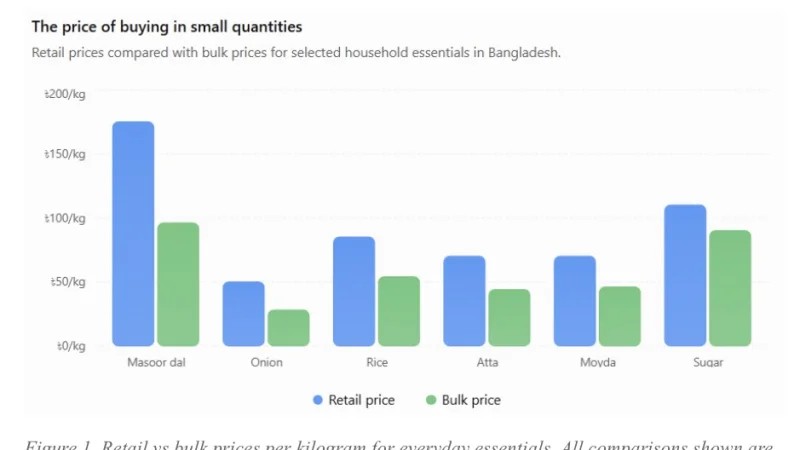
Oscar Lewis’s culture of poverty theorizes that poverty is a self-perpetuating cycle through attitudes, behavior, and values that emerge under conditions of persistent deprivation. However, the cycle of entrapment occurs in more insidious ways, specifically through concepts like the poverty premium. For example, a kilogram of sugar costs around ৳110 in retail, but only ৳90 in bulk, representing a 19% decrease.
Sugar is not an isolated case, as larger disparities have been found across several essential goods. Masoor dal showed a price difference of 45% between retail and bulk purchasing, while onions showed a gap of 44%. Rice, perhaps the most important staple product in households, was around 36% cheaper when purchased in bulk, while atta and maida showed similar differences at roughly 37% and 34% respectively. Each of these comparisons was like for like, involving the same product of the same quality priced on the same day, with the only variable being the quantity purchased.
For a typical 4.26-person household, rice alone accounts for 42 kilograms of consumption monthly. Because of this sheer volume, even a modest price difference across several retail purchases can aggregate to a substantial monthly expense. In the household basket calculation, rice itself accounted for roughly Tk1,303 of the Tk1,815 in potential monthly savings, representing approximately 72% of the total.
Across the basket, the difference between retail and bulk purchasing amounted to Tk1,815 per month for a household eating at national average levels, or Tk21,780 per year. Among Bangladesh’s poorest households, whose monthly expenditure exceeds income by roughly Tk3,817, the potential savings would represent nearly half of that deficit.
While the numbers are staggering, they barely capture the harshness of reality: If the poorest households live on about Tk283 a day, how can they afford any bulk products? If they can’t do so individually, could they access them collectively?
Shomobay operates by having families within neighbourhoods pre-register their weekly requirements, which are then aggregated. The service purchases goods in bulk from the nearest wholesaler and delivers everything the same day to a collection point at close to the bulk price, thereby avoiding storage constraints.
Through this approach, individual families are not required to become bulk buyers themselves. Instead, Shomobay acts as an intermediary among all bulk product customers within the neighbourhood, creating a collective initiative.
The aim is not to reinvent how groceries are bought, but to recalibrate the purchasing position of the household, and that is what Shomobay achieved in the first pilot.
Anwar, one of the pilot participants, stated, "If I could buy through Shomobay every week, my monthly savings would increase significantly." Fatema, a mother of three, echoed the same sense of optimism, saying, "Because of this initiative, after buying the household groceries, I still have enough money left to buy other things."
If each of the 15 pilot families bought the full basket this way every month, they would collectively save about ৳27,225 a month. Across 1,000 families, that figure becomes about ৳18 lakh a month, or more than ৳2 crore a year. For a single family, the savings amount to about twice what a year of food inflation adds to a family's grocery bill.
For a garment worker earning the minimum wage, this adds up to roughly 45 days of wages over the course of a year. When broken down to a single day, the saving amounts to about ৳60, which is close to what a single person in the poorest tenth of households lives on in a day.
Bangladesh continues to face challenges in making groceries more affordable despite various state efforts. While the Trading Corporation of Bangladesh (TCB) provides subsidized lentils, oil, and sugar, its coverage has shrunk from one crore families to roughly 70 lakh following mass cancellations. Furthermore, truck sales arrive irregularly and frequently feature long queues. Buyers interviewed also raised concerns regarding corruption, syndicates, and poor quality, while newer state initiatives such as the Family Card remain largely inaccessible to the individuals who need them most.
The strategy of pooling demand has faced major challenges internationally. India’s DealShare, which once achieved a valuation of $1.7 billion, engaged in sale talks valued at approximately $90 million by 2026. In Kenya, Twiga Foods raised over $150 million before entering administration in August 2026, while community group-buying startups in China became mired in destructive price wars.
In each instance, the business model collapsed due to consistent vulnerabilities: prices artificially subsidized by investor capital, costly investments in warehouses and delivery fleets, and the extension of unrecoverable credit to customers.
Shomobay is designed to avoid three major issues by operating without subsidies, as families pay the actual bulk price; without warehouses, since goods are bought and sold upfront; and without credit, as payments are made upfront. The initiative does not aim to replace the Trading Corporation of Bangladesh (TCB), but rather to mitigate the shortcomings that have plagued it for years.
As Shomobay continues refining its model, the organisation is building a wider presence beyond its initial operating neighbourhoods. Organisers envision the initiative growing from neighbourhoods to cities, extending to communities across Bangladesh, and eventually expanding beyond national borders to reach households facing the fundamental disadvantage of paying higher prices simply because they can afford to buy less.
Jaif Bin Morshed is a research intern, PRI (Policy Research Institute).
Why it matters
The persistence of a poverty premium forces low-income households in Bangladesh to pay significantly more for basic goods, making community-based bulk purchasing models a vital alternative for reducing daily living expenses.