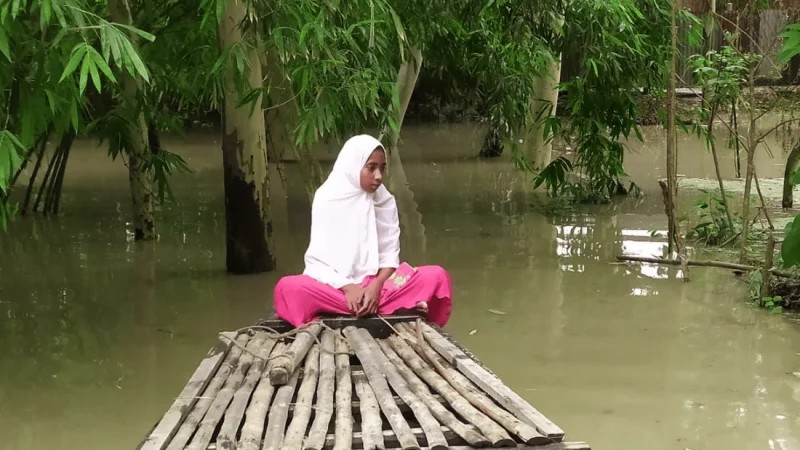
Bangladesh maintains a master plan for its haors and possesses a distinctive legal and institutional framework specifically for the Chittagong Hill Tracts.
After more than two decades of working among the chars of the northern riverine areas, watching homes disappear into the river and reappear somewhere else, the author still struggles to answer a simple question: Who is responsible for people who live on land that does not stay?
I have travelled for years through the char areas of Kurigram and Gaibandha, along the Jamuna and Brahmaputra.
"I have watched families dismantle their homes for the third or fourth time in a decade -- tin sheets pulled down, bamboo bundled, chickens loaded onto boats -- often without knowing where they will rebuild next."
Bangladesh has established specific institutions and programs for other fragile geographies, including the creation of the Bangladesh Haor and Wetland Development Board in 2000. This was followed by the launch of a 20-year Haor Master Plan in 2012.
Meanwhile, the Chittagong Hill Tracts maintain a distinct legal and institutional framework that is rooted in the 1900 Regulation, the 1997 Peace Accord, and the 1998 Regional Council Act.
The chars are different. Bangladesh maintains programs such as the Char Development and Settlement Project, which has worked on infrastructure, livelihoods, and land settlement in newly accreted chars.
Despite these challenges, there remains no dedicated statutory framework to address a recurring reality faced by erosion-prone char communities: land can physically disappear, communities can be displaced, and the administrative identity tied to a specific place can vanish along with it.
Our institutions are largely designed for land that stays put. Registration, schools, health facilities, local government records, and land administration become extraordinarily complicated when the land itself is moving.
When a char disappears, it is not only houses that go with it.
"I have seen villages where the school, the madrasa, the tube-well and other community facilities vanished into the river in a single season," stating that it is not several separate disasters, but rather "one settlement disappearing at once."
I worked with these communities for years and witnessed their repeated displacement firsthand.
The inhabitants of Sidhai Char, located under Mollarchar Union, have been forced to relocate their entire settlement more than once. This movement involved not only their homes, but also the local school and an NGO-run weaving centre that had provided local women with a rare source of income.
An entire ecosystem of livelihoods and community life had to be dismantled and rebuilt because nothing could remain anchored to the land once the river took it away.
In nearby Dewanganj, river erosion has also threatened and swallowed schools and other community infrastructure. However, at least some communities manage to move together, while certain chars do not offer even that possibility.
I think often of Sirajbeg, a char in Kurigram that no longer exists. The river did not simply erode its edges; it eventually took the whole char.
There was no single relocation and no common destination. Its people scattered to other chars, upazilas and districts across the north -- and, for families I know personally, as far as Dhaka.
They did not resettle as a community. They dispersed as individuals, each finding their own way to survive.
Ask them where they are from, and they will say Sirajbeg.
But Sirajbeg is no longer on the map in the way it once was.
There may be no functioning local institution linked to the vanished settlement, no surviving school record readily accessible to every family, and no land document that every displaced household can produce to prove what it once owned.
What remains is memory -- and memory alone is rarely enough at a land office or government counter.
A community like Sidhai's can lose its buildings and still retain much of its social fabric because it moves together.
A community like Sirajbeg's can lose both the land and the community itself, leaving people scattered across different places and holding records that may no longer reflect where they came from.
When a char reforms, the community does not simply return. It starts again, often without a single institution responsible for helping it do so.
For years, we have advised char families to keep their NID, birth registration, and land documents together and carry them whenever they move. It is sensible advice.
But imagine a family fleeing a collapsing riverbank at night, with children and livestock to save and perhaps one boat available. Is it realistic to expect them to remember a folder of papers?
Sometimes those papers go into the river too.
And even when documents survive, another question remains: Which institution will recognize the family's connection to the place it has left behind?
For a family whose home, school, and local community infrastructure disappeared together, the challenge is immense.
This is not simply a housing issue. It is a question of legal identity, land rights and access to citizenship and public services.
In December 2025, the International Organization for Migration, together with the government of Bangladesh and its development partners, released the country's first comprehensive nationwide estimate of disaster‑induced internal displacement.
An assessment estimates that 4,955,527 people are currently internally displaced due to natural disasters. The assessment covered all eight divisions, 64 districts, and thousands of local administrative units.
A large share of those displaced have been displaced for years rather than only during a recent emergency.
Bangladesh is not starting from zero. The country adopted a national strategy on disaster- and climate-induced internal displacement in 2015 and a broader National Strategy on Internal Displacement Management in 2021. A National Action Plan for implementing that strategy covers 2022-2042.
Programs such as Ashrayan have also provided housing and rehabilitation to hundreds of thousands of landless and homeless families. The Char Development and Settlement Project has worked for decades to improve livelihoods, infrastructure and land settlement in vulnerable char areas.
But a house is not legal identity, and resettlement is not necessarily a secured land claim.
A family can receive a new roof and still struggle to establish its previous land rights. It can be counted as resettled and still move again when the next erosion event arrives.
Children may hold birth registration and NID records, even as the administrative memory of their community of origin gradually disappears.
This is the gap we need to address.
The river does not simply take land. It can take the administrative memory of a community.
As Bangladesh considers its next phase of development and climate-adaptation priorities, it should consider creating a dedicated institutional mechanism for the rights and administrative continuity of char communities.
Such a body would not replace existing char-development programmes. Rather, it could fill the gap between development, land administration, legal protection and internal displacement.
It could maintain digital and physical records of land claims that survive relocation; preserve the original identity of vanished settlements; maintain duplicate civil and community records; provide legal assistance to families contesting land and inheritance claims; coordinate services when communities relocate together; and help trace families when a settlement is dispersed across chars, districts or cities.
Most importantly, it could create a system of portable legal and administrative identity for people whose geography is not portable.
The goal is not simply to move people from one place to another.
It is to ensure that when the river takes their land, it does not also take their rights.
In Dhaka today, a family still refers to themselves as the people of Sirajbeg, a char that exists only in their memory.
The chars have no legal memory. It is time Bangladesh gave them one.
Ahmed Toufiqur Rahman is a rotarian and development professional with 24 years of experience. Email: thetoufiqrahman@gmail.com.
Why it matters
Creating a dedicated institutional mechanism for char communities ensures that displaced residents retain their legal identity and land rights when river erosion destroys their settlements.