Bangladesh could save an estimated Tk753.75 crore over a period of 20 years by installing solar power systems at public universities, colleges affiliated with the National University, and selected urban areas. This finding was revealed in an assessment presented in Dhaka on Thursday.
The proposed installations would feature a combined capacity of 132.61 megawatt-peak (MWp) and require an estimated initial investment of Tk731 crore.
These projects would cover 31 public universities, 150 colleges affiliated with the National University, Shailkupa municipality, and Rajshahi city.
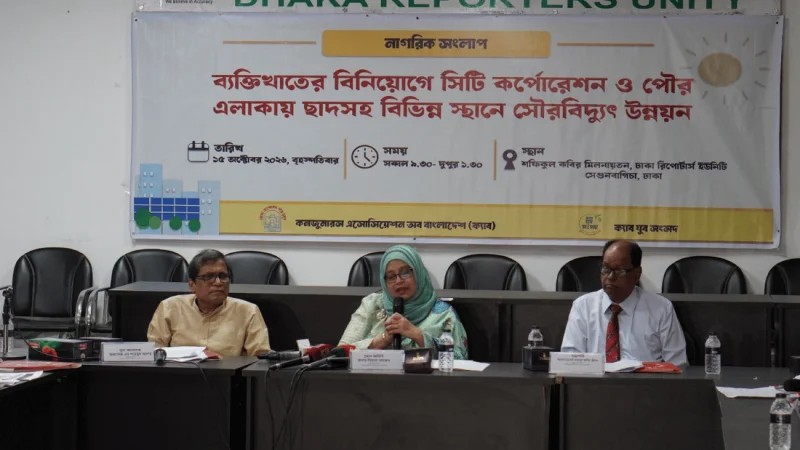
The assessment was presented during a citizen dialogue organized by the Consumers Association of Bangladesh (CAB) at the Dhaka Reporters Unity auditorium on October 15.
The proposed systems are estimated to generate 192.7 million units of electricity in the first year and approximately 3.7 billion units over a 20-year period. According to the assessment, electricity could be produced at a cost of around Tk4 per unit, depending on the specific project and installation type.
The assessment identifies 52.50MWp of potential solar capacity across 31 public universities, requiring an estimated investment of Tk288 crore.
For 150 National University-affiliated colleges, it identifies an additional 51.12 megawatts-peak (MWp) of capacity, with projected annual generation exceeding 71.4 million units of electricity.
The estimated levelized cost of electricity is Tk4.04 per unit for the university projects and Tk4.15 per unit for the college projects.
The assessment also examines installations in Shailkupa municipality and Rajshahi city. Shailkupa has an estimated potential of 4.36MWp through rooftop, ground-mounted and floating solar installations, while the potential identified for Rajshahi is 24.63MWp.
The estimated cost of electricity is Tk4 per unit for Shailkupa and Tk4.04 per unit for Rajshahi. Meanwhile, electricity generated through floating solar installations in Shailkupa is estimated to cost Tk4.75 per unit.
Together, the proposed installations across the universities, colleges, and the two urban areas would bring the estimated capacity to 132.61 megawatts-peak (MWp).
The estimates rely on site assessments, electricity-generation simulations, and financial calculations. However, actual generation and costs might vary due to operating conditions, maintenance, financing arrangements, and grid connectivity.
The assessment estimates that the proposed projects could generate Tk2,777 crore in electricity sales over a period of 20 years, assuming a benchmark selling price of Tk7.50 per unit.
The projected sales revenue should not be treated as net profit, as operating expenses, financing costs, taxes, insurance and equipment replacement would have to be deducted.
The estimated savings of Tk753.75 crore are based on a comparison between an assumed alternative electricity-generation cost of Tk10 per unit and a solar electricity purchase price of Tk7.50 per unit. This produces an estimated difference of Tk2.50 per unit.
The assessment's savings estimate depends on the projected generation and the assumptions used in the financial calculations. Actual savings would depend on which sources of electricity solar power replaces and which costs can be avoided.
Power Division Secretary Mirana Mahrook, who served as the chief guest at the dialogue, stated that the government was expanding its solar power initiatives and had considered proposals put forward by stakeholders.
She stated that the government had undertaken initiatives, which included measures aimed at reducing import duties, and added that it would consider additional proposals designed to support the development of solar power.
Regarding the benchmark price for merchant power, Mahrook stated that Tk7.50 per unit was reasonable under current conditions. She also noted that this price could potentially decrease as incentives and facilities improved.
The proposed projects would enable institutions and urban areas to generate electricity through solar installations, though their financial viability would rely on equipment costs, long-term maintenance, and arrangements for purchasing the generated electricity.
Consumers Association of Bangladesh (CAB) energy adviser M Shamsul Alam stated that rooftop solar electricity could cost approximately Tk4.50 per unit. He noted that solar power has the potential to reduce dependence on fuel purchases and protect consumers from volatility in international fuel markets.
Alam also emphasized the importance of energy conservation, though he questioned whether government agencies possessed sufficient capacity to maintain solar installations under the capital expenditure (capex) model.
Omera LPG Chief Executive Officer Masudur Rahim identified maintenance, equipment security and payment guarantees as barriers to investment.
He raised concerns regarding investor security when solar installations are placed on buildings owned by others. Additional concerns included the theft of electrical transformers and cables, as well as delayed payments or unpaid electricity bills, which could undermine investors' ability to recover their costs.
Other entrepreneurs participating in the dialogue also emphasized the necessity for reliable payment arrangements, transparent contracts, and clearly defined maintenance responsibilities.
These concerns highlight the importance of establishing clear agreements among investors, electricity purchasers, and the institutions hosting solar installations before projects begin operating.
The assessment indicates that technical potential and projected costs alone will not determine whether the installations succeed. Financing, secure equipment, dependable payments, and clearly assigned operational responsibilities will also affect long-term performance.
The proposed installations are estimated to avoid approximately 2.3 million tons of carbon dioxide emissions over a 20-year period, based on an emissions factor of 0.62 tons per megawatt-hour.
The actual reduction would depend on the sources of electricity displaced by solar generation and the composition of the electricity grid's generation mix over the projects' operating lives.
According to the assessment's implementation considerations, long-term performance would also depend on maintenance, grid connections, transparent procurement processes, and independent monitoring.
CAB Secretary General Advocate Humayun Kabir Bhuiyan chaired the dialogue, while CAB research coordinator Shuvo Kibria moderated it.
Why it matters
The assessment outlines a viable pathway for public institutions and municipalities in Bangladesh to reduce energy costs and carbon emissions through targeted solar investments.