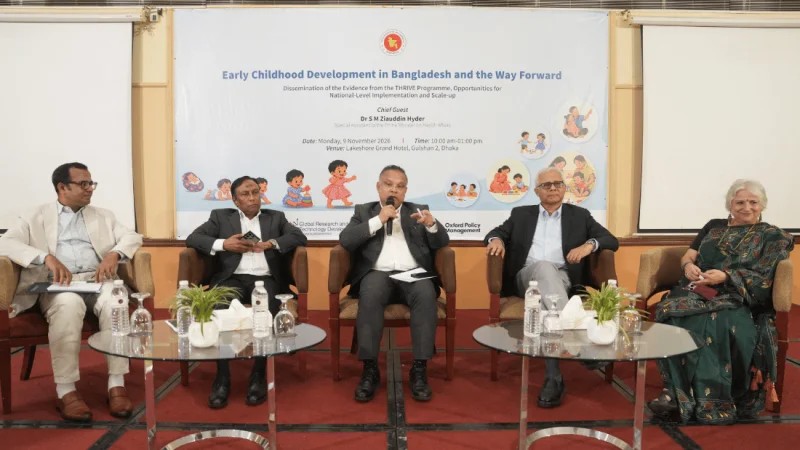
A study involving more than 600 Community Clinics has found improvements in parenting practices and home stimulation, though no significant changes in child-development outcomes were observed. Early childhood development support delivered through existing public services has shown potential to improve parenting practices and home-based learning, although effective expansion requires stronger quality assurance, supervision, and workforce support. Evidence from the THRIVE Programme highlighted how existing public platforms can be used to deliver early childhood development support while identifying key challenges to its effective implementation at scale.
The findings were presented at the national research dissemination event titled “Early Childhood Development in Bangladesh and the Way Forward” in Dhaka on Monday, attended by policymakers, researchers, and development partners. Dr Jena Derakhshani Hamadani, Emeritus Scientist at icddr,b and National Principal Investigator of the THRIVE Programme, presented the research findings and lessons. Building on previous evidence, the Strengthening Bangladeshi Babies’ Brains Programme expanded early childhood development activities through more than 600 Community Clinics, reaching over 15,000 children and training around 1,950 frontline health workers and more than 400 supervisors.
A recent cluster-randomized trial found significant improvements in parenting practices, home stimulation, and access to play materials among intervention families. However, no statistically significant differences were found in child-development outcomes. The findings highlight that expanding reach alone may not be sufficient to achieve the intended impact without consistent implementation, effective supervision, and continued support. Dr Tahmeed Ahmed, Executive Director of icddr,b, highlighted the close connection between nutrition and early brain development, noting that poor nutrition during early years can affect brain development and cognition.
Dr S M Ziauddin Hyder, Special Assistant to the Prime Minister on Health Affairs, attended the event as the chief guest and stressed the need to take early childhood development services to national scale. Highlighting Bangladesh's learning challenges, he called for a nationwide plan to expand early childhood development activities and reach children and families across the country. Mohammad Golam Kibria, Team Leader and Education Adviser at the Foreign, Commonwealth and Development Office, said national scale-up should focus not only on reaching more children but also on maintaining service quality.
A K M Fazluzzoha, Managing Director of the Community Clinic Health Support Trust, appreciated icddr,b's work supporting children and mothers through healthcare facilities and highlighted the importance of building on this experience to expand services nationally. The discussions identified several priorities for the next phase, including stronger supervision, adequate frontline capacity, caregiver engagement, sustainable financing, and government ownership. The THRIVE Programme is funded by the UK's Foreign, Commonwealth and Development Office through its Global Research and Technology Development portfolio and the New Zealand Ministry of Foreign Affairs and Trade, and is managed by Oxford Policy Management.
Why it matters
The study provides empirical evidence on the challenges and pathways for scaling up early childhood development services through public healthcare platforms in Bangladesh.