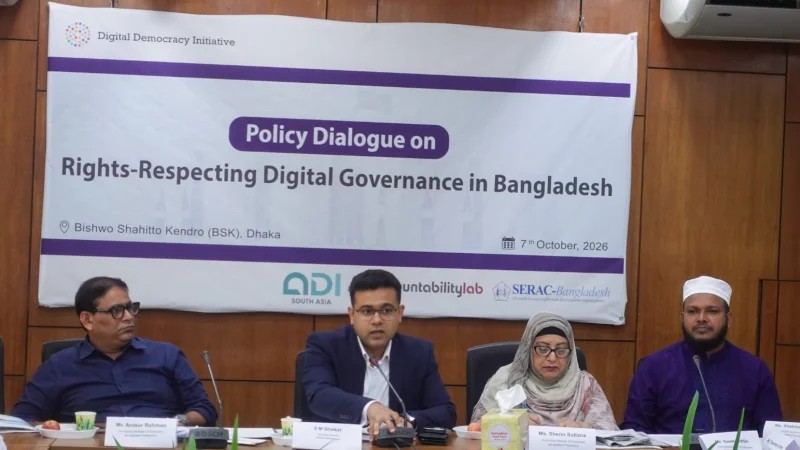
During a policy dialogue in Dhaka, participants urged stronger safeguards for privacy, freedom of expression and digital safety, and called for greater institutional accountability, noting that Bangladesh’s use of technology continues to expand.
The “Policy Dialogue on Rights‑Respecting Digital Governance in Bangladesh” convened parliamentarians, policymakers, civil‑society representatives, journalists and young people to discuss the creation of a safer, more inclusive and rights‑based digital governance system.
The dialogue was organised by SERAC-Bangladesh, with support from DDI South Asia and Accountability Lab.
Members of Parliament Anisur Rahaman of Madaripur‑3, Salah Uddin of Gazipur‑4 and Sherin Sultana, who holds a reserved women’s seat, attended the event. Representatives from civil‑society organisations, the media and youth groups were also present.
The programme began with welcome remarks by Mizanur Rahman Akanda, project manager of SERAC-Bangladesh.
S M Shaikat, executive director of SERAC‑Bangladesh, delivered the keynote address, emphasizing the need to protect citizens, promote youth participation and enhance institutional accountability in order to create a safe, rights‑respecting digital Bangladesh.
The roundtable discussion was moderated by Md Salim Miah, director (programme) of SERAC-Bangladesh.
Freedom of expression was a key focus of the discussion.
Participants emphasized that freedom of expression must be safeguarded both online and offline, adding that the exercise of this right must not violate the rights, dignity, privacy or safety of other individuals.
The group urged a balanced approach to online expression, stating that legitimate criticism and public debate must be safeguarded, while threats, incitement to violence, fraud and other harmful conduct should be tackled with clear, necessary and proportionate legal measures.
The participants emphasized that accuracy and contextual reporting are essential in news and digital media, warning that incomplete or one‑sided coverage can mislead the public and distort perceptions of events.
Data privacy was another major concern at the dialogue.
Participants, including Members of Parliament, discussed the difficulties that citizens face when attempting to correct or update their personal information.
They highlighted a contrast between the difficulties people often encounter when correcting or updating their National Identity (NID) information and concerns that unauthorized individuals can obtain sensitive personal data for relatively small sums of money.
The discussion referred to reported payments ranging from Tk30 to Tk250 for access to personal information.
The participants emphasized that organisations gathering and processing personal data must limit collection to information strictly required for defined purposes and ensure that access is confined to individuals whose official duties justify it.
The group also urged the establishment of transparent, auditable logs documenting who accesses and uses personal data, the implementation of clear accountability mechanisms for handling such information, and the provision of effective remedies for unlawful access or misuse.
The dialogue also highlighted growing digital risks for children and young people.
The participants cited online harassment, identity misuse, manipulated and AI‑generated content, and the unauthorised use of personal information as the principal concerns.
The group urged the establishment of confidential, easily accessible complaint mechanisms, prompt remedial actions and appropriate psychosocial support for young people exposed to online harm.
Participants emphasized that young people must not be regarded solely as recipients of digital policies. They argued that youths should play a substantive role in shaping the laws and policies that govern their digital lives, ensuring that their experiences and viewpoints are incorporated into decision‑making.
The speakers also urged stronger coordination among laws and policies governing cybersecurity, personal data protection and national data management, and they called for clear, accessible mechanisms that allow citizens to obtain remedies when their rights are violated.
The dialogue also emphasized that, before new digital laws and policies are introduced, consultations must be held with young people, civil‑society groups, technology experts, legal professionals, journalists and the communities directly affected.
Stakeholders highlighted a range of priorities for enhancing digital governance. These include establishing clear definitions of digital offences, ensuring proportionate enforcement of laws, strengthening institutional accountability for personal data, improving safety for children, young people and women in digital environments, conducting meaningful public consultations, and reinforcing parliamentary oversight.
They said Bangladesh’s digital transformation must be accompanied by stronger safeguards for fundamental rights, privacy, safety, dignity and freedom of expression.
The officials stressed that digital governance must evolve in step with technological development, while remaining accountable, transparent, inclusive and respectful of citizens’ rights.
Why it matters
Strengthening digital rights protections in Bangladesh is essential to safeguard citizen freedoms and prevent abuse of emerging technologies.