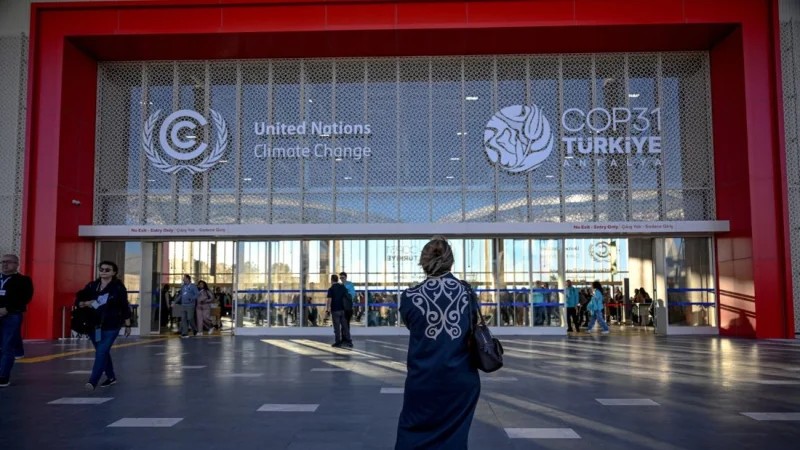
The 31st UN Climate Change Conference (COP31) opened in Antalya on Monday in the absence of several major world leaders, raising fresh questions about global political commitment to tackling climate change.
As the world's largest economies face mounting pressure to reduce emissions, provide climate finance, and accelerate adaptation efforts, the summit confronts a critical test regarding whether governments can translate years of climate pledges into concrete action.
US President Donald Trump, Chinese President Xi Jinping and Indian Prime Minister Narendra Modi are not expected to attend the event. French President Emmanuel Macron, German Chancellor Friedrich Merz and Canadian Prime Minister Mark Carney are also expected to stay away.
An early United Nations speakers' list, which remains subject to change, includes leaders from 77 countries scheduled to address the Antalya Leaders' Summit on November 11-12.
Turkiye's Environment Minister Murat Kurum and Australia's Climate Change and Energy Minister Chris Bowen opened the conference alongside UN climate chief Simon Stiell.
COP31 runs until November 20 under an unusual leadership arrangement. Turkey is hosting the summit, with Kurum serving as COP President, while Australia is responsible for leading the formal negotiations. Turkey is also overseeing the voluntary climate action agenda.
Brazilian President Luiz Inácio Lula da Silva, whose country hosted COP30 in Belém, is expected to attend the event, where inequality between developed and developing nations is likely to feature prominently in his message. European Commission President Ursula von der Leyen will also participate in the gathering. Meanwhile, the United Kingdom delegation is set to include Andy Burnham and Energy Secretary Ed Miliband.
The United States' withdrawal from the Paris Agreement took effect in January 2026. Washington has also moved to withdraw from the 1992 UN Framework Convention on Climate Change (UNFCCC), which serves as the foundation of international climate negotiations.
The absence of the world's largest historical emitter creates a significant challenge for global climate diplomacy.
Beyond the absence of US representatives at the summit, Washington's retreat raises questions about international efforts to mobilise climate finance, reduce greenhouse gas emissions and maintain collective pressure on major polluters.
The US position could also complicate efforts to secure stronger commitments from other major economies.
The challenge for COP31 is to prevent political divisions from weakening the multilateral climate process and undermining the implementation of the Paris Agreement.
Global temperatures have reached alarming levels, with the past two years marking the hottest on record. Annual global temperatures have reached or exceeded 1.5°C above pre-industrial levels.
For climate-vulnerable countries, the growing risk of exceeding 1.5°C is not an abstract scientific debate. It represents more destructive cyclones, prolonged heatwaves, worsening floods, agricultural losses and increasing threats to human health and livelihoods.
Climate finance is expected to remain one of the most contentious issues at COP31.
Developing countries are demanding predictable, accessible, and additional financial support to address climate impacts, strengthen resilience, and accelerate the transition to cleaner energy.
They are also seeking greater access to grants rather than loans, arguing that debt-based financing can deepen the economic vulnerabilities of countries already struggling with climate-related losses.
The debate centers not only on the amount of money wealthy nations pledge, but also on whether this funding reaches vulnerable communities, arrives when needed, and includes conditions that developing countries can realistically meet.
For Bangladesh, the outcome of these negotiations has direct implications.
Despite contributing a relatively small share of global greenhouse gas emissions, Bangladesh remains among the countries highly exposed to climate risks. Rising sea levels, cyclones, river erosion, recurrent flooding and saltwater intrusion threaten coastal communities, agriculture, freshwater supplies and livelihoods.
The country requires substantial investment in climate adaptation, disaster preparedness, and resilient infrastructure. It also needs international support to address the loss and damage caused by climate impacts that can no longer be avoided.
Without adequate international financing, the burden will increasingly fall on vulnerable communities and developing countries with limited resources.
Climate justice requires more than financial promises, demanding accountability from major historical emitters alongside a fair distribution of the costs of the global climate crisis.
The world does not lack climate agreements, scientific evidence or technological solutions. Renewable energy, climate-resilient infrastructure and cleaner industrial technologies are increasingly available.
What remains inadequate is the political commitment, financing and accountability required to implement them at the necessary scale.
For developing countries, COP31 must deliver more than another declaration of ambition. It must produce measurable progress on climate finance, adaptation, loss and damage, technology transfer and emissions reductions.
The credibility of the Paris Agreement will increasingly depend on whether countries honour their commitments rather than repeatedly announcing new targets.
For communities on the frontline of climate change, the consequences of diplomatic failure are already visible in damaged homes, lost livelihoods, declining agricultural productivity and growing displacement.
As negotiations begin in Antalya, the central question is whether world governments can bridge the widening gap between climate commitments and actual delivery.
The absence of several major leaders may cast a shadow over the summit, but it must not become an excuse for governments to avoid their responsibilities.
For climate-vulnerable nations such as Bangladesh, the real measure of COP31 will be whether international promises finally translate into finance, protection and action on the ground.
Why it matters
The outcome of COP31 directly determines whether climate-vulnerable nations like Bangladesh receive necessary international financing and support for adaptation and loss mitigation.