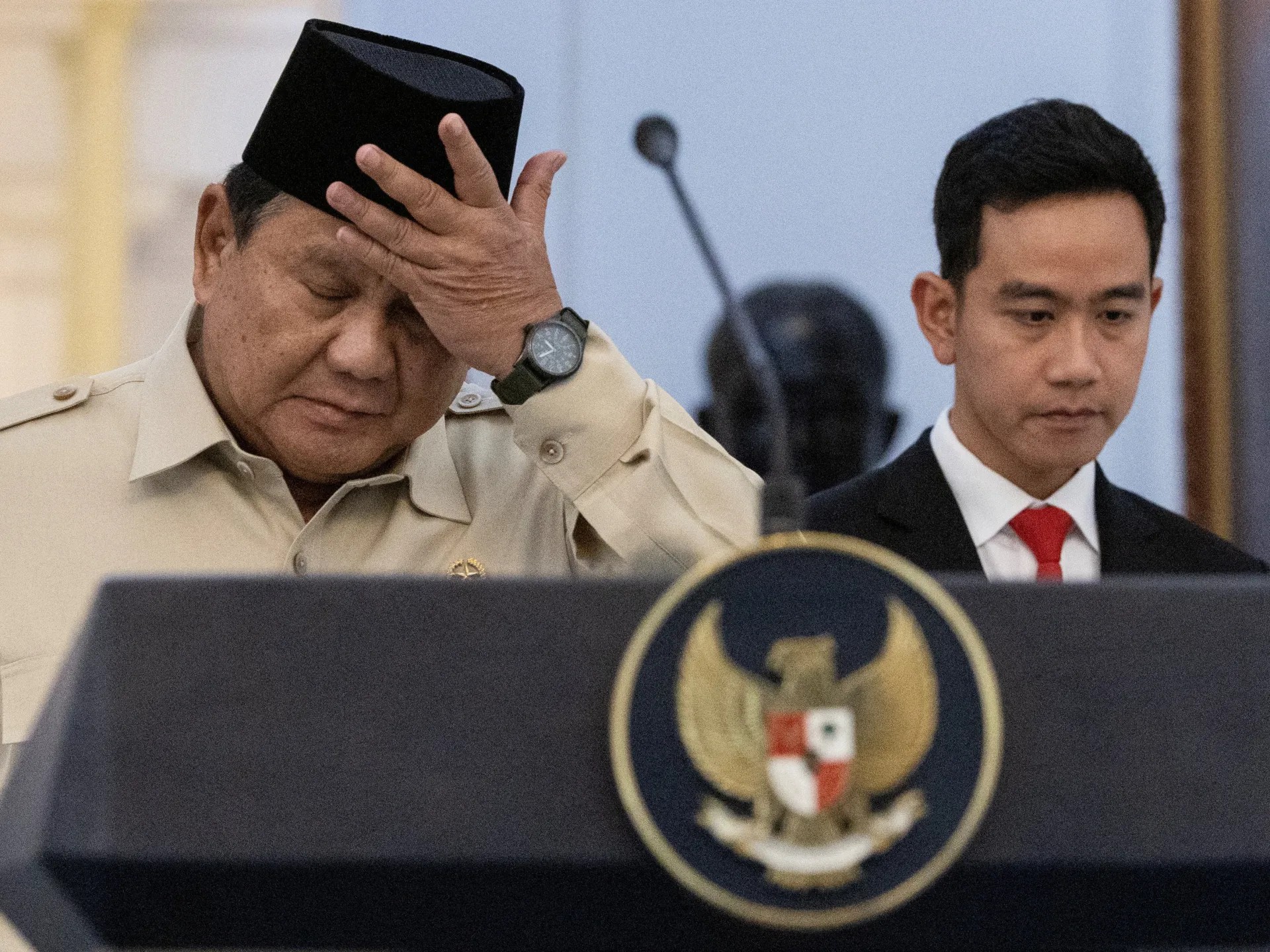
Indonesia’s vice president has resigned amid a scandal involving his high school diploma, increasing pressure on a government that is already facing widespread public dissatisfaction regarding the economy, corruption, and wildfires.
Gibran Rakabuming Raka submitted his resignation to President Prabowo Subianto and parliament on Thursday, the speaker of the People’s Consultative Assembly told reporters.
Speaking hours later at a press conference alongside Gibran at the Presidential Palace, Prabowo said he had accepted the resignation with a “heavy heart”.
Gibran is the eldest son of former President Joko Widodo, Prabowo’s immediate predecessor.
“There will always be political dynamics in public office, that’s normal,” Widodo told reporters from his hometown in Solo following the resignation. He added that he had reminded his son that political positions are temporary.
“We will continue to support President Prabowo’s government, especially programmes that serve the interests of the broader public,” the former leader said.
Gibran, 39, leaves office after serving two years of his five-year term as questions grew over his eligibility following recent court rulings that disputed his educational credentials.
Under Indonesia’s Constitution, a vice presidential vacancy does not trigger a new election. Instead, the office remains vacant until the People’s Consultative Assembly elects a replacement from two candidates nominated by the president within a 60-day period.
Gibran had offered to resign on Tuesday during a meeting with the president, stating that he wanted to avoid a prolonged political controversy.
But a cabinet minister said Prabowo urged Gibran at the time to defend himself, and it wasn’t clear whether he had accepted the resignation offer.
Indonesia's vice presidency carries few constitutionally defined powers. Beyond representing the president at official functions, the office's principal role is to assume the presidency should the president become incapacitated.
The Constitutional Court and the Supreme Court ruled last month that the documents Gibran submitted regarding his overseas education did not meet election requirements. His critics have accused him of never receiving a high school diploma.
A subsequent petition submitted on Wednesday to the leaders of the House of Representatives by 120 lawmakers from eight political parties began a parliamentary process that could lead to Gibran’s impeachment.
Under Indonesian law, House leaders must establish a special committee to examine whether Gibran has violated the constitution by serving as vice president despite allegedly failing to meet election requirements.
If lawmakers determine there is sufficient basis for the accusation, the House must ask the Constitutional Court to rule on whether a constitutional violation has occurred.
Gibran's downfall comes as thousands of protesters have taken to the streets in recent weeks, rallying against economic hardship, corruption and perceived authoritarianism, as well as the government's handling of months of devastating wildfires. The fires have emitted a toxic haze that has made thousands of people ill.
It also comes amid investigations into allegations that top police officials were involved in wiretapping targeting the president. The academic credentials investigation was apparently not related to the wiretapping scandal.
Why it matters
The resignation of Indonesia's vice president creates a constitutional vacancy and alters the political stability of President Prabowo Subianto's administration.