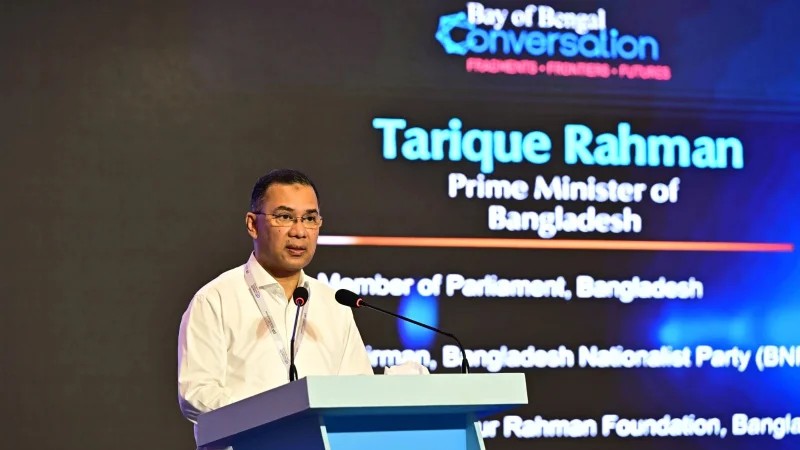
Prime Minister Tarique Rahman stated on Saturday that the new government, having received a strong mandate from the people, is moving forward with a clear action plan to fulfill its commitments over the next five years.
"Our priorities are to protect national interests, maintain policy continuity, ensure economic stability and carry out institutional reforms. We are now moving directly from commitments to implementation," he stated.
The prime minister was addressing the inaugural session of the three-day international conference "Bay of Bengal Conversation (BOBC) 2026," organized by the Centre for Governance Studies (CGS) at the Pan Pacific Sonargaon Hotel on Saturday morning.
This year's BOBC is being held under the theme "Fragments, Frontiers and Futures: Navigating Power, Technology and Trust in a World Rewritten".
Around 200 speakers, more than 300 delegates, and over 1,000 participants from more than 100 countries are taking part in the conference, which is being held from Saturday to Monday.
Former Serbian President Boris Tadic, former Maldivian President Mohamed Nasheed, and former Malian Prime Minister Moussa Mara are among the participants attending the conference. They are joined by other former and incumbent state officials, diplomats, policymakers, researchers, business leaders, technologists, and experts from various countries.
The prime minister stated that the government has undertaken initiatives to make Bangladesh an attractive investment destination and transform the country into a robust hub for both production and investment.
"We want to create extensive employment opportunities in production, services, exports and all other sectors," he said.
Emphasizing the need for policy certainty for investors, the prime minister stated that continuity in long-term policies would provide them with the necessary assurance.
He said the government's social protection programs had been designed to give priority to the most disadvantaged people.
Under the Family Card initiative, financial assistance will reach the hands of mothers in every family, beginning with the poorest and most marginalised communities, he said.
The Farmers Card will connect farmers with government incentives, agricultural services, and markets, while the Health Card will ensure access to healthcare for all, he said. He added that ultimately the Universal Card would bring integrated government services under one umbrella.
The prime minister mentioned the government's pledge to bring healthcare directly to people's doorsteps, stating that authorities are working to recruit 100,000 health workers, with approximately 80 percent of them being women.
They will provide primary healthcare, health advice and necessary referral services at the grassroots level, he said, adding that the government is also giving special attention to maternal and child health.
Addressing education reform, the prime minister stated that education should extend beyond simply obtaining certificates and instead prepare students for real life. "We are working to ensure a joyful learning environment," he said.
He stated that culture, sports, values, and ethics would hold an important place in the curriculum to help build children's character. Students would also be given the opportunity to learn a third language, while technical and vocational education would be expanded alongside general education.
He stated that the government has implemented initiatives to provide free uniforms, schoolbags, midday meals, and stipends starting from the first grade. Additionally, authorities are expanding free education for girls up to the graduate level.
Describing the country's large young population as one of the key drivers of national progress, the prime minister said skills development and suitable employment opportunities were essential to harnessing the demographic advantage.
The government is focusing on improving language skills, creating employment opportunities, technological transformation, and the wider use of artificial intelligence, he stated. "We are supporting innovation, entrepreneurship and start-ups. We want our young people to compete on the global stage and transform brain drain into brain circulation," he added.
Why it matters
The prime minister's address sets the official policy framework, economic priorities, and reform agenda for Bangladesh over the next five years.