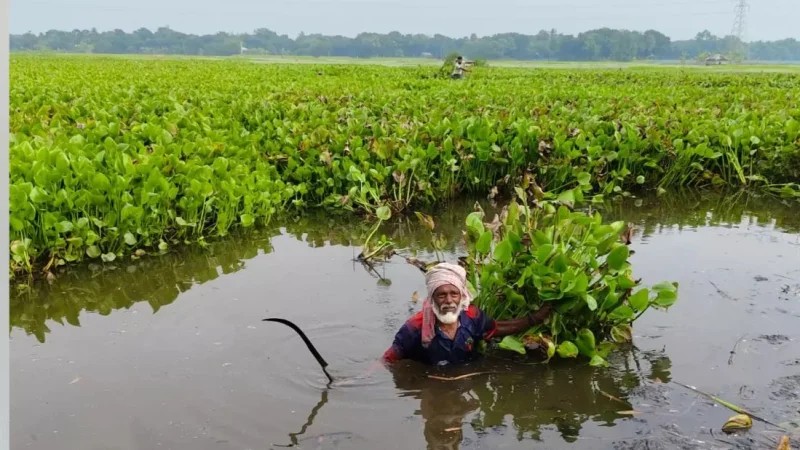
Approximately 1,250 hectares of cultivable land in Kumarkhali upazila of Kushtia remain waterlogged for seven to eight months annually. This waterlogging causes an estimated annual loss of Tk35 crore in potential agricultural production.
Surrounded by the Padma, Gorai, Kaliganga and Dakua rivers, the upazila features approximately 18,240 hectares of cultivable land. Farmers are able to grow crops on this waterlogged land only once a year, specifically during the Boro season, yielding around 6,225 tonnes of paddy.
If the waterlogging problem is resolved, the land could produce an additional 10,000 tonnes of paddy and other crops during the Aman and Aus seasons, with an estimated market value of Tk35 crore.
Agricultural officials and local farmers stated that food production could increase further if modern farming methods and high-yielding crop varieties were introduced.
Farmers stated that although the upazila featured numerous irrigation canals under the Ganges-Kobadak (G-K) Irrigation Project, which is managed by the Bangladesh Water Development Board (BWDB), there was no proper drainage system.
Many canals have remained neglected for years, while some have been filled in to build houses and others blocked by dams for fish farming.
As a result, land that could otherwise produce crops three times a year remains submerged for seven to eight months, severely affecting agriculture.
Farmers stated that the problem persisted for nearly a decade without any effective initiative to resolve it, which reduced agricultural production and caused recurring financial losses for them.
Visits to the wetlands of Bahalbaria, Chandpur, Banshara, Bakhai, Karatkandi and Jagonnathpur revealed large areas under water, with the stagnant surfaces covered by water hyacinths, water spinach (kolmi) and water lilies. During the visits, some local residents were observed fishing from small boats, while others cleared weeds in preparation for cultivating their land this season.
Many farmers have turned to fish farming by digging ponds after suffering repeated losses from crop cultivation. Ponds have also been dug along canals near the wetlands, while houses and roads have been built in the areas.
Poor maintenance has also left many canals unable to drain water properly.
Rabiul Islam, a farmer from Bahalbaria Beel in Nandolalpur union, said he owned 16 bighas of land.
"Ten to 12 years ago, water used to flow through a canal into the Gorai River, allowing us to grow rice three times a year," he said. "Now, as water cannot drain out, we can barely grow even one crop."
Majed Ali, another farmer from the same area, expressed frustration that water remained stagnant despite the presence of four nearby rivers.
"The stagnant water is covered with water hyacinths and weeds. Clearing them requires six labourers per bigha. Farming has become costly, but yields and profits remain low," he said.
Abdus Samad, a farmer from the Gobindapur Beel area, stated that certain areas lacked canals entirely, while existing waterways were blocked by weeds and silt.
As a result, water remains trapped on the land, allowing farmers to cultivate crops only once a year.
He said planned excavation of canals could help farmers grow crops three times a year.
Azahar Biswas, a farmer over 60 years old, owns three bighas of land located in Karatkandi Beel under Sadki union.
He said farmers were struggling because of the lack of proper drainage channels.
Azahar stated that a single harvest yields approximately 12 to 14 maunds of rice per bigha, but the income generated is almost entirely consumed by the cost of clearing weeds.
"If we could cultivate the land two or three times a year, farming would become profitable," he added.
According to the local Department of Agricultural Extension office, approximately 1,250 hectares out of the upazila's 18,240 hectares of cultivable land are currently affected by waterlogging.
Of the affected land, 290 hectares are located in Nandolalpur union, 250 hectares in Sadki, 240 hectares in Jagannathpur, 205 hectares in Shelaidaha, 75 hectares in Jadu Boyra, 120 hectares in Kaya, and 70 hectares in Chapra union.
The waterlogging is affecting agricultural production and making it difficult to meet the upazila's overall food production targets.
In 2024, the area of waterlogged land was only 510 hectares, according to the office.
Upazila Agriculture Officer Md Monir Hossain stated that the extent of waterlogging had increased over the years along with rising rainfall.
He said that approximately 1,250 hectares of land were currently affected, producing only 6,225 tonnes of paddy during the Boro season.
If the land could also be cultivated during the Aman and Aus seasons, farmers could have produced an additional 10,000 tonnes of crops, worth around Tk35 crore, the official said.
He added that the issue had been brought to the attention of the local administration and higher authorities.
Upazila Nirbahi Officer (UNO) Md Raisul Islam said proposals for excavating two canals in Kumarkhali had been submitted under the government's ongoing canal excavation project.
Once the excavation work begins, the waterlogging problem will be partly reduced, he said.
Further initiatives would be taken after discussions with local public representatives, the DAE, farmers, the Bangladesh Agricultural Development Corporation (BADC) and the BWDB, the UNO said.
Why it matters
Persistent waterlogging in Kumarkhali restricts agricultural output and inflicts financial losses on local farmers.