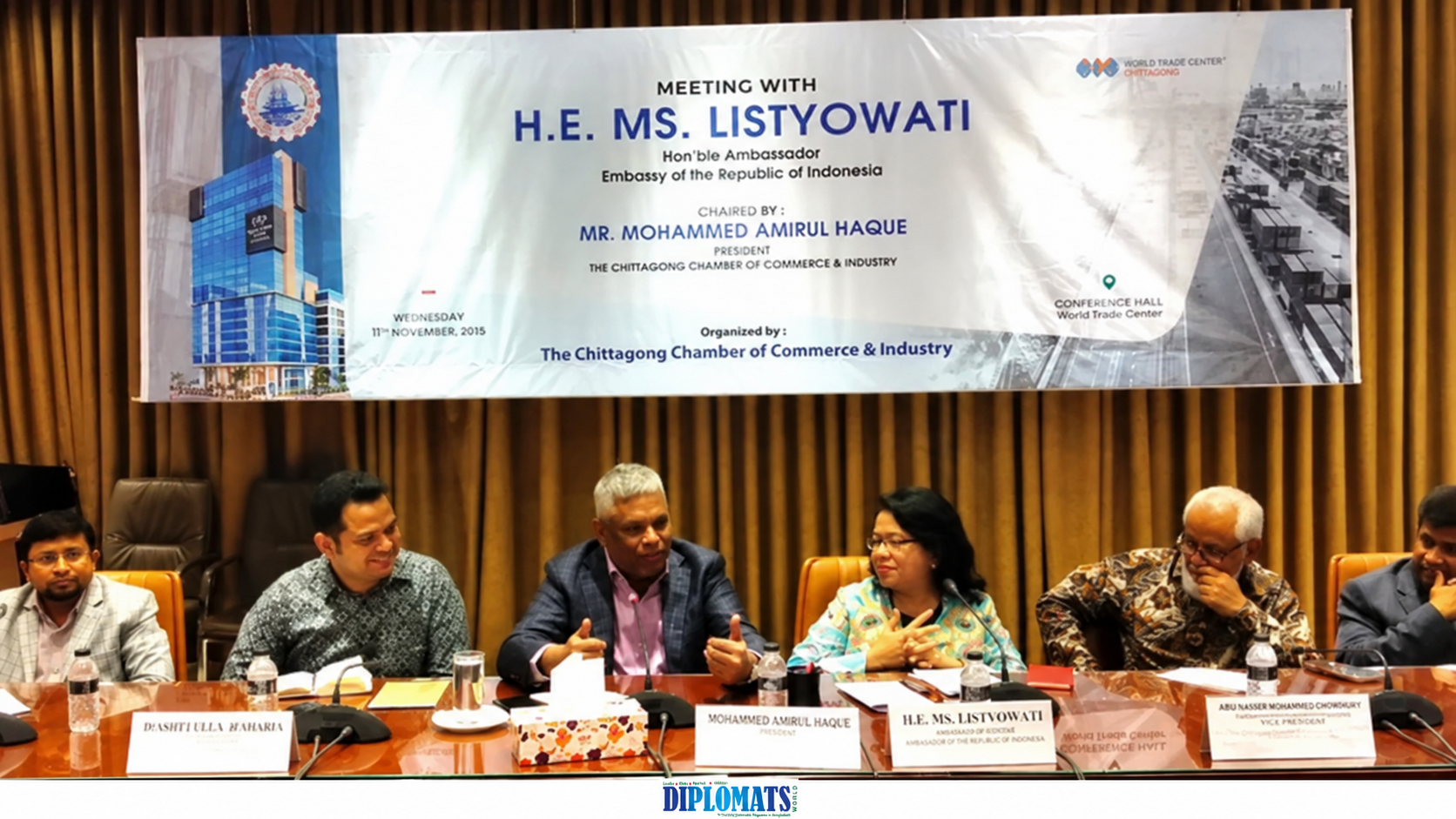
Indonesia's ambassador to Bangladesh has urged stronger business‑to‑business engagement to address the widening trade imbalance between the two nations, highlighting opportunities for cooperation in pharmaceuticals, halal food, energy and industrial raw materials.
Ambassador Listyowati noted that Bangladesh’s exports to Indonesia have risen by almost 6 percent in recent months, even though overall bilateral trade remains heavily weighted in Indonesia’s favour.
"There are ample opportunities to strengthen existing commercial relations and expand cooperation into new sectors," she stated at a business leaders' meeting organized by the Chittagong Chamber of Commerce and Industry (CCCI) at the World Trade Centre in Chattogram today (11 November).
She identified halal food, energy, pharmaceuticals, chemicals and industrial raw materials as potential areas for joint ventures and investment.
Praising the quality of Bangladeshi pharmaceuticals, the ambassador urged local businesses to establish stronger links with Indonesian counterparts to expand the market for Bangladeshi medicines.
She also highlighted Chattogram's importance as a major economic and commercial hub, stating that its port, industries, and business potential could help boost trade between the two countries.
To achieve this, she emphasized the necessity of stronger institutional ties between the Chittagong Chamber and Indonesian business organizations, as well as reciprocal business delegations. Additionally, she highlighted the importance of improved maritime connectivity, enhanced logistics facilities, and the establishment of direct air connectivity.
The ambassador assured business leaders that the Indonesian embassy would provide the necessary support to facilitate visa processing, investment, and commercial engagement.
CCCI President Mohammad Amirul Haque stated that Indonesia is one of Bangladesh's important trading partners, providing significant quantities of coal, clinker, palm oil, fuel, and industrial raw materials.
He stated that Indonesian clinker played an important role in Bangladesh's cement industry, while coal supplied by Indonesia served as a major raw material for the country's coal-fired power plants.
Highlighting Indonesia's global position in the halal industry, Amirul stated that Bangladesh could benefit from Indonesian expertise and technology through knowledge-sharing initiatives and investment, encompassing both joint and individual ventures.
Cooperation in halal food processing, industrial raw materials, and other promising sectors could help increase bilateral trade to $10 billion within the next five years, he stated.
However, he expressed concern over the substantial trade deficit and urged the Indonesian ambassador to facilitate imports of at least $1 billion worth of products from Bangladesh.
He also highlighted difficulties faced by Bangladeshi businesses in opening letters of credit (LCs) for trade with Indonesia.
According to him, Indonesian companies do not directly accept letters of credit issued by Bangladeshi banks. This forces local importers and exporters to route transactions through third countries, which increases costs and transaction times.
He called for greater coordination between banks and financial institutions in the two countries to resolve the issue.
The chamber president also urged Indonesia to introduce multiple-entry visas for Bangladeshi businesspeople and to establish direct air and maritime connections between Dhaka and Jakarta.
Former Chittagong Chamber of Commerce and Industry (CCCI) president and chairman of the Port Users Forum, Amir Humayun Mahmud Chowdhury, called for Indonesian cooperation in developing Bangladesh's railway manufacturing capabilities.
Noting that Bangladesh imports railway coaches from Indonesia, he suggested that the two nations work together to develop local railway workshops and facilitate domestic coach production with Indonesian technical assistance.
Other speakers proposed boosting Bangladeshi exports of pharmaceuticals, jute and jute goods, and muslin sarees to Indonesia to help narrow the trade gap.
They also called for Indonesian investment, either independently or through joint ventures, in Bangladesh's cement, steel, and power sectors, with a particular focus on industries that supply raw materials and support backward linkages.
Speakers described Indonesia as a friendly nation with longstanding religious, historical, and cultural ties to Bangladesh, stating that enhanced commercial engagement could transform these relations into greater economic benefits.
Among those present were Vietnam's Honorary Consul S M Abu Tayyab, Spain's Honorary Consul Mia M Abdur Rahman, Korean Honorary Consulate representative Mohammad Mohsin, former chamber director Dr Moinul Islam Mahmud, chamber directors Engineer Golam Sarwar and Shahidul Alam, and Chittagong C&F Agents Association General Secretary Shawkat Ali Chowdhury.
Brigadier General (retd) Shahidullah Chowdhury, executive director of Abul Khair Group, Women Chamber director Nuzhat Noori Kristi, and Sunshine Grammar School Principal Safia Rahman Gazi also attended the meeting.
Also present were Indonesian embassy Third Secretary Robbi Firly Harkha and Economic Affairs Officer Sapto Rudiyanto, along with CCCI Vice-President Mohammad Mashiul Alam Swapan, other chamber directors, and business representatives.
Why it matters
Stronger commercial engagement and direct financial coordination can help bridge the bilateral trade deficit between Bangladesh and Indonesia.