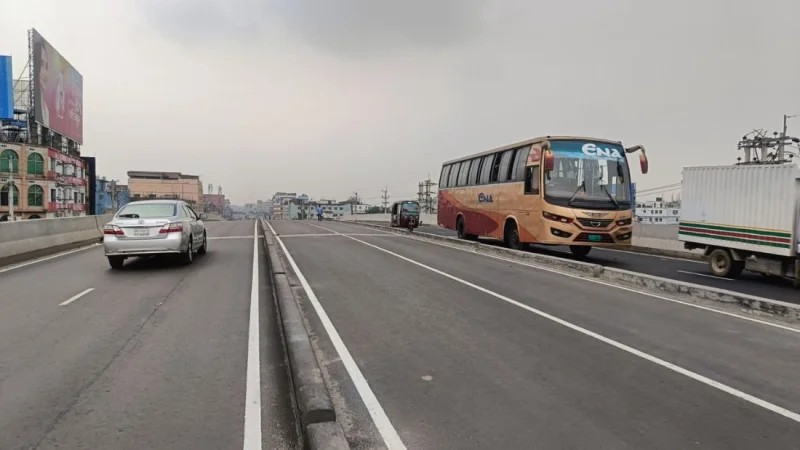
The government has planned to convert the Dhaka-Gazipur Bus Rapid Transit (BRT) corridor into a six-lane conventional highway by removing BRT stations, lane dividers and associated infrastructure to ensure smoother and faster traffic movement.
Under the plan, three lanes will be allocated for general traffic in each direction. Two existing two-lane flyovers will also be upgraded to four lanes, an official familiar with the process said.
The issue was discussed at a cabinet meeting on October 18, chaired by Prime Minister Tarique Rahman, according to a letter issued by the Road Transport and Highways Division on October 19.
The meeting decided to dissolve Dhaka Bus Rapid Transit PLC and transfer it under the Roads and Highways Department (RHD) for oversight.
The authorities concerned have been instructed to submit an initial progress report on implementing the decisions within 15 days, followed by updated reports by the third day of each month until implementation is complete, the letter said.
RHD Chief Engineer Md Moniruzzaman said the department had been informed of the government's decision and was taking the necessary steps.
Approved in November 2012, the 20.5-kilometre BRT project was initially scheduled for completion by December 2016 at an estimated cost of Tk2,037.9 crore. However, implementation delays and repeated revisions pushed the estimated cost to Tk4,268.32 crore, according to Moniruzzaman.
The project was financed by the Bangladesh government, the Asian Development Bank (ADB) and the French development agency Agence Française de Développement (AFD).
By December 2024, around 97% of the infrastructure work had been completed, while overall physical progress stood at 77.48%. The project tenure expired that month and was not extended.
Although the dedicated BRT lanes were subsequently opened to general traffic, the planned bus service could not be launched after two attempts to procure buses failed.
In July 2025, the Executive Committee of the National Economic Council (Ecnec) rejected a proposal to increase the project cost to Tk6,598 crore and extend its tenure until December 2029. It also ordered an investigation into the project's design and feasibility study.
The government later considered four options for the corridor before opting to turn it into a conventional highway. A review team from the Bangladesh University of Engineering and Technology (BUET) had recommended abandoning the planned BRT service, citing design flaws and limited capacity.
The latest decision has, however, raised concerns among urban planners and civic organisations. The Bangladesh Institute of Planners (BIP) described the move as a setback for sustainable and inclusive public transport and called for reconsideration.
Why it matters
The decision marks a major shift in public transport infrastructure policy for a critical high-traffic corridor in Bangladesh following years of implementation delays and cost overruns.