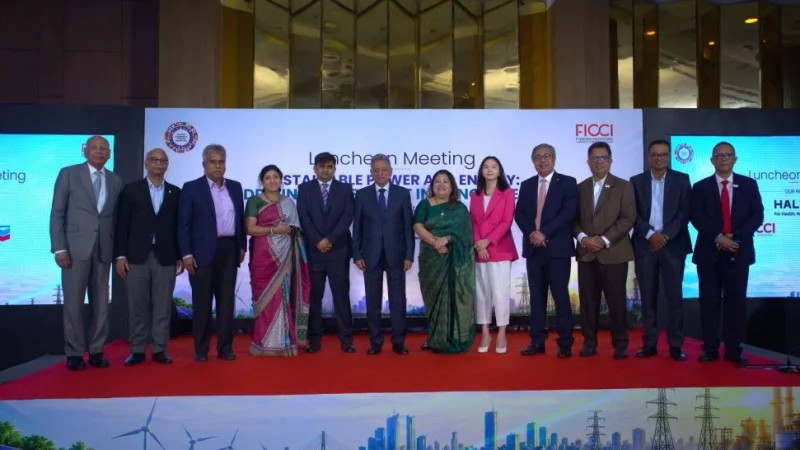
The Foreign Investors’ Chamber of Commerce and Industry (Ficci) has called for urgent reforms, increased domestic gas exploration, and accelerated investment in renewable energy. The chamber stated these measures are necessary to strengthen Bangladesh’s energy security, improve industrial competitiveness, and attract long-term investment.
The call came at a high-level luncheon meeting titled “Sustainable Power and Energy: Driving Investment in Bangladesh,” held Monday in Dhaka to discuss the country’s energy challenges and identify practical solutions for a reliable, affordable, and sustainable energy future.
The meeting was graced by Amir Khasru Mahmud Chowdhury, MP, Minister for Finance and Planning, who served as chief guest.
Shafiqul Alam, lead analyst for Bangladesh Energy in South Asia at the Institute for Energy Economics and Financial Analysis (IEEFA), delivered the keynote address.
The panel discussion was moderated by Mahbub ur Rahman, CEO of HSBC Bangladesh and a former director of the Ficci board. It featured Shu Xiong, president and managing director of Chevron Bangladesh; Prof Mohammad Tamim, vice chancellor of Independent University, Bangladesh; Nazneen Ahmed, executive director of the Centre for Policy Dialogue (CPD); and Fazlul Hoque, administrator of the FBCCI.
Finance and Planning Minister Amir Khasru Mahmud Chowdhury, MP, acknowledged the significant energy and economic challenges facing Bangladesh, noting that the government had been addressing an energy crisis alongside inherited financial liabilities and structural weaknesses.
He expressed confidence that the economy, including the energy sector, would begin to stabilize by the second year of the government’s tenure, with stronger growth expected in the following years.
He emphasized the need to reduce the cost of doing business, improve the investment climate, and strengthen the competitiveness of domestic industries through reforms and deregulation.
The Minister further underscored the importance of comprehensive reforms in taxation, banking, and capital markets to restore confidence and facilitate investment.
Referring to plans to separate the National Board of Revenue’s policy-making and enforcement functions, he said the government was pursuing measures to improve efficiency, transparency and accountability.
He urged the private sector to collaborate with the government during this transition, expressing optimism that ongoing reforms and investment initiatives would reinforce macroeconomic stability, enhance the business environment, and foster Bangladesh’s long-term economic growth.
Ficci president Rupali Haque Chowdhury highlighted how global energy disruptions have exposed Bangladesh’s vulnerability to imported fuels, raising industrial costs, disrupting production, and creating uncertainty for businesses.
She stressed that energy security must extend beyond simply ensuring supply to making energy reliable, affordable, and sustainable. Furthermore, she called for stronger domestic gas exploration, diversified liquefied natural gas sourcing, modernized infrastructure, improved energy efficiency, and faster investment in renewable energy.
She also underscored the importance of regional cooperation and greater private-sector participation in building a resilient energy system to support industrial growth, export diversification, and job creation.
Delivering the keynote, Shafiqul Alam highlighted Bangladesh’s growing energy challenges, which are driven by declining domestic gas reserves, rising liquefied natural gas imports, and volatile global fuel prices.
He noted that domestic gas reserves could be depleted by 2036 without new discoveries, increasing pressure on power generation costs, industrial competitiveness, and household affordability.
During the panel discussion, the speakers highlighted the need for stronger domestic gas exploration, investment-friendly policies, and a diversified energy mix to ensure energy security and affordability.
Shu Xiong stressed that a stable regulatory environment is essential to attract long‑term foreign investment. Professor Mohammad Tamim emphasized the need to balance domestic gas production with renewable energy development.
Fazlul Hoque highlighted the impact of energy shortages and rising costs on industrial productivity and investment, calling for greater support for rooftop solar and green financing.
Nazneen Ahmed underscored the importance of attracting foreign investment while maintaining fiscal sustainability and affordable energy.
Ficci board director Shadab Ahmed Khan delivered the vote of thanks.
Why it matters
The high-level discussions highlight critical private sector and government strategies required to mitigate Bangladesh's escalating energy vulnerabilities and secure long-term industrial growth.