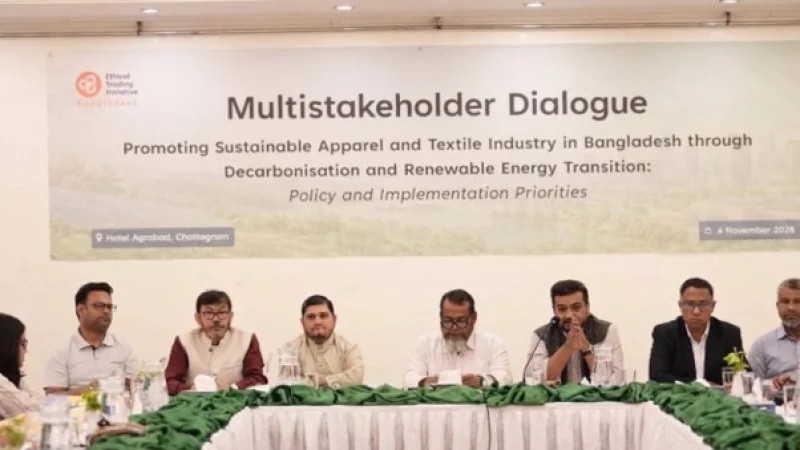
Leaders across Bangladesh’s garment and textile sector called for stronger policy implementation, accessible green financing, and shared supply-chain responsibility to turn decarbonization commitments into reality.
The consensus emerged at a multistakeholder dialogue titled "Promoting Sustainable Apparel and Textile Industry in Bangladesh through Decarbonization and Renewable Energy Transition: Policy and Implementation Priorities," which was organized by Ethical Trading Initiative (ETI) Bangladesh at Hotel Agrabad in Chittagong on Wednesday.
The event brought together 40 stakeholders representing the BGMEA, BKMEA, trade union federations, financial institutions, global brands, NGOs, and civil society. Participants met to address the challenges of accelerating renewable energy adoption within Chittagong’s specific industrial landscape while simultaneously safeguarding workers.
Participants stressed that setting target numbers alone will not ensure implementation without clear approval procedures, financing, technical support, and stable business relationships to counter rising production costs and energy supply instability.
Highlighting local industrial realities, Md M Mohiuddin Chowdhury, director of BGMEA and CEO/director of Clifton Group, pointed out that unreliable electricity and voltage fluctuations continue to jeopardize machinery, output, and market competitiveness.
Echoing operational hurdles, Md Yasin, director of the BKMEA and managing director of Sonnet Group of Companies Ltd., urged regulators to simplify net-metering procedures, grant tax concessions on solar equipment, and unlock affordable green financing.
Addressing supply-chain economics, Md Ismail Murad, corporate responsibility manager at Columbia Sportswear Company, stressed that manufacturers operating on narrow margins cannot shoulder the full financial weight of decarbonization targets alone.
Robiul Hoque Shimul, organizing secretary of the Bangladesh Labour Federation, alongside other labour leaders, has called for structured dialogue between employers and workers. The appeal aims to protect employment, guarantee fair wages, maintain safe working conditions, and ensure equitable reskilling as automation accelerates, with a particular focus on female workers.
Representing the financial sector, Saiful A Chowdhury, area head for Chittagong at Brac Bank PLC, detailed the green financing options available through Bangladesh Bank’s refinancing schemes. He emphasized the need for increased awareness and a shift in mindset among manufacturers to effectively utilize these financial tools.
Abil Bin Amin, executive director of ETI Bangladesh, reaffirmed that investments in energy efficiency and renewable energy must advance together.
"Fair prices, long-term partnerships, and enabling policies are essential to making this transition workable for factories and workers," he stated.
To accelerate the transition, delegates urged government authorities and regulators to streamline approval processes for renewable installations, particularly by simplifying net-metering and grid-connection procedures in CEPZ and KEPZ.
Alongside these administrative fixes, financial institutions must expand access to affordable green finance by easing collateral requirements and providing clear guidance for smaller, less-resourced factories.
Additionally, policy frameworks must account for enterprises operating in shared buildings through offsite generation models and collective energy procurement. At the same time, these frameworks should encourage factories to integrate renewable investments with broader resource efficiency measures, including energy audits, heat recovery, and water conservation.
Crucially, the dialogue emphasized that successful implementation hinges on a just, shared commitment across the entire supply chain and workforce.
Global brands were called on to co-fund these sustainability goals through fair pricing, predictable order volumes, and longer-term sourcing agreements rather than leaving factory owners to bear the full burden.
At the same time, labour representatives emphasized that worker rights, safe conditions, fair wages, and inclusive upskilling programs—particularly for women—must stay central to all transition planning to ensure that greening the industry delivers tangible social benefits.
Why it matters
This dialogue directly shapes how Bangladesh’s garment industry integrates renewable energy and decarbonization into production, affecting factory competitiveness, energy costs, and supply-chain sustainability in a key export region.