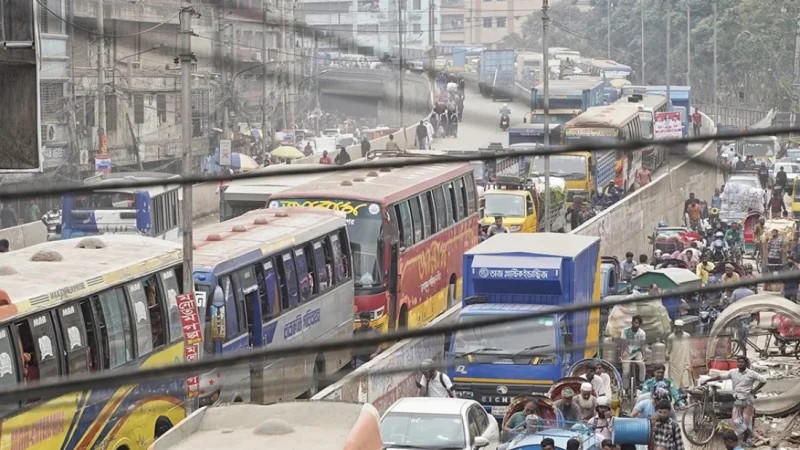
Bus services operating under a franchise-based system have officially commenced on seven routes across Dhaka. The network includes six regular routes and one circular route, marking a development in the capital's long-delayed bus route rationalisation initiative.
However, the Sunday launch has left several issues unresolved, including the absence of new buses, delays in repainting existing vehicles, route allocation disputes, and questions over whether the new system can bring discipline to the city's chaotic public transport network.
The services have been introduced using existing buses rather than newly procured vehicles. Furthermore, many of the buses scheduled to operate on the six routes were not on the roads on the opening day.
The Dhaka Transport Coordination Authority (DTCA) plans to operate 831 buses under six companies. This effort forms part of the latest phase of a broader initiative to reduce Dhaka's 98 existing bus routes down to 32.
Under the new arrangement, each company will operate on designated routes, with separate colours and route numbers planned to make buses easier for passengers to identify.
Dhaka Metropolitan Police Commissioner Mosleh Uddin Ahmed stated that the authorities were unable to repaint the buses prior to the launch due to time constraints.
Speaking at the inauguration ceremony at Manik Mia Avenue around 11:30 am on Sunday, he stated that previous attempts to reorganise Dhaka's bus routes had failed due to a lack of cooperation from transport owners, workers, and other stakeholders, alongside bureaucratic complications.
He also proposed replacing the existing trip-based payment system for drivers and helpers with fixed monthly salaries, arguing that this change would reduce unhealthy competition among drivers to complete more trips.
The programme was inaugurated by Shimul Biswas MP, chief coordinator of the Transport Owners and Workers Unity Council.
The six regular routes are Shibbari in Gazipur–Dhakeshwari Temple, Mirpur–Keraniganj, Ghatar Char–Demra, Ghatar Char–Kanchpur, Ghatar Char–Uttara and Tongi–Azimpur.
Meanwhile, an air-conditioned circular bus service has also begun operating from Mirpur-1 through Kachukhet, Sainik Club, Jahangir Gate and Agargaon to Ansar Camp. The service is being operated by Trust Transport Services using 30 new AC buses.
Shimul Biswas stated that the authorities had decided to introduce separate colours for buses operating on each of the 32 routes, following examples from major cities in developed countries.
"This will not be just a photo session today followed by the service being discontinued later," he said.
He said that restoring discipline to the roads of Dhaka would benefit the majority, even though some individuals profited from the existing disorder.
Referring to traffic congestion and the widespread presence of battery-powered rickshaws and other vehicles, he stated that the resulting loss of working hours, time, and money was affecting the country's economy.
He added that disorder on the roads also shaped foreign visitors' perceptions of Bangladesh.
DMP Commissioner Mosleh Uddin Ahmed said six companies had been formed by bringing bus operators previously running under around 18 different banners under a single management structure.
He said that, among 25 planned circular routes within the city, five had initially been approved. One has now been launched using AC buses, while 27-seat minibuses have been ordered for the remaining four routes, which are expected to become operational within the next two months.
He added that the authorities were discussing fixed monthly salaries for transport workers with bus owners' and workers' associations. Separate colours, route numbers and digital destination boards would also be introduced on buses operating across the 32 routes.
The six routes were inaugurated despite unresolved issues surrounding the number of buses, vehicle fitness, repainting, route allocation and operational arrangements. This has raised questions over how successful the initiative will be in bringing discipline to Dhaka's chaotic public transport system.
DTCA Executive Director Mohammad Mashiur Rahman described the initiative as a final implementation rather than a pilot project, saying there would be no turning back.
He also urged legal action, through traffic police and executive magistrates, against those obstructing the initiative by deliberately parking buses on roads.
Despite plans to operate 831 buses across the six regular routes, a significant number were missing from the roads on the first day.
On route 17, connecting Mirpur and Babubazar Bridge, 133 buses were scheduled to operate under the Chiriakhana City Transport Company, formed by bringing Dishari, Tanzil and Metrolink services together.
On Sunday, only Dishari buses were seen operating on the route, while buses from the other two operators were absent.
ASM Ahmed Khokon, president of the bus owners' association under Chiriakhana City Transport, told Dhaka Tribune that 60 Dishari buses had started operating on Sunday, while buses from Tanzil and Metrolink would join the service from Monday.
Visiting several of the newly launched routes, this correspondent also found that buses continued to stop frequently at locations other than designated bus stops, undermining one of the key objectives of the rationalisation initiative.
Khokon acknowledged the challenge, saying both passengers and transport operators had become accustomed to irregular practices.
"We have become accustomed to irregularities, and passengers have also become accustomed to them. As an owners' association, we are trying to ensure that buses stop only at designated stops. Everyone's cooperation is necessary," he said.
Dhrubo Alam, deputy transport planner at the DTCA, told Dhaka Tribune that around 70% of the planned 831 buses across the six routes had started operating on the opening day.
He said the buses would be repainted soon.
Although the authorities have proposed fixed monthly salaries for drivers, transport owners say the existing system cannot be changed overnight.
According to the owners' association, drivers have been working under a daily payment arrangement for around 40 years. Any transition to monthly salaries would therefore need to be gradual.
During the inauguration ceremony, Saiful Alam, Secretary General of the Bangladesh Road Transport Owners Association, urged passengers to board and alight from buses only at designated stops in order to help restore discipline on the roads.
Despite the launch of the new arrangement, passengers on the routes said their travel times remained largely unchanged.
Businessman Sabbir Rahman, who travelled from Demra Staff Quarter to Matsya Bhaban on Route 19 operated by Ramzan Ali City Transport, told the Dhaka Tribune the journey took about two hours.
"It used to take me two hours even before. I have not noticed any significant change," he said.
During the inauguration ceremony, Saiful Alam called for government assistance to facilitate the purchase of new buses, saying transport owners were willing to buy vehicles by making advance payments rather than seeking subsidies.
He said the owners' association would provide guarantees to support the purchases and that older buses would gradually be replaced with new ones.
The initiative to rationalise Dhaka's bus routes dates back to 2015, when then Dhaka North City Corporation mayor Annisul Huq introduced a plan to divide the city's routes into eight corridors, with buses operating in separate colours.
The initiative stalled following his death in 2017.
Later, under former mayor Sheikh Fazle Noor Taposh, a new plan was taken to merge 246 bus companies into six franchise-based operators and reorganise 278 routes into 22 corridors.
In December 2021, Dhaka Nagar Paribahan was launched experimentally on the Ghatar Char–Signboard route. However, other operators could not be brought under the system, and the initiative eventually became inactive.
The programme stalled again after the July uprising. The interim government also attempted to introduce a franchise-based system, but that effort failed as well.
After the BNP government assumed office, Prime Minister Tarique Rahman held several meetings aimed at restoring discipline to Dhaka's public transport system. The latest launch represents a partial start of the franchise-based arrangement within the six-month timeframe.
The inauguration ceremony was attended by Additional Secretary of the Urban Transport Wing of the Road Transport and Highways Division Anisur Rahman, Bangladesh Road Transport Authority Chairman Mohammad Habibur Rahman and Dhaka Road Transport Owners Association President MA Baten, among others. It was chaired by DTCA Executive Director Mohammad Mashiur Rahman.
Why it matters
The successful implementation of Dhaka's bus franchise system is critical for reducing severe traffic congestion, improving urban transit efficiency, and enhancing economic productivity.