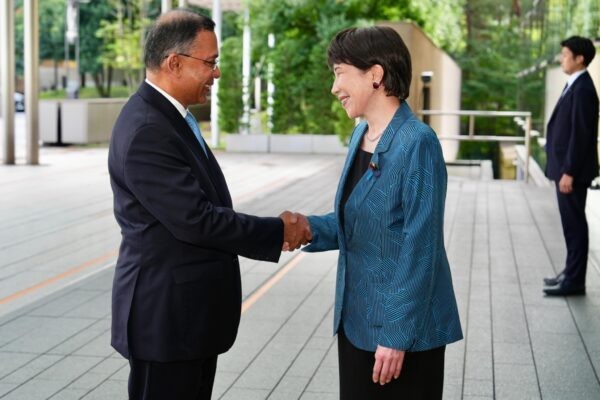
Bangladeshi Prime Minister Tarique Rahman, who visited Japan between Oct. 26 and 29, returned home with promised private investment totaling $6.3 billion for a five‑year period in the Bangladeshi economy.
The investment is expected to create around 200,000 jobs.
Japan also pledged new loans and announced a grant for a patrol vessel.
The visit also clarified how Japan plans to work with his government.
Japan will maintain its long‑standing development programme in Bangladesh. The country said its forthcoming investment plans will be more closely aligned with maritime security.
At a press briefing, Bangladesh’s State Minister for Foreign Affairs Humaiun Kobir said that private‑sector entities signed 17 memoranda of understanding during Rahman’s trip.
The summit communiqué, however, omitted a detailed breakdown of the $6.3 billion investment, neither specifying the contributing companies nor indicating which initiatives are newly announced versus those already under discussion.
Several major agreements were signed before Rahman assumed office in February of this year. Consequently, the investment amount he announced during his recent trip cannot be counted as investment secured by that visit.
It pledged $100.8 million to improve the investment environment and allocated $194.7 million for the second phase of the Upazila (sub-district) Governance and Development Project.
Together, the loans amount to about $295.5 million.
That is smaller than the $1 billion package formalized during Chief Interim Adviser Muhammad Yunus’ visit to Japan in May 2025.
That package included $418 million in budget support, $641 million for railway development and a scholarship grant.
Earlier in 2026, Japan agreed to lend Bangladesh $316.1 million to help the country cope with economic shocks and keep energy supplies steady.
During his visit in October, Rahman acknowledged that loan.
The earlier loan was separate from the new funding Japan pledged in October.
An agreement on improving the business environment accompanied the new loan pledges.
Rahman committed to greater transparency and predictability in taxation, customs, licensing, and fund transfers.
These changes affect the cost of operating a factory.
Machinery delayed at customs or production interrupted by power shortages can weaken the case for expansion, including among Japanese firms already operating in Bangladesh.
For more than a decade, Japan has supported infrastructure projects in Bangladesh with the aim of helping to attract private investment and improve connectivity with the rest of the region.
When then-Prime Minister Sheikh Hasina visited Japan in 2014, Tokyo pledged up to $5.9 billion, primarily in the form of loans, to be disbursed over a period of four to five years.
That was the year Japan and Bangladesh launched the Bay of Bengal Industrial Growth Belt, known as BIG-B.
The two countries upgraded ties to a strategic partnership in 2023.
In February, shortly before Rahman assumed the office of prime minister, Yunus' interim government signed an Economic Partnership Agreement with Japan, alongside a separate accord concerning the transfer of defense equipment and technology.
During Rahman’s visit, Bangladesh and Japan reaffirmed their commitment to the deals.
Once the trade agreement takes effect, Bangladeshi businesses will gain improved access to the Japanese market alongside clearer rules for trading with Japan. The development comes as Bangladesh prepares to graduate from least developed country status.
Under the flagship development initiative "BIG-B for Shared Prosperity," the program now explicitly incorporates geopolitical risks, economic security, and cooperation for peace and stability.
Security cooperation already featured in the 2023 strategic partnership.
The revision brings it directly into the framework organizing infrastructure and industrial development.
Matarbari and Moheshkhali, on Bangladesh’s southeastern coast, are central to that approach.
The two governments agreed to develop the area as a logistics, energy, and industrial hub centered on the deep-sea port.
The potential return brings prospects for jobs and supplier contracts in the surrounding area, together with improved transport connections for exporters.
That depends on the port, energy, and industrial facilities working together.
This serves Japan’s interest in developing stronger supply networks across South and Southeast Asia.
Bangladesh’s location offers access to both regions.
During Rahman’s visit, Japanese Prime Minister Takaichi Sanae also placed the partnership within Japan’s Free and Open Indo-Pacific policy.
The industrial plans sit alongside Japanese support for coastal patrols and port security.
Japan has agreed to provide a grant of approximately $13.4 million to the Coast Guard for a patrol vessel and related services.
The Japan International Cooperation Agency (JICA) has stated that it will support responses to maritime crime, accidents, and disasters, while also contributing to the safety of regional sea lanes.
Japan handed over five patrol boats to the Bangladesh Navy in July through its Official Security Assistance program.
The new patrol vessel will be transferred to the Coast Guard. The delivery will be made through Japan’s development aid program.
Thus, Japan is now helping both the Navy and the Coast Guard patrol Bangladesh’s waters.
The defense agreement signed in February also sets out how Japan can supply more equipment in the future.
For Bangladesh, closer ties with Japan mean an additional source of funding and technology for its industries, along with increased support for maritime patrols.
They also give Dhaka a bigger role in Japan’s ambitions in the Bay of Bengal.
Although the port and industrial projects rely on secure shipping routes, Japan's backing for patrols remains modest in comparison to the scale of those initiatives.
Takaichi’s backing for Rahman’s administration also signaled that the partnership would continue with his government.
That matters for projects whose financing and construction extend across political terms.
Japan has been one of Bangladesh’s main development partners since the early years of independence.
That same year, it began studying a bridge across the Jamuna River to connect eastern and western Bangladesh.
When the bridge opened in 1998, a crossing that had taken hours by ferry took about 15 minutes.
Japan provided grants to build two bridges on the road from Dhaka to the port city of Chittagong.
The Meghna Bridge opened in 1991, followed by the Meghna-Gumti Bridge in November 1994.
Together, they made road travel between the two cities easier.
As traffic grew, Japan provided loans to build two more bridges, one alongside each of the original crossings.
They opened in 2019 as part of the first project completed under the BIG-B initiative.
Japan also helped finance the Jamuna Railway Bridge, which opened in March 2025.
In Dhaka, Japan began financing Bangladesh’s first metro line in 2013 and helped train staff to operate it safely.
Japan also helped finance and build the third terminal at Dhaka’s Hazrat Shahjalal International Airport.
At their October summit, Rahman and Takaichi agreed to accelerate preparations to bring it into service under the BIG-B initiative.
Dhaka is targeting partial operations on December 16 this year, more than three years after the ceremonial opening.
The proposed deal for a Japanese consortium to run the terminal still needs approval.
One draft clause has drawn criticism: it would prevent competing civilian airports within a 100-kilometer radius of Shahjalal from starting commercial operations for a period of 15 years.
Japan’s growing security role in the Bay of Bengal may help explain what Rahman’s visit delivered.
Tokyo is increasing defense spending and developing longer-range missiles.
Its cooperation with Dhaka reflects a wider interest in regional security.
Support for maritime patrols now sits alongside investment in ports and industries.
The visit yielded new funding pledges, a grant of a Coast Guard vessel, and the prospect of increased private investment for Bangladesh.
It also strengthened Bangladesh’s place in Japan’s plans for the Bay of Bengal.
The revised BIG-B initiative brings economic development and security cooperation into the same framework.
It remains uncertain how much private investment will follow the visit, but the trip demonstrated how closely Japan now connects its own economic and security interests with Bangladesh.
Why it matters
The visit deepens bilateral economic and maritime security ties, anchoring Bangladesh more firmly within Japan's Indo-Pacific industrial and geopolitical framework.