The uprising that erupted in Bangladesh in July 2024 stemmed from multiple grievances, the most profound being that, for ten years, the principal opposition party, the Bangladesh Nationalist Party (BNP), had been excluded from credible electoral contests. This prolonged exclusion from meaningful elections has been identified as a central driver of the unrest.
The uprising promised Bangladeshis that no one would be shut out of politics.
More than two years on, that promise is fraying.
The Awami League, a major political party that was ousted during the July 2024 uprising, has been placed under a ban. The ban is being employed as a blanket authority for arrests and imprisonment.
The measure is now being applied to workers who are on strike demanding a wage that allows them to live.
Such a development undermines democracy and poses an even greater risk to an economy that cannot afford another crisis of trust.
Following the change of government, the Yunus‑led interim administration banned the Bangladesh Chhatra League, the Awami League’s student wing, in October 2024, invoking the Anti‑Terrorism Act (ATA).
On 12 May 2025, it further employed the newly amended Anti‑Terrorism Act (ATA) to impose a “temporary” ban on the Awami League itself.
The ban covers meetings, publications, and even online speech supporting the party.
According to the existing legislation, the prohibition will remain in force until the party leaders accused of crimes committed while in office are brought to trial.
Nevertheless, the legal proceedings could span several years, effectively banning a party that has been active since before the country’s independence.
The Bangladesh Nationalist Party (BNP), which secured victory in the 2026 election—a contest in which the Awami League was not on the ballot—later codified the ban.
Of particular concern is how the ban is being used.
Rights organizations documented at least 8,600 arrests in the “Operation Devil Hunt” campaign alone.
Human Rights Watch reported that ten murder cases have been filed against more than 8,400 individuals, most of whom remain unnamed, and that hundreds of alleged Awami League supporters detained as murder suspects are routinely denied bail.
The government allegedly increasingly uses the counterterrorism law against the supporters.
Amnesty International said the ban called into question the government’s commitment to freedom of association.
Earlier, a communication from several United Nations experts said that the executive order banning the Awami League did not follow the ordinary procedure for dissolving political parties under the Political Parties Ordinance 1978. The experts added that the lack of judicial oversight of the order, together with the subsequent codification of the law, makes the decision controversial.
The same logic is now being turned on garment workers.
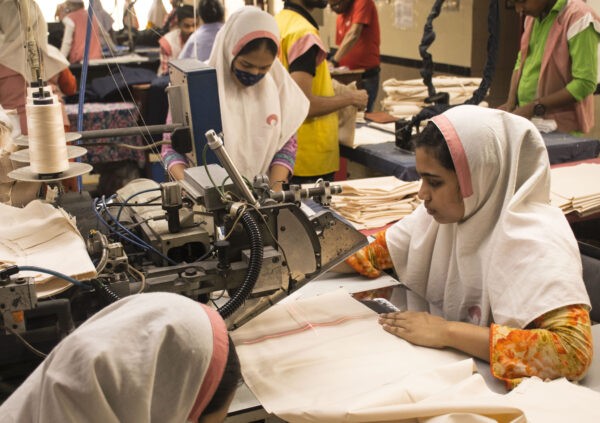
Since 31 October, hundreds of thousands of workers have staged walkouts in Mirpur, Ashulia, Gazipur and Narayanganj. The demonstrators are demanding a statutory minimum wage of 30,000 Bangladeshi taka (approximately US$241).
Within 24 hours, police announced that the protest movement had been infiltrated by members of the Awami League and that a significant number of demonstrators were not genuine garment‑industry workers.
Police have, as of this report, taken into custody 21 individuals identified as Awami League activists and several thousand other persons whose identities have not been disclosed, all detained under the Anti‑Terrorism Act (ATA).
Bangladesh’s Home Minister Salahuddin Ahmed said that supporters of former Prime Minister Sheikh Hasina were responsible for the protests, a claim that AFP reported was made without supporting evidence. He also alleged that the unrest was being instigated from across the border.
In response to the government’s harsh treatment and the detention of workers under the ATA, numerous labour leaders have gone into hiding.
There is also an allegation of disproportionate force used against laborers during protests.
Social‑media videos and images appear to show workers being beaten and police conducting raids on slums to detain protesters, with authorities citing the Awami League label as justification.
Rising food prices, inflation, and energy costs drove them into the streets to survive.
The World Bank projects that economic growth will be 3.4 percent in both fiscal year 2026 and fiscal year 2027, making it the second‑lowest growth rate in South Asia, surpassed only by Afghanistan.
Non‑performing loans continue to rise, and total revenue accounts for only 8.3 % of gross domestic product.
Approximately 2.1 million more people have fallen below the poverty line, and the disparity between rich and poor is widening.
The BNP government inherited much of this from the interim administration.
Following the inauguration of the new administration, mob violence and a breakdown of law and order have driven the economy to the brink.
Between August 2024 and June 2026, 457 garment and textile factories shut down, resulting in the loss of more than 240,000 jobs.
Most of those who lost their jobs are women.
Many individuals have no alternative formal employment, and some observers claim that employers are now screening new hires for union affiliations.
Net foreign direct investment declined to $1.47 billion in fiscal year 2026, a decrease of roughly 13 percent, and no company has been listed on the stock market since mid‑2024.
A survey by the Fashion Industry Association indicates that the proportion of U.S. buyers sourcing garments from Bangladesh fell to roughly 78 % this year, down from 88 % a year earlier.
Investors and purchasers factor political risk into their calculations, and political exclusion is regarded as a form of that risk.
The current Bangladeshi government’s room to maneuver is further narrowed by a trade deal it did not negotiate.
The interim administration signed the Agreement on Reciprocal Trade with the United States on 9 February 2026, just days before the election.
Under the deal, Bangladesh has now ordered 25 Boeing aircraft this year.
Under the new tariff schedule, 7,132 U.S. products will be admitted duty‑free, up from the 441 items previously covered, and the agreement targets virtually all U.S. imports to be duty‑free by 2035.
The nation raises only 8.3 % of GDP in revenue. By forgoing customs duties and pledging fixed, dollar‑denominated purchases, it faces a heavy financial burden.
Bangladesh’s ready‑made garment (RMG) sector remained a major source of foreign‑exchange earnings, generating nearly $39 billion in the most recent financial year.
Yet, the workers who make these products have always been the most neglected.
The phenomenon was evident in the collapse of the Rana Plaza, which claimed 1,134 lives in 2013, and in the Tazreen disaster, which killed at least 112 people in 2012.
Today, the entry wage is still the 12,500 taka set in December 2023.
An experienced sewing operator told Al Jazeera that she earns roughly 15,000 taka a month and sometimes goes hungry.
The government is caught in a real bind.
Industry owners caution that rising wages could increase production costs and drive buyers toward alternative manufacturing hubs such as Vietnam, India or Cambodia.
The head of a manufacturing firm dismissed the 30,000‑taka demand as having “no logical or mathematical basis.” He warned that, when political participation is prohibited, such a label can be used by authorities as a weapon against anyone deemed inconvenient.
Today that label is being used against workers asking for a wage that covers rent and rice.
Tomorrow it could be students, journalists, or the BNP’s own critics.
When a democratic nation bans its principal competitor, it also forfeits the capacity to distinguish between legitimate dissent and acts of sabotage.
Buyers value reliability above a few cents of cost.
The supplier, previously regarded as cheaper, is now facing higher costs because ongoing labor unrest continues to interrupt its production.
Repression does not generate stability; it merely postpones unrest, and the subsequent wave of protest is likely to be more intense.
A sizable cohort of participants enlisted in the July uprising after being offered the prospect of a nation where every citizen would be included in legitimate political participation.
Banning a party and branding wage protesters as its agents betrays that promise.
Bangladesh cannot rebuild its democracy or its economy by shrinking the space for people to speak.
Why it matters
The crackdown on garment workers threatens Bangladesh’s export earnings and social stability.