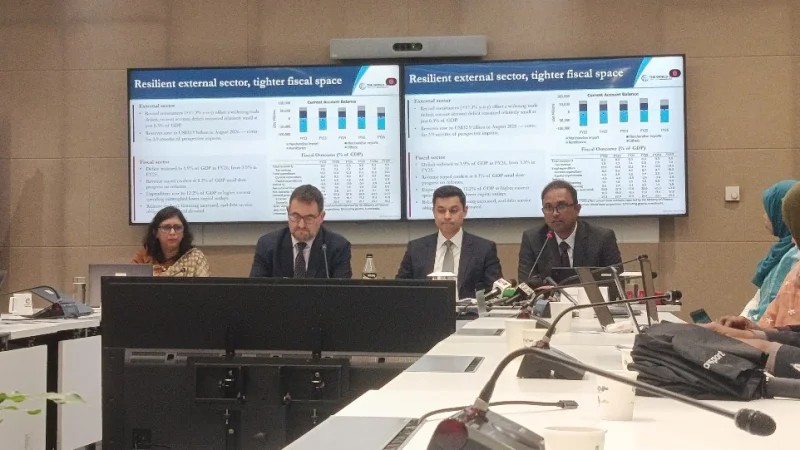
Bangladesh’s economic growth is projected to remain subdued at 3.4% for both FY26 and FY27, constrained by persistent structural bottlenecks, elevated inflation, and financial sector vulnerabilities, according to the latest Bangladesh Development Update released by the World Bank on Tuesday.
While noting that foreign exchange reserves show resilience and that growth is expected to gradually pick up to 3.9% in FY28 as energy supply and reforms improve, the World Bank warned that fast, bold reforms in revenue mobilization, banking, and energy are urgently required to restore growth and job creation.
Prolonged structural constraints—including a deepening energy sector crisis, banking sector vulnerabilities, and weak revenue collection—continue to weigh heavily on Bangladesh’s economic momentum, the World Bank stated in its latest report.
According to the latest Bangladesh Development Update, economic growth slowed sharply to 3.4% in FY26 and is projected to remain static at 3.4% in FY27. This slowdown reflects sluggish investment activity, softened export momentum, high inflation eroding household purchasing power, and rising business operational costs.
Despite these domestic and global challenges, the external sector demonstrated notable resilience.
Strong remittance inflows and improving foreign exchange reserves provided crucial stabilization.
Looking further ahead, gross domestic product growth is projected to recover moderately to 3.9% in fiscal year 2028, provided that energy supply gradually eases and government-led structural reform initiatives gather momentum.
The economic fallout has directly impacted living standards across Bangladesh.
In FY26, poverty and inequality increased, resulting in approximately 2.1 million more people living in poverty compared to the previous year. During this period, job creation stalled, and women experienced disproportionate job losses.
The ratio of non-performing loans (NPLs) surged to 33.2% in June 2026, increasing from 30.6% in December 2025. On the fiscal side, revenue collection remained severely constrained at 8.3% of GDP—ranking among the lowest globally—while the fiscal deficit widened to 3.9% of GDP in FY26.
"To avert economic downturn and return to an inclusive growth path, driven by private investment, fast and bold reforms are needed in banking sector, domestic revenue mobilization, and energy sector," said Jean Pesme, World Bank division director for Bangladesh and Bhutan.
The country needs to respond with urgency and speed up the reforms essential for protecting the poor and creating more and better jobs, according to statements emphasizing that the time to act is now.
To buffer vulnerable groups against rising living costs, the report emphasizes expanding and better targeting social safety net spending, including energy, food, and agricultural subsidies.
Currently, nearly half of the poorest households remain outside existing social assistance schemes.
The World Bank recommends consolidating food subsidies, expanding the government's Dynamic Social Registry, and improving the targeting of cash transfers. It estimates that these structural refinements alone could lift an additional 2.85 million people out of poverty.
The report was published alongside the regional companion report, the South Asia Economic Update, which forecasts South Asia's regional growth at 6.9% this year before moderating to 6.7% in 2027.
Both reports emphasize the transformative potential of Artificial Intelligence (AI) to enhance labor productivity, service delivery, and export opportunities throughout South Asia. They point to existing local initiatives, such as AI-assisted retinal screening in Bangladesh, as examples of this potential.
However, experts stress that governments must bridge foundational gaps in skills, digital infrastructure, and regulatory environments to fully integrate into artificial intelligence global value chains and unlock future economic opportunities.
Why it matters
The World Bank warns that without urgent reforms in banking, revenue mobilization and energy, Bangladesh's economic downturn will deepen, pushing millions more into poverty and stalling job creation.