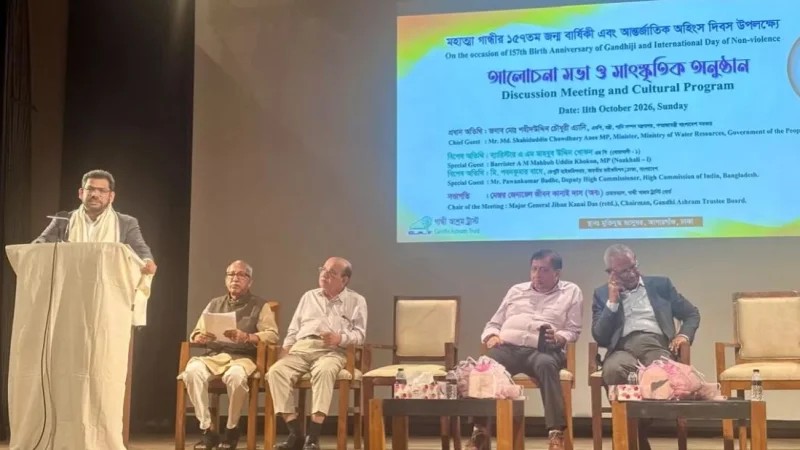
Acting Indian High Commissioner to Bangladesh Pawan Badhe stated on Sunday that strong relations between Bangladesh and India can contribute to regional peace, prosperity, and mutual understanding among their peoples.
Stating that India and Bangladesh share a "language of the heart" that includes a common history, culture, river system, and future, he noted that the relationship is broad and encompasses trade, connectivity, energy, education, health, and interpersonal bonds.
The acting Indian envoy made the remarks at a function marking the 157th birth anniversary of Mahatma Gandhi and the International Day of Non-Violence at the Liberation War Museum.
Water Resources Minister Md Shahiduddin Chowdhury Anee attended the discussion as the chief guest. Others who also spoke included Barrister AM Mahbub Uddin Khokon, MP, and Gandhi Ashram Trustee Board Chairman Major General Jiban Kanai Das (retd).
Pawan Badhe stated that Gandhi’s relevance in the contemporary world is profound. “At a time marked by geopolitical tensions, armed conflicts, environmental challenges and social inequalities, Gandhi’s principles offer a moral compass for humanity,” he said.
He stated that Mahatma Gandhi’s belief in simple living, ethical leadership, truth, and service to the most vulnerable challenged people to measure progress not merely by economic growth, but also by compassion, justice, and human welfare. “His life reminds us that moral courage can be more powerful than physical force,” he added.
Pawan Badhe shared three ideas of Gandhi that he said were extremely relevant to the present time.
“Gandhi never saw non-violence as weakness. He called it the weapon of the strong, because it takes more courage to hold your ground without hatred than to strike. In an age of polarisation, his lesson is that we can disagree firmly and still remain humane,” he said.
The acting envoy stated that the United Nations' recognition of Gandhi’s birth anniversary as the International Day of Non-Violence demonstrated how widely this principle is valued.
He highlighted the primacy of truth, noting that Gandhi titled his autobiography “The Story of My Experiments with Truth.”
“He believed that public life without honesty is hollow. Today, when a falsehood can circle the globe before the truth has dressed, his insistence on integrity, in speech, in politics, and in what we share online, is not old-fashioned. It is essential,” Pawan Badhe stated.
“He reminded us that the earth provides enough for everyone's need, but not for everyone's greed. South Asia is among the regions most exposed to climate change, from rising seas along our coasts to floods and cyclones that respect no border,” he said.
Pawan Badhe stated that Mahatma Gandhi’s principles concerning simple living, local self-reliance, and the responsible use of shared resources directly addressed the challenges currently confronting both Bangladesh and India.
He also highlighted Gandhi’s close ties with Bengal’s intellectual world, particularly his relationship with Rabindranath Tagore, who is equally cherished in Bangladesh and India.
He said their relationship was marked by mutual respect and friendly disagreement.
The Indian diplomat stated, "Tagore gave him the name ‘Mahatma’. Their conversations show that two great minds can differ and still enrich each other. That is a good model for our two countries, and for the region."
He noted that Gandhi’s spirit of dialogue, mutual respect, and shared well-being offered guidance for strengthening bilateral relations and building a better future for the region.
Why it matters
The statement reinforces diplomatic ties and mutual cooperation between Bangladesh and India in regional stability and development.