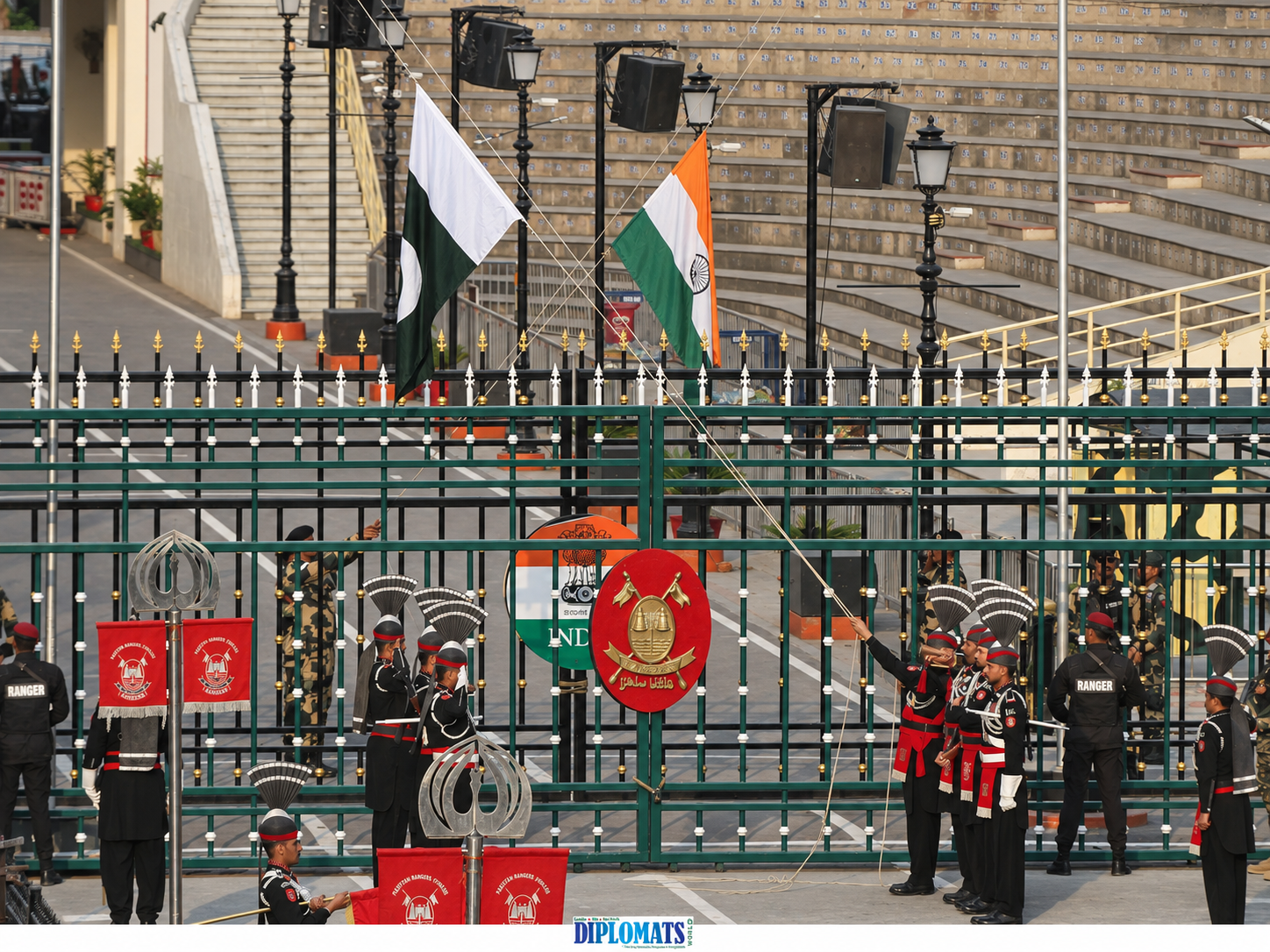
Islamabad, Pakistan — Pakistan’s climate change minister Musadik Malik arrived in New Delhi on Friday, marking the first visit by a Pakistani federal minister to India since the two neighbours fought a four‑day war in May 2025.
Malik is taking part in the inaugural Shanghai Cooperation Organisation (SCO) Civilisational Dialogue Forum, a three‑day event that Indian Prime Minister Narendra Modi will open on Friday evening. He is slated to speak at the forum on Saturday.
No bilateral meeting has been announced. On Thursday, Pakistan’s Foreign Office said its participation reflected the country’s contribution as an active Shanghai Cooperation Organisation member state, aimed at promoting dialogue, cooperation and understanding in line with the “Shanghai Spirit.”
The trip marks the first such visit since then; Pakistan’s Foreign Minister Bilawal Bhutto‑Zardari travelled to Goa in May 2023.
Both governments have framed these exchanges as routine SCO business.
Pakistan is slated to host the bloc’s leaders in August next year, prompting questions about how far engagement limited to a multilateral setting can progress and whether such a framework could pave the way for Prime Minister Narendra Modi to travel to Islamabad for the summit.
Indian media, citing diplomatic sources, reported that the invitation extended by India was addressed to Pakistan’s Minister for National Heritage and Culture, Aurangzeb Khan Khichi.
Pakistan’s Foreign Office said on 6 November that it had received an invitation and would decide after consultations. Islamabad has not explained why it sent Malik.
The Foreign Office said that Malik will share Pakistan’s perspective on the salience of dialogue among civilisations and will meet SCO member states on the sidelines.
Jauhar Saleem, president of the Islamabad‑based Institute of Regional Studies (IRS) and a former foreign secretary, said the decision is Pakistan’s to make.
The official said there is no fixed rule governing who a nation may send to such forums, adding that the invited state retains the prerogative to appoint the delegate it deems most appropriate, he told Al Jazeera.
“Civilisation encompasses more than heritage and culture; it also reflects how societies engage with their land, their rivers and each other,” Saleem added.
Khurram Dastgir Khan, a former federal minister for foreign affairs and defence and a senior leader of the governing Pakistan Muslim League‑Nawaz (PML‑N), said the choice was deliberate.
He told Al Jazeera that allowing Pakistan to send a minister of its own choosing “lets Pakistan take part as an SCO member without being seen to buy into India’s framing or showcase.”
He said it also signalled Pakistan’s aim “to be seen as a constructive host for the 2027 summit; thereby nudging the door open an inch for PM Modi’s participation”.
Pakistan assumed the rotating chairmanship of the Shanghai Cooperation Organisation on 1 September and is slated to host the SCO leaders’ summit in Islamabad in August 2027, coinciding with the 80th anniversary of independence for both countries.
New Delhi has sought to keep the visit within a narrow SCO frame.
During a briefing on October 28, Foreign Ministry spokesperson Randhir Jaiswal said that India had invited all SCO members, in accordance with established practice, together with its dialogue partners and one observer.
When asked whether New Delhi was reviewing its Pakistan policy ahead of upcoming multilateral engagements, he replied, “Following the Pahalgam attack, we have a Pakistan policy. That policy remains in place; there has been no change.”
India has accused Pakistan of orchestrating the April 2025 attack in Pahalgam, in Indian‑administered Kashmir, in which gunmen killed 26 civilians, an incident that set the stage for the war that followed. The Pakistani government in Islamabad has denied any involvement.
Sharat Sabharwal, who served as India’s high commissioner to Pakistan from 2009 to 2013, said the invitation resulted from India’s role as the host. He noted that the invitation was a direct consequence of India acting in that capacity.
Speaking to Al Jazeera, he said the gathering is being held under the Shanghai Cooperation Organisation framework, and that, as the host, India is obliged to invite every member state. Consequently, he added, there is no basis at this stage to read any deeper significance into the visit.
Indian Prime Minister Narendra Modi proposed the forum at the Shanghai Cooperation Organisation summit held in Tianjin, China, last year.
Irfan Nooruddin, a professor at Georgetown University’s School of Foreign Service, said the initiative gave New Delhi a narrative of its own.
He told Al Jazeera, “If anything, it will be spun as further indication of India’s leading role in the region and its magnanimity in terms of including Pakistan in the dialogues.”
Rezaul Hasan Laskar, foreign affairs editor of The Hindustan Times in New Delhi, said there was little appetite at home for anything more.
“The government has maintained this is a multilateral engagement under the SCO framework, and that there will be no bilateral engagements with Pakistan till the issue of terrorism is addressed,” he told Al Jazeera, adding that “there doesn’t appear to be widespread public backing for a fresh approach towards Pakistan.”
Since joining in 2017, the Shanghai Cooperation Organisation (SCO) has served as one of the few forums bringing the two countries together.
Bhutto-Zardari’s visit to Goa ended in public sparring. During his speech, he warned against “weaponising terrorism for diplomatic point scoring,” though he did not name India.
Jaishankar later described him to reporters as a “promoter, justifier and spokesperson of a terrorism industry.” The two did not hold a separate bilateral meeting.
Jaishankar’s subsequent visit to Islamabad in October 2024, for a Shanghai Cooperation Organisation (SCO) heads of government meeting, passed more quietly, featuring pleasantries but no formal talks.
In September this year, Alok Dimri, India’s SCO coordinator, spent three days in Islamabad and shook hands with Pakistan’s Foreign Minister Ishaq Dar. He described the visit to reporters as “an annual rotational ritual of the SCO”.
Dastgir said such contact had done little to change the course of relations.
Referring to the Indian External Affairs Minister's October 2024 trip to Islamabad for the Shanghai Cooperation Organisation (SCO), he stated that the visit proved to be a dead-end despite the surrounding hoopla and failed to prevent open hostilities in May 2025.
Salman Bashir, a former Pakistani high commissioner to India, was blunter regarding the Shanghai Cooperation Organisation. “SCO is an opportunity to maintain a semblance of civility. Don’t think that it is a pathway to normalcy,” he told Al Jazeera.
Beyond the SCO calendar, nearly every bilateral link remains frozen.
India has held the 1960 Indus Waters Treaty “in abeyance” since the Pahalgam attack.
On August 31, a court of arbitration in The Hague ruled that India could not suspend the treaty unilaterally. New Delhi rejected the court’s jurisdiction.
In September, Indian and Pakistani naval vessels collided in the Arabian Sea, prompting India to summon Pakistan’s chargé d’affaires in protest. Neither country has had a high commissioner stationed in the other’s capital since 2019.
Laskar pointed to “several Track 1.5 and Track 2 engagements right from a few months after the conflict in May last year,” referring to semi-official and unofficial meetings only partly involving government representation.
Pakistan’s chairmanship will bring a series of tests before next August.
At its summit in Bishkek, the Shanghai Cooperation Organisation (SCO) named Lahore its tourism and cultural capital for 2026-27. During his visit, Dimri stated that he hoped to see the city.
The biggest test will be the leaders’ summit itself. Indian officials have informed local media that New Delhi will determine its level of representation closer to the date.
Laskar said a breakthrough was hard to predict, but such a visit “could be the pathway to opening all sorts of possibilities”.
Dastgir said SCO meetings “can provide the pretext for bilateral communication, however rudimentary. Sidelines encounters need no announcement and no concession.”
Nooruddin did not rule out a visit by Modi.
“If there’s a single leader in India’s context who could do that, and get away with it, it is he. A sort of Nixon goes to China , if you would,” he said.
“But, again, so much will happen between now and next August that prognosticating so far into the future is pretty pointless. Let’s just say that it’s entirely possible that Modi goes but I wouldn’t bet on it.”
Why it matters
This visit represents a rare diplomatic engagement between India and Pakistan within a multilateral framework following their 2025 conflict.