On 29 October 2012, Hurricane Sandy struck New York City, generating a severe storm surge that inundated residences, subway systems, and tunnels, caused widespread power outages, and ignited fatal fires.
Within just 48 hours, 44 people were killed, nearly two million New Yorkers lost power, and 6,500 patients were evacuated from hospitals and nursing homes.
As climate change threatened to bring increasingly extreme weather and dangerously raise sea levels around the coastal city, "never again" meant constructing ambitious resiliency infrastructure all along its coastline.
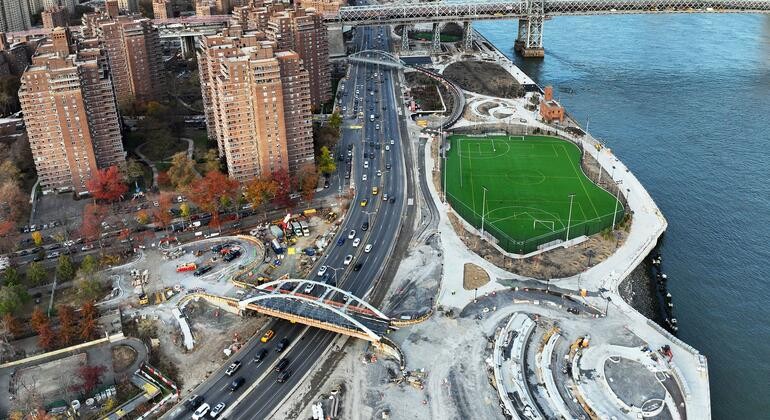
Fourteen years after Sandy, UN News visited one section of the multibillion-dollar project: the East Side Coastal Resiliency (ESCR) Project.
North of the Williamsburg Bridge, a white crane hoists buckets of fill off a barge and tips them into waiting earth movers. Load by load, the East River Park is being raised as much as 10 feet (three metres).
The park serves as one link in a chain of flood defences rising along more than three miles, or five kilometres, of Manhattan’s waterfront. Conceived after Hurricane Sandy swamped the area in 2012, the East Side Coastal Resiliency project and a smaller companion to the south represent an investment of roughly $2 billion designed to protect more than 110,000 residents.
“This whole place was inundated,” said Bobby Issac, Assistant Commissioner of Coastal Resiliency Construction at the city’s Department of Design and Construction.
During Hurricane Sandy, he recalled, at least one storey of the public housing blocks behind him was submerged, leaving residents unable to enter or leave.
Here, most of the protection is out of sight. A floodwall runs hidden through the heart of the rebuilt park. At the water’s edge, concrete-filled piles plunge about 100ft (30m) into reclaimed land that can hide anything from old piers to the remains of ships.
“What you see on the top is only a third of what is built,” Mr. Issac said.
When a storm approaches, nothing in the park needs to move. Elsewhere along the waterfront, crews will swing or slide 18 floodgates shut, and farther south nearly 100 flip-up barriers will be raised. The design also builds in about 30 inches (76 centimetres) for rising seas, he said.
He added that about 90 per cent of the system is in place, and temporary barriers can plug any gaps at a few days’ notice until work ends in 2027.
In addition to the lives lost, Sandy caused $19 billion in damage, recalled Kathryn Prybylski, New York City’s Assistant Commissioner of the Bureau of Coastal Resilience, who will operate the new walls and gates.
“These projects that are in construction now around the city are kind of a reaction to Sandy,” she said. “It’s really time for us now to look to the future.”
The wider picture adds urgency, according to the World Meteorological Organization (WMO), which reports that the rate of global sea level rise has nearly doubled since satellite measurements began in 1993, while warming oceans are fuelling more intense tropical storms.
For a city with 520 miles (840 kilometres) of coastline, the threat comes not only from the next superstorm but also from the everyday tide. Without protective measures, Ms. Prybylski warned, many New Yorkers will face regular tidal flooding in the decades ahead.
She said that regular occurrences could be as infrequent as once a month or as frequent as ten times a month in some locations, and she added that some streets could be flooded by the tide every day, changing how people travel to work and how children are sent to school.
New York is only one of the cities facing these threats.
Nearly 10 per cent of the world’s population – some 770 million people – live in coastal areas less than five metres (16.4ft) above the high tide and are thus heavily exposed, a recent UN report found.
UN Secretary-General António Guterres has warned that “mega-cities on every continent will face serious impacts” from rising seas, naming New York among them.
“[New York’s flood defence project] is a commendable step forward. It's also a message to all big cities,” Navid Hanif, from the UN’s Department of Economic and Social Affairs (DESA), told UN News .
“What New York is doing should be acknowledged, appreciated and emulated in other parts of the world,” he said.
Rising seas primarily threaten infrastructure in high‑income cities such as New York, Miami and China’s Guangzhou, while posing an existential threat to communities in low‑lying South Asian cities including Kolkata, Mumbai and Dhaka.
Over 14 million people in South Asia are at risk of losing their homes to permanent inundation.
Communities in Fiji, Vanuatu, the Solomon Islands and other low‑lying Pacific islands have already been forced to relocate.
The United Nations, headquartered less than two miles north of the ESCR, is an active partner supporting mitigation and adaptation efforts worldwide.
At a recent meeting on sea level rise, Member States adopted the UN Declaration on Sea Level Rise, the first time all Member States have agreed on a single, common text on the issue.
The Declaration notably called for more predictable and accessible funding for adaptation and resilience, especially for small islands and least developed countries.
New York’s East Side Coastal Resiliency project offers a glimpse of what such investments can mean for local communities.
East River Park, now elevated, offers strollers riverside walking paths that overlook the Brooklyn skyline, alongside well‑maintained green areas and community spaces that include sports fields, playgrounds and barbecue spots.
“We're in this park twice a day, every day. We love it! It's a beautiful example of how climate resilience can help people enjoy their lives,” said Liz, a passer-by from the neighbourhood walking her dog.
Why it matters
Rising seas threaten Dhaka and other South Asian cities, putting millions at risk of permanent displacement.