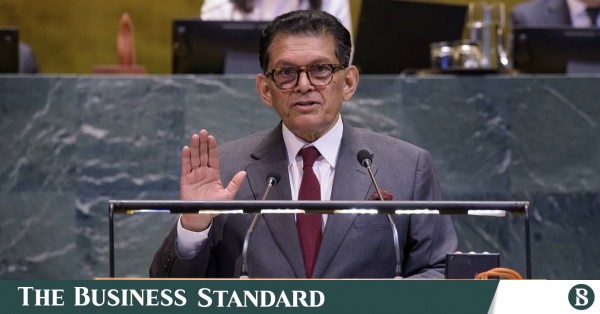
Dr. Khalilur Rahman, president of the United Nations General Assembly’s 81st session, described the Rohingya crisis as a “grave human crisis” and warned that violence will not solve any problem.
He said the lesson he carries is that “violence will not solve any problem. It will only defer it and make it worse. Only through talks and negotiation, only by coming together, we can resolve these issues.”
The president of the United Nations General Assembly described the situation as “a grave human crisis,” saying that a population is being attacked, its homes bombed, its villages burned and its people driven out by compatriots. He added that pregnant women are having their abdomens cut open and the fetuses thrown into fire.
Khalilur observed, “I also saw their resilience, their ability to survive and their yearning to go home.” He recalled that when the Secretary‑General visited Cox’s Bazar last year, more than 100,000 refugees assembled on a Ramadan evening to share breakfast with him, each holding a placard that read: “We want to go home.”
He said, “That’s why I see such value in the assembly—a place where people gather at the highest levels, in a safe environment, to work out the best way forward.”
As the high‑level week—described as the busiest period on the United Nations calendar and the largest gathering of world leaders anywhere—gets underway, Rahman recently sat down with UN News. He outlined his vision of a “much‑needed transformation,” explained why he believes artificial intelligence presents a test unlike any the UN has faced before, and noted the lessons from his work on the Rohingya crisis that he is bringing into his new role.
Bangladesh is currently sheltering more than 1.3 million Rohingya refugees in the Cox’s Bazar district and on Bhasan Char island, a senior government official told United News of Bangladesh (UNB). The official said Prime Minister Tarique Rahman will use his upcoming United Nations General Assembly address to call for renewed international attention to the protracted Rohingya crisis and to seek stronger global cooperation for its resolution.
He is due to attend a Bangladesh‑hosted side event on the Rohingya issue on 23 September, where he will call for effective international cooperation to achieve the earliest possible repatriation of the forcibly displaced Rohingya to Myanmar.
Foreign Secretary Asad Alam Siam said on Sunday that the Rohingya issue remains an “ongoing problem” and that Bangladesh will again use the gathering of world leaders to underscore its magnitude and the challenges it poses.
Siam said Bangladesh will again present to the international community the scale of the Rohingya issue, the challenges it creates and the international cooperation, assistance and support the country requires.
Bangladesh has repeatedly asserted that the only viable and lasting solution to the Rohingya crisis is the safe, voluntary, dignified and sustainable return of the refugees to Myanmar.
UN General Assembly President [Name] rebutted critics who claim the Assembly lacks power compared with a stalemated Security Council, and noted that he is speaking at a moment that comes more than four decades after he served as foreign minister during a previous Bangladeshi presidency of the Assembly – a tenure that now sees him return to lead the body himself.
He assumed the presidency of the United Nations General Assembly’s 81st session, noting that the body is confronting a crisis of confidence. The official has been associated with the UN in various capacities for 35 years.
Bangladesh’s senior diplomat, who is also serving as foreign minister, has pledged that his one‑year presidency will be devoted exclusively to rebuilding trust.
He frequently returns to this theme, linking it to the optimism that accompanied the United Nations’ founding in 1945 and highlighting the disparity between the expectations of Member States at that time and the outcomes the organization has achieved ever since.
The high‑level week of the United Nations General Assembly offers a rare chance for world leaders to articulate their perspectives on global affairs, regional issues and national priorities, as well as their expectations of the United Nations, UN General Assembly President Khalilur said.
He said that the principal focus of his presidency is “reviving trust in the organisation,” describing this as the highlight of his term. “I’ve made it my own theme, and I want to draw on their views as a guide for my work on this agenda,” he added.
Reflecting on the founding of the United Nations in 1945, Khalilur recalled the eight‑day Yalta conference where U.S. President Franklin D. Roosevelt, Soviet leader Joseph Stalin and British Prime Minister Winston Churchill met.
He said that, alongside planning the end of the Second World War, they envisioned a global organization whose primary purpose was to prevent a repeat of the conflicts that characterized the two world wars.
Recalling the formal creation of the United Nations in San Francisco, he noted that delegations gave the organization a standing ovation and remained standing for a while. That reaction represented the aspiration that the United Nations would be able to deliver peace, he said.
He stated that the world has successfully avoided a large-scale global conflagration during the eight decades that have passed since the creation of the United Nations.
"And I'm happy to say that in the eight decades since, we've avoided a large-scale global conflagration," he said.
Countries that were not present at the time of the United Nations' creation have since emerged from colonial rule and built a robust development pillar within the organization, Khalilur said.
"At the same time, we haven't prevented many conflicts, and progress on development has often been sluggish," he said.
"We have to work hard to ensure that the Security Council works more coherently and delivers as it was expected to," he added.
Khalilur stated that both the peace and development pillars carry major unmet expectations, which has contributed to frustration and a sense that the UN is not doing what people expected of it.
"That has fed declining trust," he said. Khalilur also highlighted human rights as the UN's third pillar.
Addressing human rights, which he described as the third pillar, he noted that the organisation spends only four percent of its total budget in this area. "We've made major strides, but much remains to be done," he said.
"We have to work hard along all three pillars to bring back the confidence the organization had at its creation. It's a major challenge, and it will require all member states and stakeholders to work together," Rahman said.
Regarding artificial intelligence, Khalilur stated that the technology could serve as "a great accelerator of human endeavour," while simultaneously presenting serious dangers to humanity.
"We shouldn't do anything to slow innovation - that has to continue. But it's vital that we put guardrails in place, so this innovation serves humanity rather than working against it," he stated.
Khalilur stated that the responsibility for establishing such safeguards rests not only with governments, but also with everyone involved in developing and using artificial intelligence.
"That's a job not only for governments but for everyone practically involved in developing and using the technology," he said.
"We need all of these communities to be part of the discussions and decisions ahead, so we find a safe pathway toward AI genuinely serving humanity," Khalilur stated.
Responding to questions about the relevance of the General Assembly, Rahman said its continued high-level participation demonstrates its utility.
"If the assembly were useless, there wouldn't be a high-level week, and Heads of State wouldn't come. There must be some utility," he said.
He identified the UN General Assembly’s “great convening power” as one of its key strengths, saying, “What I see is the great convening power of a body that represents the entire world – there’s no other place quite like it,” Rahman said.
Khalilur said diplomacy is not always conducted in public and that the General Assembly provides Heads of Government and Heads of State with a safe environment to discuss serious issues together and find ways to resolve them.
"It's also an authoritative way of hearing directly from those governing our societies," he said.
"I believe the assembly will continue to play an important role in setting norms and giving overall direction to the work of the international community," he added.
The president of the UN General Assembly said he remains focused on both the immediate priorities of his term and what he can achieve before passing the gavel to his successor.
He said, "This is what I told my team today - I'm not looking at today. I am looking at the day when I'm handing over the gavel to my successor."
He identified three areas where progress would be important: helping member states agree on necessary reform of the organisation, keeping the UN financially solvent and speeding up delivery at the local level.
"If I can help Member States agree on necessary reform of the organisation, agree to keep it financially solvent and agree to speed up delivery at the local level - if I have some movement on any of these, I'll happily hand over my gavel to my successor," Khalilur said.
Why it matters
The statement by the UNGA president highlights Bangladesh's ongoing diplomatic efforts to mobilize international support for the sustainable repatriation of over 1.3 million Rohingya refugees.