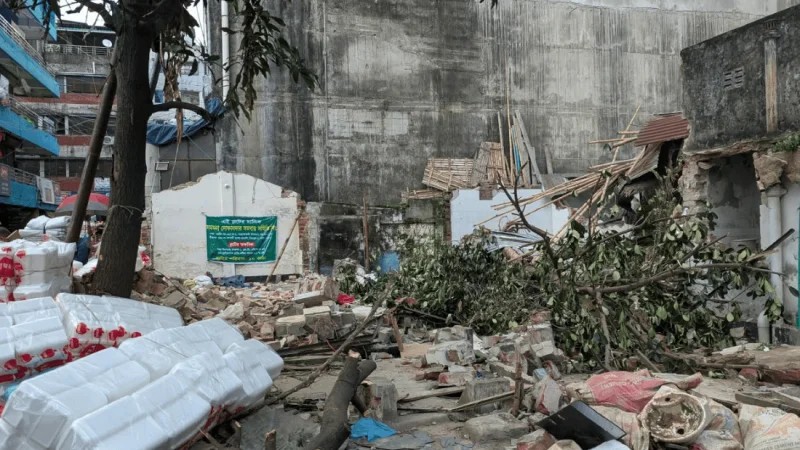
Although their political ideologies diverge, activists from opposing parties appear to converge on matters such as land grabbing, extortion, attacks, vandalism and looting.
Recent incidents have underscored the pattern, with police and intelligence agencies reporting that activists linked to the Bangladesh Nationalist Party (BNP), Jamaat‑e‑Islami and even the Awami League were involved.
Police and intelligence officials said they uncovered evidence of political connections among the alleged masterminds, patrons and several suspects detained in connection with the attacks on the Radda MCH‑FP Centre in Mirpur‑1 and on content creator Salman Muqtadir’s studio.
Both incidents have attracted considerable attention in Dhaka in recent weeks.
Thirty-eight citizens issued a statement condemning the incidents. Social and crime experts attributed the events to the recent political transition, the deployment of muscle power under party banners and a broader deterioration of law and order.
They asserted that the government could not evade responsibility and urged that the individuals involved, together with their patrons, be brought to justice.
Meanwhile, Transparency International Bangladesh (TIB) has strongly condemned the armed attack and attempted murder of media workers at Rajshahi University.
The anti-graft watchdog called for the perpetrators to be brought to justice regardless of their political affiliations or influence.
In a statement released on Monday, TIB urged both the ruling BNP and the opposition Jamaat‑e‑Islami to adopt effective measures to prevent violent activities by their parties and affiliated organisations.
TIB Executive Director Dr Iftekharuzzaman stated that justice must be ensured for the journalists and students who were targeted in attacks.
He said that attackers, their associates and patrons must be held accountable through impartial investigations, irrespective of their political identity or influence.
Bangladesh Nationalist Party (BNP) reserved‑seat lawmaker Ferdousi Ahmed Misty and former BNP leader Md Hanif Mia have been accused of patronising and masterminding the attack on the Radda MCH‑FP Centre.
Ferdousi Ahmed Misty has resigned from Parliament after receiving a directive from Bangladesh Nationalist Party (BNP) chairman Tarique Rahman. The resignation follows the recent expulsion of 14 BNP and affiliated‑organisation leaders and activists.
The party’s expulsion notices did not explicitly reference the Radda attack, instead citing alleged breaches of party discipline and unethical conduct. Nevertheless, several party insiders said the expulsions were motivated by the assault on the health centre.
Six BNP and affiliated organisation leaders and activists have been arrested over the attack.
Local political sources said the individuals arrested include Saiful Islam Khokon, 48, a member of the Bangladesh Nationalist Party in Shah Ali thana, and Md Alam, 53, president of Ward 8 of the Shah Ali thana Sramik Dal.
Nur Alam, who had been expelled from his role as president of the Shah Ali Thana Jubo Dal, was taken into custody. He was removed from the post four years earlier on accusations of breaching party discipline and extortion.
Among those taken into custody are Rakib Ahmed, a former joint convener of Shah Ali Thana Jubo Dal; Sarwar Alam, vice‑president of Dhaka Metropolitan West Chhatra Dal; and Sazzad Hossain Mishu, a former member of the founding committee of Shah Ali Thana Chhatra Dal.
Police said that Sazzad also identifies himself as vice‑president of the Dhaka district unit of the Jatiyatabadi Cyber Dal, and that Sarwar has been expelled from the party.
Police have also identified links between the assault on Salman Muqtadir’s studio and a former Chhatra League activist, as well as members of Jamaat.
Police, together with the Detective Branch (DB), have detained several individuals in connection with the attack on the content creator’s studio and the New Guinea Properties bhaban.
Among those taken into custody is 59‑year‑old Mizanur Rahman, the son‑in‑law of the member of parliament representing Kushtia‑2, who has been listed as an accused in the case.
Another suspect, Shah Alam Anik, is a former Chhatra League and Jubo League activist and serves as a joint convener of the Muktijoddha Projonmo League.
During a recent monthly crime‑review meeting at Police Headquarters, Inspector General of Police Md Ali Hossain Fakir said that an offender’s political affiliation or party identity would not be taken into account in investigations.
“An offender’s only identity is that of a criminal,” he said.
Bangladesh Police chief Shafiqul Islam told the Dhaka Tribune that a significant number of people detained in connection with recent attacks and looting in the capital have political affiliations.
He said, “They were arrested after their information was verified and preliminary evidence was found linking them to the incidents.”
He said police had clear instructions not to consider political affiliations in criminal investigations.
“If anyone commits a crime and the investigation finds evidence against them, we do not consider their party identity. Whoever they are, they will be brought to justice if the allegations are proved. No one will be allowed to get away with crime,” he said.
Advocate Syed Moazzem Hossain Alal, adviser to the Bangladesh Nationalist Party chairman, said that both the prime minister and the BNP chairman have repeatedly warned party leaders and activists against committing crimes in the party’s name since the BNP returned to power.
He warned that there would be no leniency for anyone who commits a crime under the party banner, stating, “There will be no leniency if anyone commits a crime under the party banner,” he said.
Alal said taking action against party members accused of wrongdoing was not a new practice for the BNP.
“It has a long history. In the past, action was also taken against party leaders and ministers when allegations were raised against them,” he said.
Commenting on the proceedings against a reserved‑seat lawmaker, Alal said she had made significant sacrifices for the BNP but was nevertheless instructed to resign and held accountable for the allegations against her.
Jamaat‑e‑Islami Secretary General Mia Golam Parwar told the Dhaka Tribune that offences may encompass breaches of social, legal, moral or party regulations.
The official stated that the constitution provides for action against individuals who commit offences, with measures varying according to the nature of the crime. “No one will be spared if they commit a crime by using their party position or identity. Punishment is inevitable,” he said.
Thirty-eight citizens have issued a statement condemning the recent attacks, vandalism and looting.
They called for impartial, high-level investigations to identify those directly involved as well as the groups and patrons behind the incidents and bring them to justice.
In the statement, civil society representatives said that political and muscle power were being used across different parts of the country to grab land, attack homes, and occupy khas land in riverine areas.
Such incidents, they stated, were generating fear and anxiety among the public while also contributing to a deteriorating law and order situation.
Dr Touhidul Haque, a social and crime expert and teacher at the University of Dhaka, told the Dhaka Tribune that the recent political transition, the use of muscle power under party banners, and the deterioration of law and order had contributed to such incidents.
“The government cannot evade responsibility in any way,” he said.
He said that political activists from various parties were found to have been involved in the attacks on the Radda MCH-FP Centre and the Salman Muqtadir studio, adding that several suspects had already been arrested.
“In most major organised crimes in the country, political leaders and top criminals work together,” he said.
He stated that the political landscape had changed and that the absence of several influential figures from the country had created opportunities for others to attack properties, engage in gunfire, vandalism, and looting, and attempt to seize assets.
“These incidents show that the rule of law is weak and law enforcement agencies are inactive, which is a matter of serious concern,” he said.
“Therefore, the solution must come from political leaders themselves.”
Why it matters
The involvement of political activists in organized crimes and attacks in Dhaka highlights a serious challenge to the rule of law and public safety during the ongoing political transition.