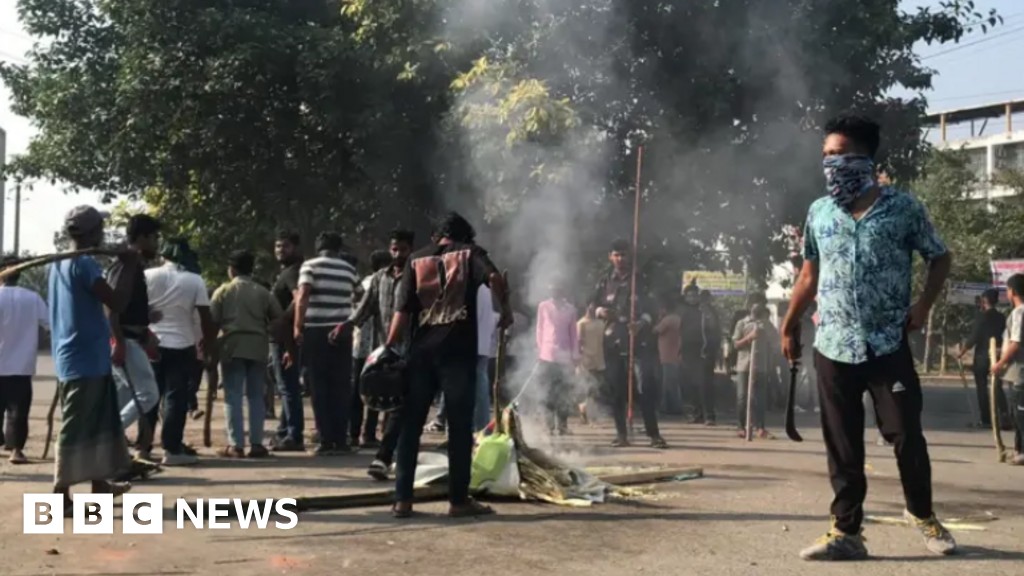
Police in Bangladesh fired tear gas and rubber bullets to disperse supporters of the deposed Prime Minister Sheikh Hasina. The demonstrators were demanding her return to the country.
In the Gopalganj district, a police vehicle was set on fire as security forces clashed with the banned student wing of the Awami League party, which is led by Hasina.
Nationwide protests by pro-Hasina activists began a day after the former leader announced she had requested a passport to return to Bangladesh from her exile in India.
Demonstrations by the student wing, known as the Bangladesh Chhatra League (BCL), are regarded as the initial organized show of force by supporters of Hasina since her ouster in August 2024 following a massive uprising against her administration.
Traffic was disrupted in some parts of the country as protesters tried to set up roadblocks using burning tyres.
Several passenger vehicles were also set on fire in various parts of Bangladesh in the run up to the protest.
Early on Tuesday, a 60-year-old passenger bus driver was killed by smoke inhalation after individuals set fire to the vehicle in the city of Faridpur.
Elsewhere, approximately 200 protesters briefly blocked traffic on the 6.2km (4-mile)-long Padma bridge across the Ganges, which connects the capital Dhaka with the south-western region.
Bangladeshi local media reported that dozens of crude bombs have exploded over the past few days in Dhaka and other locations.
Bangladesh Home Minister Salahuddin Ahmed stated that any attempt to deteriorate the law-and-order situation or create instability through conspiracies originating from across the border in India will not be allowed to succeed.
"Our supporters were not responsible for the violent incidents. They were carried out by unknown miscreants. We believe in peaceful protests," said a senior leader of the BCL, who is currently in exile in a foreign country.
Hasina fled to neighbouring India two years ago following a massive uprising, bringing an end to her 15-year reign.
Opposition parties accused Hasina of jailing political rivals, suppressing dissent and overseeing widespread human rights abuses. She consistently denied the charges.
The United Nations has estimated that up to 1,400 people were killed, with the majority dying from gunfire by security forces, during anti-government protests in 2024.
The activities of the Awami League were banned shortly after she fled the country, and the party was not permitted to participate in the February general election.
Last year, a special Bangladeshi tribunal sentenced her to death in absentia after finding her guilty of crimes against humanity.
She has denied all the charges, calling the trial "biased and politically motivated".
Despite facing the threat of the death penalty, Hasina stated that she wanted to return to Bangladesh in December and requested the Bangladesh High Commission in New Delhi to issue her a passport.
However, the Bangladeshi government stated that the country would not provide a passport to her, labeling her as "a terrorist."
"She is a fugitive criminal. We have an active extradition treaty with India. We want her handed over," said Humaiun Kobir, Bangladesh's junior foreign affairs minister.
"Should we treat her like an ordinary commercial traveller and tell her to come and visit her in-laws' residence?" Kobir asked.
A state prosecutor in Bangladesh stated on Tuesday that the verdict would be executed if she returned, noting that she had missed the opportunity to appeal.
Awami League leaders allege that over the past two years, hundreds of supporters have been killed in mob violence and dozens have died in the custody of security forces.
Dhaka officials reject accusations that Awami League supporters are being systematically targeted.
Why it matters
The article documents a major political crisis in Bangladesh, highlighting the government's refusal to grant a passport to the former prime minister and the violent response by security forces.