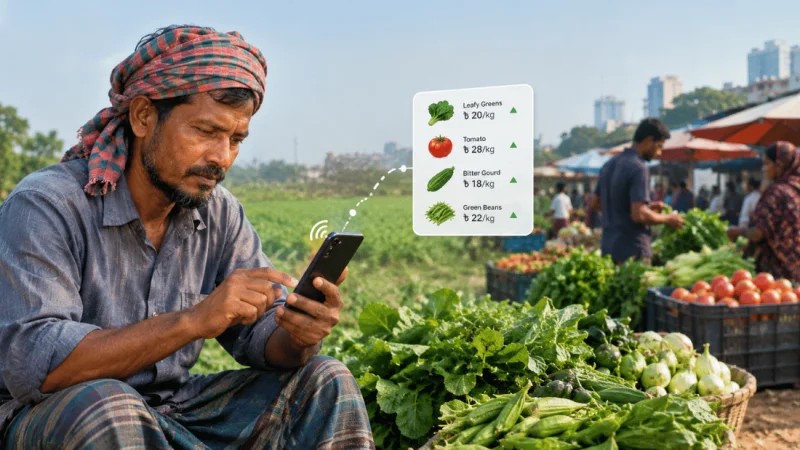
Mobile phones have enabled rural vegetable growers to know the price of their produce in city markets. Farmers and small traders at the northern trading hub of Mohasthan, Bogra, report that they now arrive at the market with a realistic understanding of prices.
Mobile phones have enabled the free flow of information regarding commodity prices. Producers report that this development has strengthened their bargaining power, although prices ultimately continue to depend on supply and demand.
Studies cited in development literature indicate that mobile connectivity significantly lowers the cost of searching for information. Currently, vegetable growers frequently utilize voice calls and SMS services to get in touch with buyers prior to harvesting.
Md Aminul Islam, a 36-year-old farmer from Rahmotbala village in Bogra Sadar upazila, has cultivated radish, gourd, pumpkin, and yard-long bean on one acre of land. On October 2, he brought radish to the Mohasthan vegetable market. "I knew the price of each maund (40 kilograms) was about Tk 1,000 three days ago, but today it has fallen to Tk 500-600 per maund. This is because of higher supply, and because the quality of this vegetable is sometimes not good when grown in hot weather," he explained. "Farmers cannot unite to fix the price. Farmers and traders have mobile phones, so both can get information about supply and demand."
Rabbi Molla, 25, from Utholi in Shibganj, cultivated an early variety of cauliflower on approximately 50 decimals of land. He stated that farmers and traders gauge likely vegetable prices prior to harvest through discussions with one another.
"I sold some cauliflowers from the field. I come here (to Mohasthan) hoping for a higher price. Prices go up, prices go down. When the demand for vegetables in Dhaka or other cities increases, that is when wholesalers and traders offer us better prices," Molla pointed out.
Observing the pricing situation, numerous paikars (traders) purchase seasonal vegetables directly from farmers to supply Mohasthan-based arotdars (wholesalers), who subsequently distribute the commodities in bulk to counterparts in Dhaka and other cities. Highlighting the market's unpredictability, 27-year-old trader Masum Islam from Bichok, Shibganj, stated, "I bought bitter gourd for Tk 1,600 per maund from farmers today, expecting to sell at Tk 1,800. I am struggling to get it because we don't know the exact price in advance."
Wholesalers at Mohasthan purchase vegetables based on orders from city wholesalers and current supply levels. Cucumbers, aubergines, sponge gourds, pumpkins, yard-long beans, and olives are currently abundant.
Abdul Hamid Pramanik (48) of Lahiripara, Bogra, who has worked in the wholesale market for about a decade, said, "The higher the supply, the higher the profitability for us. But when there is higher demand in Dhaka, the farmers also ask higher prices. Everybody keeps track of demand and supply, via phone or Facebook. Farmers now get a share of any price-hike."
The Mohasthan trading hub, which supplies vegetables to various cities, accommodates about 200 traders and 70 wholesalers who own trading houses known as arots. Al-Mamun, 40, owns one such trading house called Maisha Traders. He observed that the use of mobile phones by farmers and small traders has revolutionized farming while ensuring farmers receive a fair price. "This has increased the competition in the business," he added, noting that "You no longer see a huge difference between the price paid at the farm and the wholesale price. Of course any price-hike affects consumers, but farmers benefit."
Hefzul Bari Fakir, a 40-year-old representative of the Bishal Bhandar wholesale trading house in Mirpur, Dhaka, was at Mohasthan. He explained that he receives orders with likely prices from Dhaka via mobile phone, purchases vegetables from farmers and small traders, and transports them to Dhaka. "Farmers have access to market information, and try to sell to whoever offers them a better price," he said, adding that "if production falls, or if there is a problem in communication, vegetable prices go up."
Vegetables are perishable and spoil quickly, with experts estimating that 30% of harvested vegetables spoil before reaching consumers. Because farmers and traders can now obtain price information quickly, this should help them sell their produce faster. It is hoped that this will reduce spoilage.
Why it matters
Real-time mobile connectivity improves market transparency and bargaining power for rural farmers in Bangladesh, bridging the gap between agricultural producers and urban consumers.