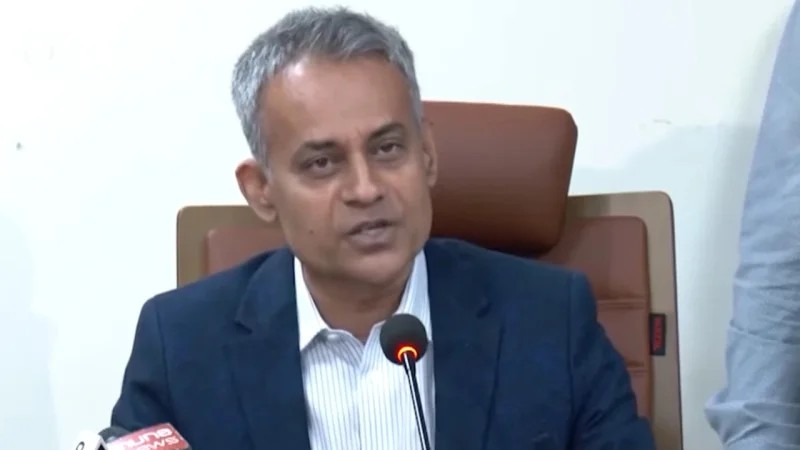
Shipping Minister Shaikh Rabiul Alam stated on Thursday that the 15-year concession agreement between the Chittagong Port Authority (CPA) and Dubai-based global port operator DP World incorporates robust financial and operational safeguards designed to protect the national and economic interests of Bangladesh.
He stated that the agreement, signed for the operation, management, and modernization of the New Mooring Container Terminal (NCT), will ensure substantial financial returns for Bangladesh while attracting fresh foreign investment, advanced technology, and world-class terminal management.
"The agreement has been finalized keeping Bangladesh's interests at the highest priority," the minister said at a press briefing following the signing ceremony in Dhaka.
The minister stated that the agreement represents a major shift toward modern, technology-driven port management, while emphasizing that it does not compromise Bangladesh's ownership, sovereignty, or control over Chittagong Port.
Under the agreement, DP World will operate and manage NCT and undertake its modernization for an initial period of 15 years.
The deal provides Bangladesh with $50 million, equivalent to approximately Tk600 crore, as upfront signing money against the existing terminal equipment.
A total of 25% of the amount will be paid at the time of signing, while the remaining 75% will be paid before the physical handover of the terminal.
He stated that DP World has committed $150 million, which is approximately Tk1,800 crore, in fresh investment to modernize NCT.
The investment will be used for the replacement and upgrading of terminal equipment, yard rearrangement, digital integration, automation, and the introduction of modern terminal operating systems.
The minister stated that the new foreign investment would alleviate pressure on the government to fund the modernization of the terminal, while simultaneously enabling Bangladesh to leverage DP World's international operational expertise.
A major safeguard in the concession agreement is the continued financial participation of Bangladesh in terminal operations.
Under the terms of the agreement, the CPA and the government will retain approximately 40% to 67% per twenty-foot equivalent unit (TEU). DP World will receive the remaining share in accordance with the contractual terms.
Based on a standard handling charge of approximately $140 to $150 per twenty-foot equivalent unit (TEU), Bangladesh's share is estimated to be around $93 per TEU.
In addition, the CPA will receive a guaranteed minimum annual payment of Tk10 crore, regardless of the volume of containers handled.
The minister stated that these provisions would guarantee that Bangladesh does not solely benefit from the initial one-time investment, but instead continues to generate substantial revenue over the entire course of the concession period.
The agreement also includes a specific mechanism designed to safeguard the revenue of the CPA if container traffic is distributed across different terminals in the future.
A volume and revenue protection mechanism has been incorporated based on the existing annual container-handling level of NCT, which stands at approximately 1.23 million TEUs.
The mechanism is designed to protect the financial position of the CPA even after other terminals, including Laldia, Patenga and additional facilities, become operational and competition for container traffic increases.
The minister stated that the provision was particularly important because Bangladesh's port sector is entering a new phase in which several modern terminals will operate simultaneously.
The agreement is expected to significantly improve NCT's handling capacity.
The terminal currently handles approximately 1.23 million TEUs annually, while modernization is expected to raise its capacity to between 1.6 million and 1.8 million TEUs.
This additional capacity will help Bangladesh handle growing import and export volumes and reduce pressure on the country's principal maritime gateway.
The minister stated that enhanced terminal efficiency would ultimately help lower logistics costs and boost the competitiveness of Bangladeshi exporters and importers.
The agreement contains specific operational targets for improving efficiency.
Truck waiting times at the port, which currently stand at approximately 24 hours, are targeted to be reduced to two hours within the first year, 1.5 hours in the second year, and one hour by the third year.
Similarly, vessel turnaround time is expected to decrease from the current two to three days to approximately one to one and a half days.
The terminal will also introduce measures to reduce container dwell time, enabling importers and exporters to receive and dispatch cargo more quickly.
The agreement targets international-standard operational efficiency of around 93%.
Another major component of the modernization programme is digital transformation.
The NCT will move towards paperless terminal operations, with real-time digital tracking of vessels, containers and cargo.
The minister stated that automation would decrease unnecessary manual intervention, enhance transparency, and render cargo handling faster and more predictable.
Digital integration with relevant government systems, including revenue and Customs-related processes, is expected to reduce delays and create greater accountability in the movement and clearance of containers.
The shipping minister strongly rejected any suggestion that the agreement amounted to leasing out Chittagong Port.
"Port leasing and container terminal handling are not the same thing," he said.
He explained that the concession concerns solely the operation and management of NCT, while 100% ownership of the port territory remains with Bangladesh.
Overall harbour management, national security, Customs administration, National Board of Revenue (NBR) revenue collection, intelligence, and other sovereign responsibilities will also remain under the Bangladesh government and the Chittagong Port Authority (CPA).
The minister stated that the arrangement follows the internationally recognized Landlord Port Model, under which port authorities maintain ownership and regulatory control while specialized private or international operators manage individual terminals.
He said a large majority of major container ports around the world operate under similar arrangements.
The government has also incorporated safeguards for existing port workers into the arrangement.
The minister said no port officer or dockworker would lose his or her job because of the concession.
The existing workforce and their gross salary structures have been taken into consideration in the agreement, while modernization is expected to create opportunities for workers to acquire new technical skills.
Increased container handling and the expansion of related logistics activities are also expected to generate additional employment opportunities in transport, warehousing, freight forwarding, and other supporting sectors.
The physical takeover and modernization process is anticipated to be finished within six months, a timeline that encompasses equipment installation, yard rearrangement, and digital integration.
The terminal is expected to reach full operational capacity within two years.
The initial concession period is 15 years, with the possibility of a further 15-year extension only through mutual written agreement between CPA and DP World.
If either party does not agree to an extension, the concession will automatically end at the completion of the initial 15-year term.
The minister stated that the final agreement was reached following approximately six months of intensive negotiations. These talks were led by the Ministry of Shipping, Invest Bangladesh Executive Chairman Chowdhury Ashik Mahmud Bin Harun, a specialized negotiating team, and international legal experts.
He said the government had focused particularly on securing Bangladesh's financial returns, protecting the authority's revenue, ensuring continued sovereign control and safeguarding the interests of port workers.
The minister stated that while previous efforts to introduce international operators to the country's port sector had faced prolonged difficulties, the current negotiations successfully produced a commercially viable arrangement while preserving Bangladesh's key interests.
The NCT agreement also marks another significant step in Bangladesh's efforts to bring leading international terminal operators into its maritime sector.
The minister stated that global operators including DP World, APM Terminals, and PSA are now getting involved in the port infrastructure of Bangladesh.
DP World, an operator of container terminals in major international markets, is expected to bring advanced equipment, modern terminal management practices, and global shipping-line connections to NCT.
The government believes that involving internationally experienced operators will boost the confidence of global shipping lines and help integrate Chittagong Port more closely with international maritime networks.
The minister stated that the modernization of the NCT would have implications extending beyond the port itself. He noted that faster cargo handling alongside reduced waiting times for vessels and trucks would enhance the overall efficiency of Bangladesh's trade logistics.
For an import-dependent economy and major garment-exporting country, reducing port-related delays is crucial for lowering business costs, improving delivery reliability, and strengthening export competitiveness, he said.
The government expects the modernization to help Chittagong evolve into a more efficient regional maritime hub while ensuring that the economic benefits of the terminal remain substantially with Bangladesh.
Addressing concerns raised by some trade union leaders and other stakeholders, the minister stated that the government views open debate as a normal feature of democracy.
He stated that the Ministry of Shipping remains open to discussions with workers' representatives and other stakeholders in order to clarify the agreement and address their concerns.
"We believe in discussion and engagement," he said, adding that all relevant Bangladeshi port and maritime laws would remain fully effective.
The minister stated that the government's aim was not merely to transfer terminal operations to a foreign operator, but to establish a framework in which Bangladesh maintains ownership and sovereign control. He added that this approach would secure substantial financial returns, attract new foreign investment, and acquire modern technology and management expertise.
He described the agreement as a strategic partnership aimed at transforming NCT into a more efficient and internationally competitive terminal while keeping Bangladesh's interests firmly protected.
Why it matters
The concession agreement secures multi-million dollar foreign investment and modernizes Bangladesh's primary maritime gateway while retaining sovereign port ownership and revenue shares.