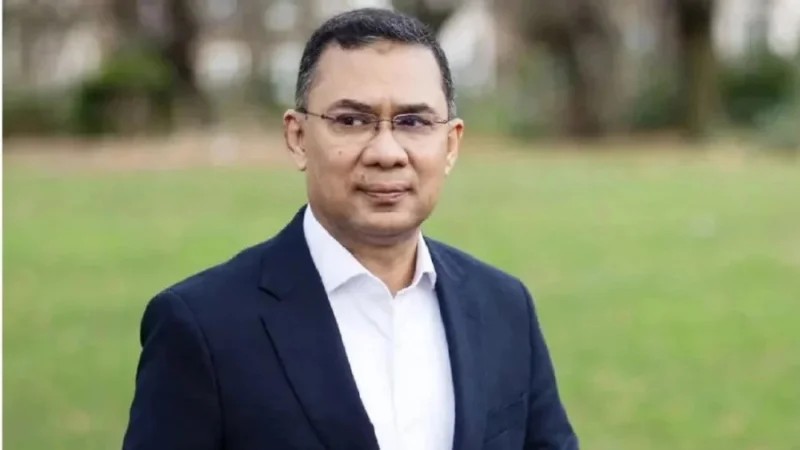
Prime Minister Tarique Rahman landed in Dubai on Saturday, returning home after concluding a five‑day trip to New York to take part in the 81st United Nations General Assembly. At the assembly he outlined Bangladesh’s stance on global peace, climate change, the Rohingya crisis and other matters of international concern.
An Emirates aircraft carrying the prime minister, his wife Dr Zubaida Rahman and members of his entourage landed at Dubai International Airport at 20:23 local time, Deputy Press Secretary Hasan Shiplu told Bangladesh’s state news agency BSS.
He is scheduled to depart Dubai for Dhaka on Emirates flight EK582 at 02:00 on Sunday, with an expected arrival at Hazrat Shahjalal International Airport at 08:40 the same day.
The prime minister departed New York on Friday (local time) after delivering his inaugural speech at the General Debate of the 81st United Nations General Assembly. He concluded a full schedule of bilateral and high‑level meetings with world leaders, UN officials, development partners and representatives of international organisations.
During a four‑day program in New York, Tarique Rahman held 30 official engagements, including bilateral meetings with officials from 11 countries, Prime Minister’s Adviser and PMO spokesperson Mahdi Amin said at a press briefing held before the prime minister’s departure.
The engagements were directed toward Bangladesh’s national interests, covering trade and investment, manpower exports, energy security, regional cooperation, the Rohingya crisis, health, climate change and international peace.
The prime minister participated in eight UNGA‑related engagements, attended four high‑level events on the sidelines of the General Assembly and held 11 bilateral meetings, in addition to meetings with international organisations and prominent personalities, Mahdi said.
Speaking at the United Nations General Assembly, Tarique Rahman reiterated Bangladesh’s commitment to global humanity and world peace, urging that disputes be settled through dialogue, diplomacy and mutual cooperation.
He pledged to create a prosperous, self‑reliant, welfare‑oriented democratic Bangladesh, promising political and economic empowerment and equal opportunities for all, and presented the government’s three‑R strategy—Recovery, Restoration and Reconstruction.
The prime minister highlighted the Rohingya crisis to the international community, urging safe, voluntary and dignified repatriation and calling for stronger international cooperation.
During his visit, he met with United Nations Secretary‑General’s Special Envoy on Myanmar, Julie Bishop, and UN High Commissioner for Refugees Barham Salih to discuss the issue.
Bishop and the prime minister said that international cooperation is essential to achieve a dignified return and a sustainable solution. Salih likewise urged continued global collaboration and commended Bangladesh for its humanitarian role.
Tarique Rahman also met United Nations Secretary‑General António Guterres, who, Mahdi Amin reported, thanked Bangladesh for sheltering Rohingya refugees, contributing troops to UN peacekeeping missions, and praised the country's efforts in climate resilience and multilateral affairs.
The prime minister held bilateral talks with Turkish President Recep Tayyip Erdogan, Bhutanese Prime Minister Dasho Tshering Tobgay, Maldives Vice‑President Uz Hussain Mohamed Latheef, Haitian Prime Minister Alix Didier Fils‑Aim, Croatian Prime Minister Andrej Plenkovic and Pakistani Prime Minister Muhammad Shehbaz Sharif.
In talks with Turkish President Recep Tayyip Erdogan, the Bangladeshi leader discussed expanding Bangladesh‑Turkey trade and investment and diversifying economic cooperation. He also met the leaders of Bhutan and the Maldives to strengthen bilateral relations and broaden cooperation, and held a separate meeting with Haiti’s prime minister that covered bilateral ties as well as regional and international collaboration.
The prime minister met with World Bank Group President Ajay Banga to discuss Bangladesh’s development priorities and its economic progress, emphasizing the need to deepen cooperation with the World Bank and to explore new areas of partnership.
The prime minister urged collective global action on climate change during the “Climate Action and the Just Transition” meeting. He later identified four urgent actions needed to confront sea‑level rise: faster emission cuts, accessible adaptation finance, wider access to climate‑smart technologies and stronger international cooperation.
Speaking at a high‑level event on maternal, newborn health and midwifery, he said his government will pursue a “Healthy Bangladesh” strategy centred on primary health care. The plan calls for the recruitment of an additional 100,000 health workers and 25,000 professional midwives.
The prime minister’s economic agenda also featured a meeting with Gates Foundation chief executive Mark Suzman to discuss public health and the modernization of healthcare, alongside talks with international philanthropic and humanitarian organisations on humanitarian challenges, climate change, sustainable development and economic partnership.
Before leaving New York, Tarique Rahman attended a breakfast meeting with top Wall Street investors hosted by JPMorgan Chase, where investment opportunities in different sectors of Bangladesh and ways to increase investment were discussed.
He also held a meeting with the president of the International Peace Institute, where Bangladesh's return to democratic rule was welcomed and its role in promoting global peace was discussed.
On Friday, the prime minister also held bilateral meetings with the Crown Prince of Kuwait, the Saudi foreign minister, and the deputy prime minister and foreign minister of the United Arab Emirates.
The three countries invited Prime Minister Tarique Rahman to visit their respective countries, while the meetings discussed protecting the interests of Bangladeshi workers, increasing manpower exports, energy security, cooperation in the mineral sector and increasing investment in Bangladesh.
Biman Bangladesh Airlines also signed an agreement to purchase 11 Boeing aircraft during the visit as Bangladesh moves to expand its aviation sector and open new international routes.
Prime Minister's wife Dr Zubaida Rahman also took part in eight high-level engagements during the visit, delivering remarks at four of them, including the UN General Assembly's Platform of Women Leaders, the First Spouses' Dialogue and a high-level event on maternal and child health and midwifery.
Why it matters
The visit marked Bangladesh's re-engagement with global multilateral forums and advanced its diplomatic, economic and humanitarian agenda on the world stage.