Indian High Commissioner to Bangladesh Dinesh Trivedi said that India had “hardly any choice” but to permit the aircraft carrying Prime Minister Sheikh Hasina to land in the country in August 2024. He added that the legal proceedings regarding her return to Bangladesh are currently under way.
Trivedi said there is a process, that it involves legality and is very structured, when asked about Hasina’s repatriation.
The process is ongoing and the courts are involved, meaning that no one can provide a time frame, the source said.
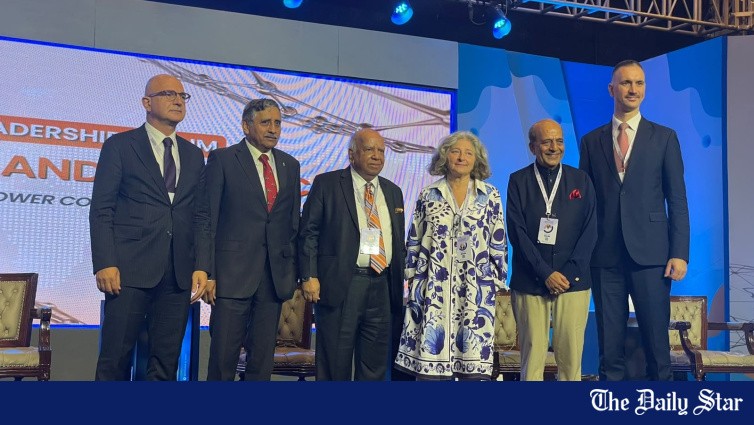
He addressed a panel titled “Power and Prudence” at the Bay of Bengal Conversation 2026, held at the Pan Pacific Sonargaon hotel in Dhaka. The three‑day conference, organized by the Centre for Governance Studies, opened today.
When asked about the circumstances of Hasina’s arrival in India after her government collapsed in August 2024, Trivedi said that India had neither invited her nor been prepared for her visit.
“Hasina Ji was not brought to India by Indian Air Force or Indian Army,” he said.
He stated that the military aircraft carrying her arrived in India amid what he described as “tragic circumstances” in Bangladesh.
He said, “At that point in time, Hasina Ji remained the prime minister of Bangladesh. We had little choice in the matter. As a neighbouring country, it was our duty to accept the reality of the situation.”
Bangladesh has formally requested the extradition of Prime Minister Sheikh Hasina from India. New Delhi has said the request is under review through established legal and judicial procedures, but it has not yet issued a final decision.
Trivedi also stressed the broader relationship between the two countries, saying it extended beyond transactional interests.
He said the Bangladesh‑India relationship is “more than transactional, it is cultural,” adding that “a good neighbour always comes out in support of each other.”
Regarding regional security, he stated that Bangladesh is an independent and sovereign nation that is fully capable of evaluating its own security interests.
He said that India has “full confidence” in the people of Bangladesh and in the trust that underpins relations between the two countries.
He said that the trust and faith shared between the two nations, and the bond that exists, make India and Bangladesh a very, very special relationship.
During the same session, Major General (Ret.) ANM Muniruzzaman, president of the Bangladesh Institute of Peace and Security Studies, characterized Bangladesh as an “aspiring middle power” amid intensifying geopolitical competition.
He said that, amid an increasingly fragmented world marked by geopolitical contestation, Bangladesh, as an aspiring middle power, serves as a stabiliser.
Describing the nation's strategic position, it was stated that “Bangladesh is a connector nation providing a critical link between South and Southeast Asia.”
Mustafa Osman Turan, the foreign‑relations adviser to the mayor of Istanbul Metropolitan Municipality, explained that strategic autonomy entails the capacity to make independent decisions in pursuit of the city’s strategic interests.
The discussion focused on strategic autonomy, regional security and emerging geopolitical complexities in the region.
Why it matters
The statement underscores the diplomatic complexities of Bangladesh’s leadership return and its impact on India‑Bangladesh relations.