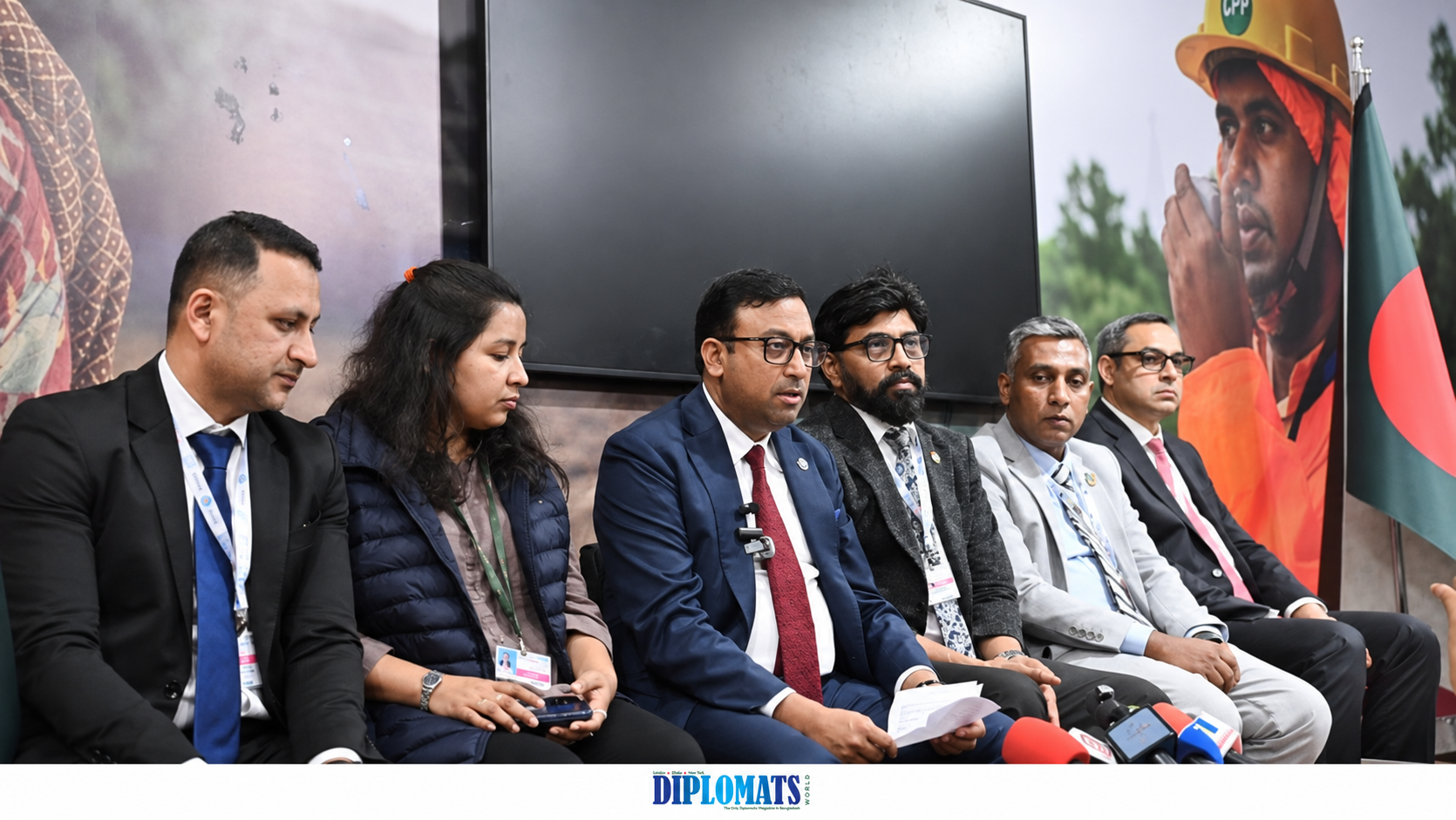
State Minister for Foreign Affairs Humaiun Kobir said yesterday that world leaders view Prime Minister Tarique Rahman as a “transformative leader” following Bangladesh’s democratic transition.
He said that leaders of various countries described the Prime Minister as a “transformative leader” during courtesy calls and bilateral meetings. He added that these leaders are taking the Prime Minister’s democratic mandate seriously as he governs a population of roughly 180 to 200 million.
Speaking to reporters at the Bangladesh pavilion on the evening of the 31st UN Climate Change Conference (COP31), the state minister said the prime minister’s leadership had attracted strong interest from the world leaders he met the previous day.
The prime minister took part in the opening and plenary sessions of the World Leaders’ Summit on the day, held courtesy calls with several world leaders and representatives of international organisations, and conducted bilateral meetings with Uzbek President Shavkat Mirziyoyev and Chinese Vice President Han Zheng.
Courtesy calls were made with the presidents of Brazil, the Maldives, Iran, Syria and Somalia; the prime ministers of Moldova, Pakistan and Kuwait; the Secretary‑General of the Organisation of Islamic Cooperation; the Mayor of London; and the President of the Zero Waste Foundation.
The prime minister also greeted members of the Indonesian delegation, including its head, Hashim Djojohadikusumo. He later held a courtesy meeting with the Indonesian leader on the sidelines of the summit.
Humaiun Kobir described the meetings as cordial, noting that the leaders congratulated the Prime Minister on Bangladesh’s democratic transition and his electoral mandate, and voiced a desire to deepen bilateral ties and cooperate on international issues.
He said the prime minister had invited the President of Brazil to visit Bangladesh, and the President of the Maldives also expressed interest in a near‑future visit. Syrian President Ahmed al‑Sharaa asked Bangladesh for cooperation in reconstruction, investment, skilled manpower and employment.
Talks with Pakistani Prime Minister Shehbaz Sharif covered regional stability, the Middle East situation and other issues of mutual interest.
In a separate meeting, Kuwait Prime Minister Sheikh Ahmad Abdullah Al‑Ahmad Al‑Sabah focused on the long‑standing friendly ties between the two countries and on strengthening investment and economic partnership.
Bangladesh reiterated its firm position on Palestine during talks with the Secretary‑General of the Organisation of Islamic Cooperation, with Dhaka confirming its continued support for a two‑state solution.
During a meeting with Uzbek President Shavkat Mirziyoyev, the two leaders discussed launching direct flights, easing visa procedures and expanding bilateral ties. President Mirziyoyev invited the Bangladeshi Prime Minister to visit Uzbekistan, and the Prime Minister pledged to make the trip in the new year.
In separate talks with Chinese Vice President Han Zheng, Humaiun Kobir said the parties discussed strengthening political and economic relations with China, one of Bangladesh’s key development partners, stressing the need for greater Chinese investment in energy, heavy industry, job creation and infrastructure.
He said that Chinese investment in promising projects—including a floating LNG terminal (FSRU) in the energy sector—was also discussed.
Discussions also covered the prospect of establishing a regional economic corridor linking Bangladesh, China and Myanmar, alongside China’s cooperation in addressing the Rohingya crisis. Humaiun Kobir said Bangladesh expects Chinese support for resolving the Rohingya crisis, adding that a sustainable solution requires an integrated international effort together with bilateral and multilateral initiatives.
The prime minister described his meeting with Turkish President Recep Tayyip Erdogan on Tuesday as “highly fruitful.” The two leaders discussed political relations, mutual cooperation and a range of international issues, and exchanged positive views on Bangladesh’s potential role in promoting peace in the Muslim world.
He said Bangladesh has long experience and a history of contribution in UN peacekeeping, and would positively consider, in the national interest, any opportunity to apply its experience to peace efforts in the Muslim world.
The state minister also stated that Dr Zubaida Rahman, the wife of the prime minister, attended a COP31 side event focusing on zero waste management. During the event, she highlighted the government's policy initiatives regarding the conversion of waste into resources and energy, alongside emphasizing the necessity for technical cooperation.
Humaiun Kobir stated that the prime minister will today present Bangladesh's position and priorities for addressing the impacts of climate change at the World Leaders' Summit. He is also scheduled to participate in several other important programmes and meetings.
Prime Minister's Press Secretary AAM Saleh Shibli and Deputy Press Secretary Hasan Shiplu were present at the press conference.
Why it matters
The extensive diplomatic engagements at COP31 underscore Bangladesh's expanding international partnerships and renewed global standing following its democratic transition.