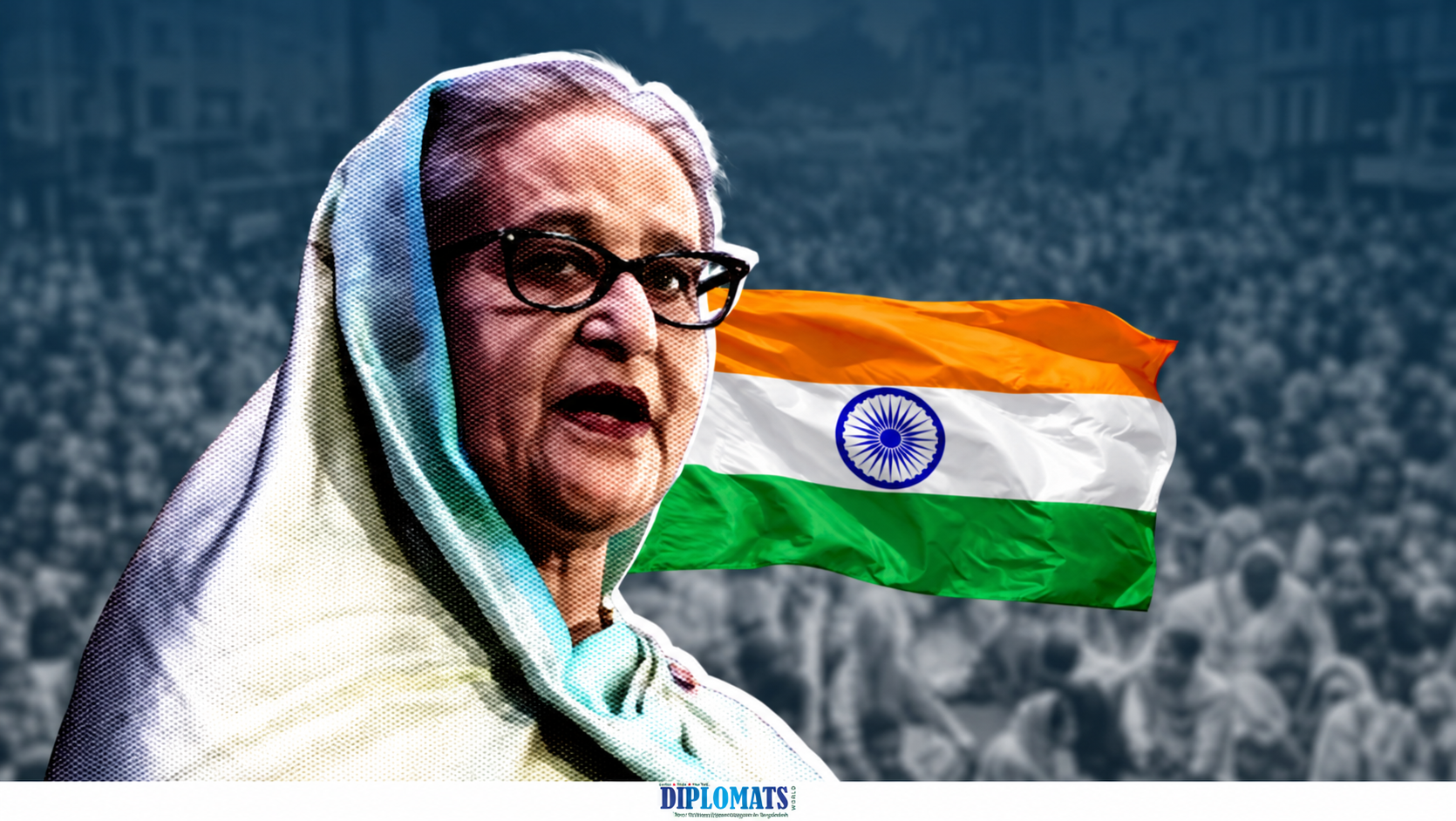
India has declined to comment on former Bangladesh prime minister Sheikh Hasina's possible return to Bangladesh through military arrangements, clarifying that its repeated references to the matter as a legal issue concern only the extradition process.
Speaking during a biweekly media briefing in New Delhi on 13 November, Indian Ministry of External Affairs (MEA) spokesperson Randhir Jaiswal stated, "When I talked about the legal matter, it is about the extradition part of it." Addressing the remainder of the inquiry, Jaiswal added, "To the other part of your question, I have no comment to offer."
Asked about reports that India wanted Bangladesh to send a military aircraft to bring Hasina home and wanted assurances of a fair trial for her, Jaiswal also declined to comment.
Earlier on Thursday, BBC Bangla reported that India wanted Bangladesh's military to assume responsibility for returning Hasina from New Delhi. According to the report, India also sought assurances that she would receive an opportunity to appeal against her death sentence and stand trial for allegations related to the killings during the July 2024 uprising.
Citing Indian government and military officials, the report stated that New Delhi outlined two major conditions for arranging her return. This came as her continued presence in India became increasingly uncomfortable for the Indian government amid mounting diplomatic and international pressure.
The first condition pertains to the transfer itself, with India reportedly requesting that Bangladesh's military assume responsibility for bringing Hasina home, preferably on a Bangladeshi military aircraft.
The second issue involves the judicial process, with New Delhi reportedly seeking assurances that Hasina will be permitted to appeal her death sentence and receive a new trial concerning allegations of killings during the July 2024 uprising.
However, India does not want to create the impression that it is interfering in Bangladesh's independent judicial system, according to the report.
"We can never knowingly push her towards the gallows. Rather, we want her to have an opportunity for a fresh, impartial and fair trial," a senior Indian foreign ministry official told BBC Bangla.
The official also stated that India would prefer the entire judicial process to take place under the scrutiny of the international community and global media.
According to a BBC Bangla report, India wants the military of Bangladesh to handle the return of Hasina, which could occur either by air or across a land border.
Under the first option, Bangladesh could send a military aircraft to New Delhi to bring her home. Alternatively, Bangladeshi military personnel could receive her at a designated border point agreed upon by the two countries.
India is prepared to provide the necessary transport and logistical support for either arrangement, the report said.
Indian officials reportedly do not want to hand Hasina over to a Bangladeshi aircraft as a prisoner. As a longtime friend and ally of India, her transfer under such circumstances could send a negative message to political allies in other neighbouring countries, including Nepal, Sri Lanka and the Maldives.
The report also stated that India sought assurances that Sheikh Hasina's security would be protected upon her return, with the Bangladesh Army expected to assume responsibility for her safety.
An Indian military official told BBC Bangla that New Delhi wanted to ensure the life and security of Hasina would not be at risk following her return to Bangladesh.
The report said India had initially explored the possibility of sending Hasina to a third country and had approached several countries in this regard. However, those efforts failed for various reasons.
Indian policymakers now reportedly consider returning her to Bangladesh and allowing her to participate in the country's judicial process the most practical way out of the diplomatic difficulty.
Her continued presence in India has increasingly become a source of discomfort for New Delhi, affecting bilateral relations with Bangladesh and exposing India to international criticism for providing shelter to a former leader sentenced over the deadly crackdown on protesters.
India also believes the Awami League, a longtime political ally of New Delhi, would find it difficult to regain political ground in Bangladesh without Hasina's return, the report said.
Although the party's activities remain banned in Bangladesh, its possible return to active politics is considered important by Indian policymakers.
BBC Bangla reported that Indian authorities regularly brief foreign nationals staying in the country on various developments and that Hasina had also been informed of New Delhi's position during such briefings.
According to the report, Hasina announced her intention to return to Bangladesh in December after reaching an understanding with Indian authorities.
In an earlier interview with Reuters, Hasina said she wanted to return to Bangladesh in December 2026. She has maintained that position but has yet to announce a specific date.
The BBC report also highlighted the potential role of the armed forces of both countries in facilitating Hasina’s return.
The report referenced a visit by Indian High Commissioner to Bangladesh Dinesh Trivedi to New Delhi in the first week of October, during which he reportedly met both Prime Minister Narendra Modi and Army Chief General Dhiraj Seth.
An Indian senior military official told BBC Bangla that, under normal circumstances, there would be little reason for the Indian army chief to hold a separate meeting with the Bangladeshi high commissioner unless a special situation required it.
The report suggested that the possible involvement of the two countries' militaries in facilitating Hasina's return could have been discussed during the visit.
Despite fluctuations in diplomatic relations between Dhaka and New Delhi over the past two to two-and-a-half years, military-to-military communication has continued, the report said.
Former Indian Army Chief General Manoj Pande and his predecessor disclosed they had regular contact with Bangladesh Army Chief General Waker‑Uz‑Zaman prior to the July 2024 uprising. Their conversations reportedly occurred on a weekly basis.
India now wants to use those existing military communication channels to facilitate Hasina's return, according to the report.
Bangladesh has made repeated formal requests for Hasina's extradition. Indian officials, however, reportedly remain sceptical about whether the current government in Dhaka genuinely wants her returned.
Citing officials from India's home and foreign ministries, BBC Bangla said New Delhi believed Bangladesh's public demand for Hasina's extradition might not fully reflect the government's actual political calculations.
Indian policymakers reportedly believe the Bangladesh government is already grappling with several challenges, including an energy crisis and garment workers' protests. They fear Hasina's return could further intensify political instability.
According to the report, several conditions would have to be met before her return could be arranged, making an early resolution unlikely. Indian observers are consequently uncertain whether she will be able to return by December.
India also acknowledges that securing her return on the terms it is seeking will not be straightforward, according to the report.
Nevertheless, Indian authorities had agreed to Hasina's public announcement about returning in December. Even if she ultimately fails to return, New Delhi reportedly sees potential diplomatic benefits in the declaration.
A South Block official told BBC Bangla, "At least then we will be able to say that Sheikh Hasina herself wanted to return home, but Bangladesh prevented her from doing so by citing various excuses."
The report also noted that Hasina's announcement had generated renewed enthusiasm among Awami League leaders and activists in Bangladesh.
India wants the Awami League to regain a place in the country's political landscape and views Hasina's stated intention to return as a potentially positive development, it added.
BBC Bangla said it remained uncertain where Hasina would be on 31 December 2026. If she remains in India, New Delhi could use her continued stay as another justification for extending its shelter to the former prime minister.
Bangladesh formally requested Hasina's extradition through a diplomatic letter in December 2024. Such communications are known as a note verbale in diplomatic terminology.
Dhaka has subsequently sent several follow-up requests. However, India has neither accepted nor rejected the extradition request so far, according to BBC Bangla.
Asked about the matter, India's Ministry of External Affairs has repeatedly said it is related to legal proceedings and will be resolved in accordance with the law.
The BBC report said provisions and loopholes in the extradition treaty between Bangladesh and India could allow New Delhi to prolong the decision-making process on Dhaka's request.
Meanwhile, addressing questions about bilateral engagement, Jaiswal said the next round of India-Bangladesh consular dialogue would be held at a mutually convenient date and would also cover revised travel arrangements.
Reiterating that "India desires a positive, constructive and forward-looking relationship with Bangladesh", he said New Delhi remained ready to discuss all issues with Dhaka through existing bilateral mechanisms, including at the technical level.
Jaiswal said initiatives had been taken and meetings held under established mechanisms on issues relating to trade, railways, water resources and water management, among others.
Why it matters
The diplomatic stance of India regarding the potential return of former Prime Minister Sheikh Hasina directly impacts bilateral relations and political stability in Bangladesh.