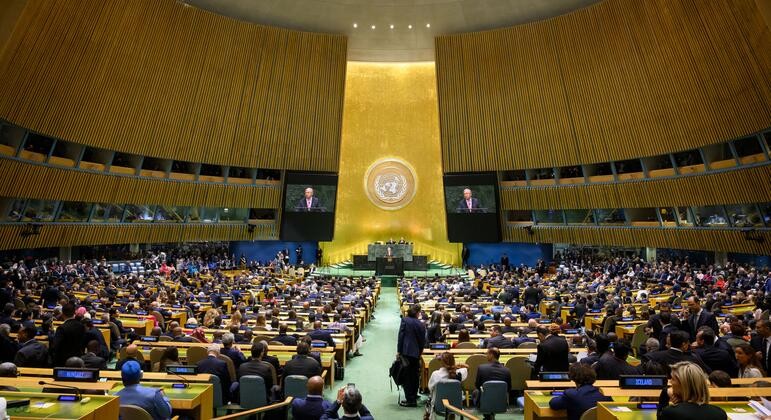
Whether the United Nations can remain relevant while continuing to look and act like the organization formed in 1945 was a central question during the General Assembly debate in New York last month, where a diverse range of Member States repeatedly raised a striking common refrain concerning UN reform.
Many governments believe the United Nations can only remain credible and effective if its institutions better reflect the realities of the 21st century.
Delegates repeatedly returned to the relationship between power, fairness, and legitimacy, addressing topics that ranged from questions of Security Council representation to institutional effectiveness.
For this third and final analysis piece highlighting key themes, UN News examined some of the speeches delivered during the annual General Debate by the 193 member states attending the UN General Assembly.
As United Nations Secretary-General António Guterres stated: “The United Nations exists because power requires rules – and humanity needs a place where power answers to principle.”
Security Council reform sat at the centre of discussions about UN reform.
Speaker after speaker argued that representation and legitimacy cannot be separated, with Africa's continued absence from permanent membership serving as a recurrent theme during the discussions.
Kenya delivered a blunt assessment at the United Assembly, stating: "The equality proclaimed in this Assembly ends at the doors of the Security Council."
Guyana made a similar case for the wider world, stating: “We need a Security Council that reflects the geopolitical realities of the 21st century, not the power structures of 1945; a Council that embraces the emerging multipolarity of our world, including permanent representation from Africa, and Latin America and the Caribbean.”
UN chief Mr. Guterres agreed with the sentiment, describing the current situation as indefensible. He stated that a 21st-century Security Council lacking permanent African seats is both unjust and indefensible.
General Assembly President Khalilur Rahman echoed this sentiment, stating, “Africa cannot be asked to wait indefinitely for its rightful place on the Council.”
While support for reform was widespread, governments proposed different solutions.
Spain went the furthest, calling for both fairer regional representation and the complete elimination of the veto. “We need to reform the Security Council so that all of the regions in the world have fair representation, and so that we can do away with the right of veto of the permanent members,” the country stated.
Russia, one of the five permanent members of the Security Council, adopted a more cautious stance, supporting "the expansion of representation by Asia, Africa and Latin America." However, Moscow added that reforms should not "undermine the intergovernmental nature of the UN system or erode the prerogatives of the UN Security Council and its Permanent Members."
A second thread ran through the week: Trust, and how easily it erodes when rules get applied selectively.
Hungary argued that cooperation and self-interest are not mutually exclusive, stating: “We believe that national interest and international cooperation do not have to stand against each other.” The country added that “the United Nations cannot demand trust. It must earn it.”
Several delegations said public confidence in international institutions depends on the consistent application of rules and principles. They raised concerns about unequal treatment, selective implementation of international law and failures to respond effectively to crises.
While the UN has championed its UN80 Initiative , that aims to make the United Nations more coherent, effective and responsive to today's challenges, countries also offered competing visions of operational reform.
Switzerland and Costa Rica emphasized clear priorities, efficiency and measurable results.
The President of the General Assembly highlighted overlapping mandates, bureaucratic silos and the need for better coordination at the country level.
However, several speakers warned against treating reform as a cost-cutting exercise.
China said reform should improve institutional performance rather than merely reduce budgets and mandates.
Guyana argued that resources should match the responsibilities assigned to the Organization.
Spain called for United Nations agencies, funds and programmes to receive more resources and greater executive capacity.
The differences were not simply about spending. They concerned what the United Nations should do, how much authority it should have and whether better delivery requires stronger operational capacity – or a narrower institutional role.
A recurring question throughout the debate was not whether the United Nations should exist, but whether it can produce results.
General Assembly President Rahman put the issue bluntly: “Outside these walls, people are not asking whether the United Nations still exists. They are asking whether it works.” He stressed that people, not process, are paramount: “Every penny must be invested to achieve impact on the ground for the people we serve.”
The United States offered a contrasting model based on institutional retrenchment: “We cut the UN budget for the first time ever, slashing it by 15 percent in 2026 and eliminating more than 4,000 positions from the UN bureaucracy,” while rejecting international involvement in areas considered national prerogatives.
For all the disagreement over vetoes, institutional power and competing reform models, delegates kept circling back to the same core concern.
The scale of today's challenges has surpassed the capacity of existing structures to address them, and Member States must pursue the creation of a more resilient and effective organization.
As Guyana noted: “This is why we must not abandon multilateralism because it is imperfect; we must renew it because humanity still needs it.”
Why it matters
The debate over UN structural reform directly impacts international governance and the global multilateral framework governing peace, security, and development.