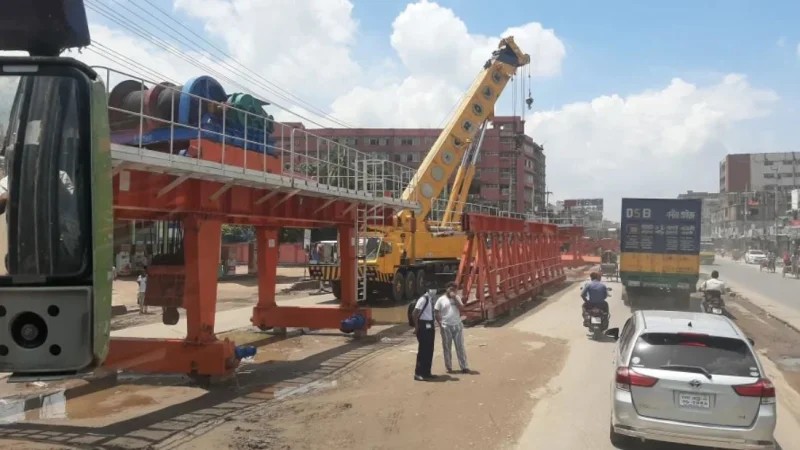
The Dhaka-Gazipur Bus Rapid Transit (BRT) project remains idle 14 years after its approval, with its estimated cost having risen to Tk4,268 crore.
The government is preparing to present four options to the cabinet.
The available options include completing the Bus Rapid Transit (BRT) system, operating route-based buses on existing infrastructure, converting the corridor into a toll expressway, or demolishing the structures to construct a six-lane highway.
Earlier, Roads Transport and Highways Division (RTHD) Secretary Ziaul Haque stated that transport experts, urban planners, residents, and transport operators recommended the options. He noted that these proposals have been presented to the prime minister and will next be submitted to the cabinet.
Eventually, Mohammad Nurul Amin Khan, managing director of the BRT company, confirmed that the four options are under consideration.
On Saturday, the Sachetan Nagarik Samaj of Gazipur held a press conference at the Dhaka Reporters Unity to demand the swift launch of the Gazipur-Airport Bus Rapid Transit (BRT) project.
Opposing any move to demolish the project after nearly 97% of the work was complete, the organization called for a clear implementation timeline, an independent technical and economic assessment, and effective use of the existing infrastructure.
Speakers urged the government to end a 14-year delay and immediately launch bus services to ease traffic congestion and reduce public suffering in Gazipur.
The 20-kilometer project was approved in 2012 with an estimated cost of Tk2,040 crore. Since then, the cost has more than doubled to Tk4,268.32 crore.
The Asian Development Bank (ADB) is providing Tk2,118.95 crore, while the French development agency AFD is contributing Tk903.49 crore, and the government is providing Tk1,245.88 crore.
It was originally scheduled for completion in December 2016. Following five extensions, the deadline was subsequently moved to December 2024.
According to project documents, around 97% of infrastructure work is complete, but overall progress stands at 77.48%.
A fourth revision proposed increasing the cost to Tk6,597 crore and extending the deadline to December 2029. However, the Executive Committee of the National Economic Council (Ecnec) did not approve the proposal on July 27, 2025, emphasizing the necessity for a review by both local and foreign experts.
The government canceled a tender for electric buses, and a second tender in April 2024 for 137 air-conditioned diesel buses also failed. Seven people have died in construction-related accidents, including five who were killed on August 15, 2022, when a girder collapsed on Uttara’s Jasimuddin Avenue.
Road Transport, Railways and Shipping Minister Shaikh Rabiul Alam has previously told the media that there is strong support for cancellation, although some believe additional spending could still yield partial benefits. A stakeholder meeting is scheduled to be held before a final decision is made.
Ministry sources stated that the interim government had decided against proceeding, although the BNP-led government has yet to take a clear position. In August, Prime Minister Tarique Rahman met with representatives from both sides.
A four-member team from the Bangladesh University of Engineering and Technology (Buet), led by Prof Shamsul Hoque, reviewed reports by two ministry committees. The team described the project as a "systemic failure" of planning and implementation, pointing to weak technical evaluation, design flaws, poor coordination, and a lack of accountability.
The team issued 17 recommendations, which include placing a stronger emphasis on commuter rail, finishing unfinished pedestrian overpasses, and either relocating or auctioning off the stations' escalators and lifts.
It states that accountability must be enforced for the feasibility and design consultants, planning officials, financiers, the project steering committee, the Implementation Monitoring and Evaluation Division, and the Planning Commission.
Confirming his assessment to the Dhaka Tribune, Prof Hoque described the Bus Rapid Transit (BRT) as an "imposed project" and stated, "It is a very poor example."
He said experienced professionals could have been brought in from abroad.
Despite the flaws, he added, the existing flyovers, footpaths, roads and drainage can still be used.
Prof Md Hadiuzzaman of BUET has proposed introducing public transport in phases using the existing BRT lanes.
Adil Mohammad Khan, an urban planner at Jahangirnagar University, told Dhaka Tribune that the government should prioritize making existing infrastructure operational through an integrated public transport plan. “Demolishing it would waste public investment,” he said.
Earlier, the Bangladesh Institute of Planners (BIP) also argued for the project's completion. The institute stated that approximately 3% of infrastructure work remains, that service could begin within a year with an additional Tk300 crore, and that dismantling and compensating contractors could cost more than Tk1,000 crore.
Engineer Md Shamsul Hoque, president of Gazipur Heritage and Development, claimed that demolition and rebuilding could cost around Tk4,000 crore and take four to five years. He also alleged that a powerful group in the transport sector had obstructed the project, a claim that could not be independently verified.
A senior ministry official, speaking on condition of anonymity, stated that abandoning the project would waste a significant portion of the borrowed funds.
Proceeding with the plan would require an additional Tk3,500 crore to purchase and operate buses, an official stated, which poses its own risk of failure.
Another ministry source, speaking anonymously, claimed that development partners want projects executed quickly in order to keep lending going and to meet disbursement targets.
This claim could not be independently verified. Furthermore, the ADB, the AFD, and the Economic Relations Division could not be reached for comment.
Out of 25 planned stations, 15 structures have been built in the median, though none is yet complete. While an escalator in Uttara was briefly operated, it is currently out of service, and machinery at other locations is rusting. Additionally, most pedestrian overpasses within the Gazipur section remain unusable.
Nearly foot-high concrete barriers separate the lane along the route and would have to be removed if the corridor is reopened. All vehicles are currently allowed on the BRT lane. Md Sohel, a covered-van driver, said a trip from the airport area to Gazipur took 10 hours on a rainy day in 2022.
The project reportedly began before a full feasibility study and detailed design were completed. Construction revealed no proper drainage, causing waterlogging, and no plan to relocate utility lines or maintain traffic. Experts say BRT is usually built on roads with 12 to 14 lanes, whereas the Gazipur road has four and the airport section six.
The central question remains whether bus services can be launched quickly and safely on the existing infrastructure, or whether the project must be rebuilt.
Why it matters
The long-delayed Dhaka-Gazipur BRT project highlights critical infrastructure planning failures and poses significant financial and transit challenges for commuters in Bangladesh.