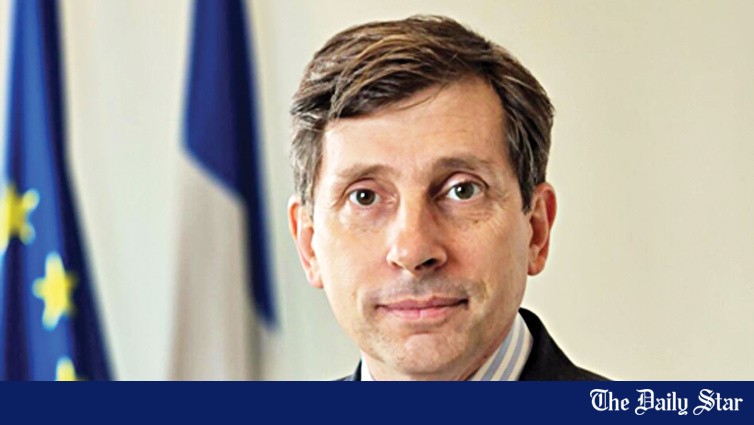
European companies will not come to Bangladesh unless they are treated on an equal footing with companies from other partner countries, French Ambassador Jean-Marc Séré-Charlet said yesterday.
"What matters for us is that there is a level playing field -- if it’s not the case, European companies won’t come to Bangladesh," he stated in response to a question during a session titled "The New Strategic Middle" at the Bay of Bengal Conversation 2026 in Dhaka.
The absence of European companies would not be the result of any restrictions imposed by France, Germany, or the European Commission.
The companies themselves would decide whether to invest based on how they are treated, Séré-Charlet said.
The European Union maintains free trade agreements with numerous countries and seeks to ensure that European companies receive treatment equal to that afforded to businesses from other partner nations.
Regarding a possible free trade agreement (FTA) between Bangladesh and the European Union, Séré-Charlet stated that negotiations have not yet begun.
Bangladesh has expressed interest in the process, but any decision to start negotiations would have to be taken in Brussels, he said.
He described a free trade agreement (FTA) as a long-term process involving “give and take” to create a level playing field.
Europe is pursuing greater "strategic autonomy" to make decisions based on its own interests without being influenced by any single major power.
“Cooperation is better than confrontation, partnering is better than threatening,” he said.
Referring to Bangladesh’s agreement with the United States, the ambassador stated that it was a decision made by the government of Bangladesh.
“I have no comment to make on that,” he added.
Jovan Ratkovic, a senior fellow at the Agora Strategy Institute, stated that the international order is shifting beyond traditional non-alignment toward "multi-alignment." According to Ratkovic, countries are now engaging simultaneously with competing powers across areas such as security, technology, energy, and trade.
Countries could choose different partners for different areas of interest as long as they retain the freedom to make such choices, said German Ambassador Rüdiger Lotz.
Former Maldives president Mohamed Nasheed stated that smaller countries did not always have complete freedom when dealing with major powers.
“You cannot say no to big powers,” he said.
Why it matters
Ensuring a level playing field is essential for attracting European capital and fostering inclusive growth in Bangladesh's economy.