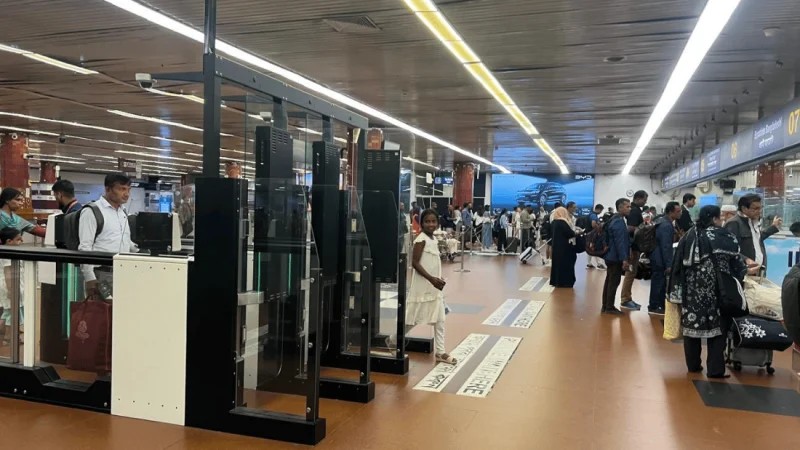
An automated border control system, or e-gate, has been introduced at the arrival counters of Hazrat Shahjalal International Airport in Dhaka, allowing e-passport holders to complete their immigration process in just 18 to 20 seconds and avoid long queues.
Officials said the introduction of e-gates at the arrivals section has eased passenger hassle and significantly reduced the time required for immigration.
Speaking to the Dhaka Tribune on Monday afternoon, Department of Immigration and Passports (DIP) Director General Major General Md Alimul Amin stated that e-gates had been introduced at the airport’s arrival counters, enabling passengers to complete their immigration within a very short time.
“We also want to introduce e-gate services at departures. We are working on it,” he said.
However, he stated that the departure service was not yet technically ready. Although passengers’ passports can be scanned at the departure e-gates, the system cannot currently complete the required stamping process, which has left the service suspended.
During a visit to the airport, a Dhaka Tribune correspondent found that passengers still have to collect their arrival stickers manually from a police booth after completing e-immigration.
Officials stated that the process will be simplified once the third terminal becomes operational, at which point passengers will no longer need to visit the police booth separately to collect their arrival stickers.
Airport immigration officials stated that Bangladesh faces several technical and operational challenges in fully digitising its immigration services, which include e-gates and e-visa verification.
These challenges include an insufficient number of e-gates, barcode readers, and biometric devices, as well as frequent server downtime and delays in IT systems.
There is also no real-time integration among the databases of the National Identity Card (NID) system, the Department of Immigration and Passports (DIP) and the Bureau of Manpower, Employment and Training (BMET).
Even minor discrepancies in passengers’ names or dates of birth can prevent e-gates from automatically identifying them as a result.
Technical problems with facial-recognition cameras and fingerprint-matching systems can also cause the gates to reject legitimate passengers. In addition, some immigration officials lack the technical expertise needed to operate digital systems and verify e-visas.
Major General Alimul Amin stated that several technical, institutional, and practical challenges still remain in the effort to convert departure immigration into a fully digital system.
“That is why the service is currently suspended. But we are working to simplify this service, as well as passport-related services, as soon as possible,” he said.
Passengers said the introduction of e-gates at arrivals had reduced both waiting time and hassle, allowing them to complete immigration automatically within 18 to 20 seconds.
Liton Kabir, who recently returned from Thailand, told the Dhaka Tribune, "The e-passport was once a dream for the people of Bangladesh. The e-gate was introduced alongside it. Although the service was closed for various reasons, I feel relieved now that it has reopened. If it is introduced at departures soon, travelling will become even easier."
Rajib Ahmed, who recently returned from Turkey, said the service had made the arrival process much easier.
Commenting on their first family tour, a traveler noted that using an e-passport allows travelers to clear immigration in about 18 seconds. He stated that having the facility at departures as well would save a lot of time and suggested that the government should pay attention to this matter.
An immigration official stated that passengers utilizing departure e-gates are still required to return to the immigration desk for visa verification and additional checks, resulting in a process that takes almost as long as it did previously.
"This makes passengers angry. Data from the e-gates also often fails to reach the immigration software. That is why the departure e-gates have remained closed," he said.
He added that while e-gates are currently closed for departing passengers at Shahjalal Airport, they remain operational for arriving passengers.
Bangladesh introduced e-passports in February 2020, becoming the first country in South Asia to do so. E-gates were subsequently installed at Hazrat Shahjalal International Airport to facilitate faster and more efficient immigration processing.
However, technical problems and the continued need for manual visa verification and other checks created complications. Consequently, passengers still had to visit immigration desks even after using the e-gates, which prompted authorities to suspend their operation.
Several members of the Immigration Police's Special Branch, speaking on condition of anonymity, stated that approximately 40 percent of the passengers using the airport each day possess e-passports.
They stated that while the e-gates are capable of automatically verifying passport and passenger information, they cannot independently verify visas.
The system also lacks provisions to automatically store information on passengers’ destinations or flights.
Consequently, visa verification continues to be conducted manually, even when passengers use the e-gates. This contributes to long queues at departure immigration, particularly when several flights arrive or depart around the same time.
Hazrat Shahjalal International Airport Executive Director Group Captain SM Ragib Samad informed the Dhaka Tribune that the e-gates currently possess the capability to verify solely passport information, while being unable to verify visas and additional details.
“That is why the e-gates have been kept closed at departures. But we hope the service will start soon,” he said.
The government has initiated a project to modernize Bangladesh's immigration system by integrating the existing Immigration Management System with new technologies.
The Ministry of Home Affairs has formed a 10-member committee to review fee-setting, payment collection, and settlement procedures under the system, and to develop an appropriate financial model.
The notice was issued on October 19 by the Departure-4 branch of the ministry's Security Services Division and was subsequently published on October 25.
According to the notice, the government plans to integrate the Advance Passenger Information System (APIS), Passenger Name Record (PNR), e-Visa and Electronic Travel Authorisation (ETA) systems, along with a sovereign data analytics platform, with the existing IMS.
The government is also considering appointing a third party to modernise the relevant infrastructure and implement the programme. As part of the initiative, the committee will review immigration facilitation charges, revenue collection and remittance procedures, and payment mechanisms. It will also prepare proposals on appropriate fees and a suitable financial model.
The committee is headed by the Joint Secretary of the Planning-1 wing of the Ministry of Home Affairs, while the Deputy Secretary of the Departure-4 branch will serve as its member-secretary.
Other members of the committee include the Joint Secretary of the Departure-1 wing of the Home Ministry and representatives from the Finance Division, the National Board of Revenue (NBR), the Civil Aviation Authority of Bangladesh (CAAB), the Special Branch, Biman Bangladesh Airlines, the Bangladesh Land Port Authority, and the Department of Immigration and Passports.
Why it matters
The introduction of arrival e-gates at Shahjalal International Airport and the formation of a Home Affairs committee mark a key step toward modernising Bangladesh's digital immigration and border control infrastructure.