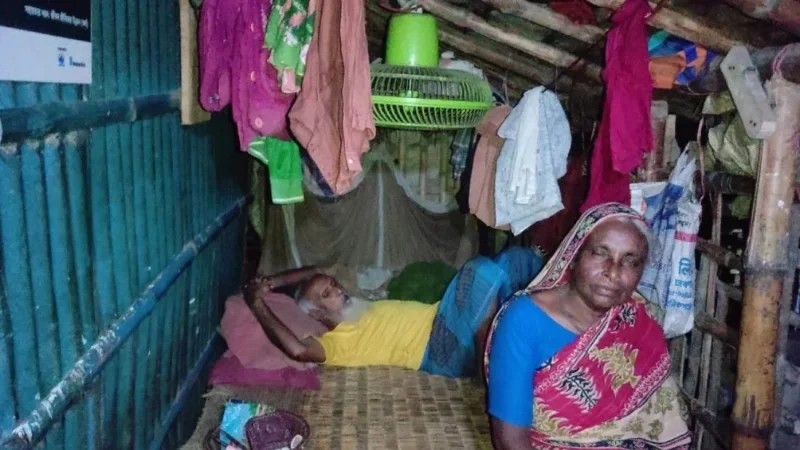
In a small, dilapidated shelter beside a canal in Haoladar Bari of Pratapnagar union in Satkhira’s Ashashuni upazila, Shahjahan Ali, in his seventies, and his wife Rabeya Begum, in her sixties, spend their days gazing at the water that has destroyed their lives.
They once owned two bighas of land, a mango orchard, paddy fields, and a well-maintained home. However, Super Cyclone Amphan in May 2020 breached nearby embankments, allowing saline water from the Kholpetua and Kapatakkha rivers to inundate their homestead and farmland. Repeated flooding subsequently destroyed their land and livelihoods.
As river erosion and salinity worsened, their adult sons departed in search of employment, taking their children along with them.
“I miss my grandchildren, but what can we do? They have left in search of work. Where can we go at this age? We once had everything, including our loved ones. Now, there is nobody,” said Rabeya.
Her husband, Shahjahan Ali, recalled how his wife’s family once owned hundreds of bighas of land.
“I can no longer work because of my illness. Whatever our son gives us is not enough to run the household, and we often go hungry. I am tired of this lonely life. Now, I am simply waiting for death,” he said.
Their story reflects a growing crisis along Bangladesh’s southwestern coast, where climate-related disasters are destroying livelihoods, driving migration and leaving elderly people increasingly isolated.
Shamsun Nahar Ratna, a senior scientific officer at the Soil Resource Development Institute’s Satkhira regional office, reported that salinity levels in the Kholpetua River increased from 22-25 deciSiemens per metre in 2019 to as high as 50-55 by 2026.
According to Bangladesh’s 2024 Soil Salinity Map, approximately 1.16 million hectares out of the country’s 1.70 million hectares of coastal agricultural land have become severely saline.
Ratna attributed the worsening situation partly to declining upstream river flows, irregular rainfall, and the movement of saline water toward the soil surface. The resulting damage to farmland is pushing farmers toward fish and shrimp farming.
According to figures cited in the report, around 2.5 million people were displaced from coastal areas during Amphan in 2020. Data from the International Organization for Migration and the government indicate that approximately 4.96 million people are internally displaced by disasters such as floods, river erosion and storm surges. Meanwhile, the World Bank has warned that Bangladesh could have nearly 20 million internal climate migrants by 2050 without effective action.
A joint survey conducted by the Satkhira municipality and the development organisation Uttaran revealed that 10,133 families relocated to the district town over a 22-year period due to natural disasters.
According to the findings, approximately 84 percent of these displaced families lost their homes as a result of river erosion, storm surges, and salinity.
Many now live in overcrowded settlements with inadequate housing, sanitation and drainage facilities.
In the neighbouring Gabura union of Shyamnagar upazila, 60-year-old Fazila Khatun, a partially paralysed widow, struggles to survive after her children left in search of work.
“We used to live by farming. Now there is salt everywhere. Even a vegetable plant cannot survive. We have to walk miles to collect drinking water,” she said.
Environmental activist and researcher Piyush Baulia Pintu attributed the weakening of embankments to repeated cyclones, unplanned shrimp farming, and poorly planned sluice gates. In areas of Gabura, such as Durgabati, Harinnagar, Singhortali, and Jelekhali, erosion has destroyed homes and entire settlements.
He said some displaced residents had taken out loans to buy vans or venture into unfamiliar occupations, but were later forced to leave when they were unable to repay their debts.
Farida Parvin, a reserved-seat woman member of the Gabura union parishad, stated that climate change—specifically persistent river erosion, tidal surges, and severe cyclones—served as the primary driver of displacement in the region.
“Income-generating opportunities are also extremely limited. Previously, paddy cultivation provided jobs for around 20 labourers during the farming season,” she said. “But saltwater fish and shrimp farming requires only one worker, leaving the other 19 unemployed and forcing them to leave the area.”
Madhab Chandra Dutta, executive director of the human rights organisation Swadesh, stated that climate change was also causing non-economic losses, which include the erosion of cultural identity, mental well-being, and social bonds.
Traditional practices including boat races, folk songs, and rituals associated with Bonbibi and Manasa are disappearing as people abandon their ancestral homes and traditional occupations.
Bhakta Munda, a resident of Datinakhali, said the struggle to survive had overshadowed cultural life.
“After Amphan and Yaas, people became so preoccupied with survival that the joy of festivals disappeared. Social bonds among neighbours are also fading,” he said.
Farida Parvin, a reserved‑seat woman member of the Gabura Union Parishad, said that shrinking employment opportunities were accelerating migration.
“During the paddy cultivation season, around 20 labourers could find work in a field. But shrimp farming can often be managed by just one worker. The others are left without jobs and forced to leave,” she said.
According to Farida, approximately two out of every 10 families in Gabura have relocated, leaving elderly parents behind frequently without independent sources of income.
Ashik-e-Elahi, convener of the Satkhira Climate Council, stated that climate change has evolved into a human rights issue. He advocated for accessible loans and entrepreneurship support to enable young people to stay in agriculture, as well as increased investment in vulnerable communities.
Dutta urged authorities to construct durable concrete-block embankments, rehabilitate displaced families on accessible government-owned land, and generate alternative employment opportunities.
Sonia Akter Pushpa, a psychosocial counsellor at Moner Bondhu, stated that migration is placing severe psychological pressure on women and elderly people left behind. She called for local employment opportunities, regular communication between family members, and community-based mental health services.
Experts warn that without sustained investment in embankments, rehabilitation, livelihoods, and psychosocial support, coastal communities risk losing not only their homes, but also their cultural heritage and social bonds.
Why it matters
Climate-driven soil salinity and displacement threaten millions of coastal residents in Bangladesh, reshaping the country's social and economic landscape.