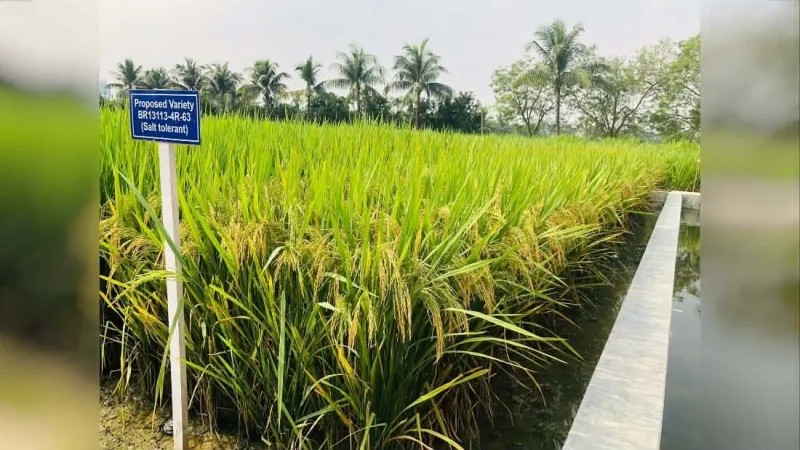
The Bangladesh Rice Research Institute (BRRI) has introduced a new high‑yielding, salt‑tolerant rice cultivar, BRRI Dhan 119, which provides fresh prospects for rice cultivation in the country’s salinity‑prone coastal regions.
The new variety, created by the Bangladesh Rice Research Institute’s Plant Breeding Division with funding from the Location‑Specific Technology Development (LSTD) Project, was granted final approval for transplanted Aman cultivation at the 116th meeting of the National Seed Board on 28 October. Researchers said the variety is also suitable for Boro cultivation, but final approval for that season is still pending.
The research team was headed by Dr Mohammad Akhlasur Rahman, chief scientific officer of the Bangladesh Rice Research Institute’s Plant Breeding Division, and included Dr Hasina Khatun, Nusrat Jahan, Armin Akter Setu and Ribet Farzana Disha as members.
The BRRI Dhan 119 rice variety yields an average of 5.7 tonnes per hectare under optimal management, with yields ranging from 4.8 to 7.6 tonnes depending on salinity and environmental conditions. Research shows it produces roughly one tonne per hectare more than the BRRI Dhan 73 variety. The crop matures in about 115 days and reaches an average plant height of 113 cm. Its strong stems give it resistance to lodging, and each panicle bears an average of 215 filled grains—around 70‑80 more than BRRI Dhan 73. The medium‑slender, white grains are reported to cook into fluffy, non‑sticky rice.
One of the variety’s key characteristics is its ability to tolerate salinity at different growth stages. According to BRRI research data, it can endure salinity levels of up to 12 dS/m for three weeks during the seedling stage and can maintain yield potential at 8‑10 dS/m during the sensitive phases from vegetative growth to reproduction.
Field trials in Cox’s Bazar evaluated its performance under fluctuating salinity, while additional assessments were carried out in the saline areas of Satkhira and in favourable non‑saline environments. Farmer‑participatory trials were also conducted in various parts of the country. Researchers noted that actual yields would depend on salinity intensity, duration, crop growth stage and field management.
The variety, which matures in roughly 115 days, could broaden cropping patterns in coastal regions. After harvesting Aman rice, farmers would have enough time to plant sunflower or salt‑tolerant mustard on medium‑high to high‑elevation land.
Performance Yield Trials for Boro cultivation were completed at 20 locations covering both saline and non‑saline environments, under the supervision of the Seed Certification Agency. The National Technical Committee, after reviewing the results, has recommended the variety for Boro cultivation.
Final approval from the National Seed Board would permit farmers to grow the variety in both Aman and Boro seasons.
The Bangladesh Rice Research Institute (BRRI) recommends sowing seeds between July 1 and July 30 for transplanted Aman cultivation. Seedlings aged 25 to 30 days should be transplanted at a density of two to three seedlings per hill, with a spacing of 20cm between rows and 15cm between hills.
The recommended fertiliser applications per hectare are 234kg of urea, 87kg of TSP, 117kg of MOP, 78kg of gypsum, and 12kg of zinc sulphate. The institute's Genetic Resources and Seed Division in Gazipur handles seed production, and ensuring an adequate supply of quality seeds will be essential to expanding cultivation.
BRRI Director General Dr Rafiqul Islam said the variety demonstrated the advanced breeding capabilities of Bangladeshi agricultural scientists. "BRRI Dhan 119 will not only bring hope to farmers in salt-affected coastal areas but will also play an important role in strengthening our food security and increasing agricultural production and farmers' incomes," he said.
Dr Khandakar Md Iftekharuddaula , head of the Plant Breeding Division, described its development within seven and a half years as a significant achievement. Lead breeder Dr Mohammad Akhlasur Rahman said the research journey had been long and challenging, adding that seeing the benefits reach farmers' fields would be the team's greatest reward.
Dr Anwar Hossain, project director of the LSTD Project, said the variety was a significant achievement under the initiative. He added that BRRI Dhan 116, BRRI Dhan 117 and BRRI Hybrid Dhan 10 had previously been released under the project, reflecting its continued contribution to developing location-specific rice varieties for Bangladesh.
Why it matters
The introduction of BRRI Dhan 119 addresses agricultural challenges in salinity-prone coastal areas to strengthen national food security.