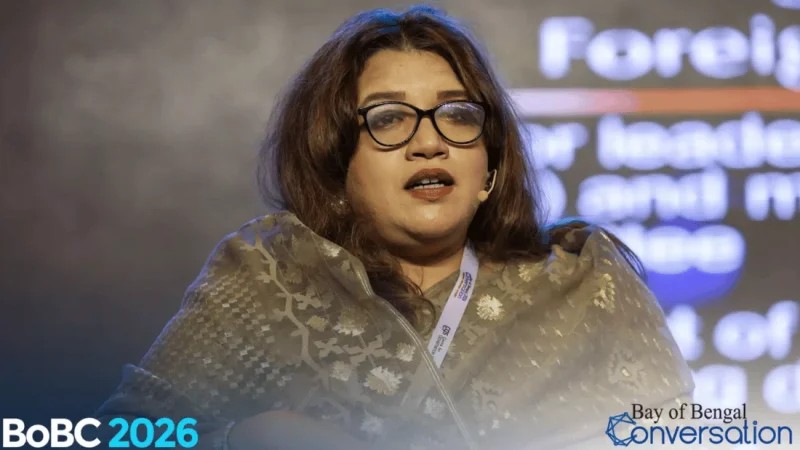
State Minister for Foreign Affairs Shama Obaed Islam stated on Saturday that Bangladesh intends to pursue its foreign policy independently while remaining open to cooperating with the international community.
“We don't want to be a chessboard for other players to play. We want to play on our own terms. We are ready to negotiate, collaborate and partner with the rest of the world with our head held high,” she said.
Speaking at a panel discussion titled “A World Rewritten: Power, Technology and Trust in the Age of Uncertainty,” held as part of the three-day Bay of Bengal Conversation, the state minister stated that Bangladesh is now positioned to hold its head high.
Prime Minister Tarique Rahman spoke as the chief guest at the inaugural session.
Former President of the Republic of Serbia Boris Tadić, Distinguished Professor at Illinois State University, USA, Ali Riaz, Deputy Head of Mission at the Royal Norwegian Embassy in Bangladesh Alexander Falck-Bilden, Member of Parliament of Montenegro Gordan Stojović, and Editor-at-Large of TIME Magazine, Singapore, Charles Thomas Campbell took part in the first panel discussion.
“But of course, remembering that the most important thing in our foreign policy is the interest of our people,” Shama said.
Seeking broader international cooperation to resolve the Rohingya crisis, she stated that Bangladesh wants to cooperate with countries across South Asia, Asia and beyond as part of its economic diplomacy.
“As far as economic diplomacy goes, we believe in collaborating and working with all the nations in South Asia, Asia, and elsewhere,” she said. “We want to collaborate with everyone. We want Bangladesh to become a hub because we have the demographic dividend.”
“We have the people, and when we talk about power, I believe our people is our power,” Shama said.
The state minister stated that Bangladesh is seeking broader international cooperation to resolve the Rohingya crisis, emphasizing that the nation cannot sustain the burden of hosting the refugees indefinitely.
"We don't know the exact number anymore, because it's 1.3 million plus Rohingya refugees, and the number is increasing every day because 30,000 children are being born every year, more or less. And every day there is influx going on," she said.
Shama stated that Bangladesh faces the challenge of a growing young Rohingya population in Cox's Bazar, noting that these individuals experience inadequate access to education, healthcare, food, and security.
She also highlighted the security challenges Bangladesh faces due to the situation in Myanmar and developments along the border.
Shama described the situation inside Myanmar as complicated, stating that resolving the crisis requires engagement with multiple stakeholders, including the Arakan Army, the Myanmar government, and other entities.
She stated that Bangladesh is currently pursuing discussions with its neighbours and other countries in an effort to find a solution to the crisis.
Speaking about Bangladesh's broader foreign policy and economic priorities, Shama stated that Bangladesh, which has a population of approximately 170 million, possesses significant potential to serve as a trade, energy, and investment hub situated between South and Southeast Asia.
Describing Bangladesh as a nation of 170,000,000 people, she noted that the country is situated where South Asia meets Southeast Asia on the shores of the Bay of Bengal. She added that the nation holds unlimited potential for trade, energy, and investment.
Shama stated that Bangladesh faced challenges following the conflict in the Gulf, specifically concerning energy security and the substantial Bangladeshi diaspora residing and working in Gulf nations.
“So it reminds me that during that time, we have lost 14 of Bangladeshis who have been working in different countries in the Gulf,” she said.
Shama said the government is focusing on economic diplomacy and diversification of energy sources.
Responding to a question on artificial intelligence, Shama stated that Bangladesh wants technology to contribute to peace, security, and stability rather than conflict.
"We want to live in a world where AI stops wars, not initiates. We want to live in a world where technology actually facilitates peace and security and stability, but does not start wars," she said.
The state minister also stated that Bangladesh intends to employ artificial intelligence in ways that provide benefits to various segments of society.
“We are living in the age of technology and AI, but we want to use AI in the social context of Bangladesh, where our farmers, our women entrepreneurs, our businessmen, our agriculture, our every sector of our population gets advantage of artificial intelligence, which is possible,” she said. “So that is what we are striving for,” she added.
Discussing artificial intelligence and technology, Shama stated that the government is pursuing an economy based on technology and innovation, with an emphasis on startups and new technologies.
Regarding artificial intelligence and technology, she stated that the Bangladesh government is currently striving for a technology-based and innovation-based economy. She added that in the budget for the current fiscal year, the government has clearly placed significant emphasis on startups, new technology, and an artificial intelligence-based economy.
The state minister stated that Bangladesh must remain mindful of the vulnerabilities linked to the expanding adoption of artificial intelligence and digital technologies.
“As we embrace artificial intelligence, as we increase training in AI in Bangladesh's social context, we have to be also aware of the vulnerabilities that it creates across the board….in the cyber world, in digital world,” she said.
Shama said AI and technology are also contributing to misinformation, disinformation and digital harassment.
“Because of AI, we have misinformation, disinformation. We are seeing digital harassment against women and children, and that is created by the technology,” she said.
She called for global cooperation to address such challenges.
“It has now become a global issue. As we embrace technology, as we embrace innovation, to strengthen our economy, we also come forward and try to unite the world to combat, how we can actually address the issue of digital harassment in the cybersecurity because it's not a country-specific problem,” Shama said.
Why it matters
Bangladesh's reaffirmed commitment to an independent foreign policy signals its strategic balancing act in regional geopolitics, particularly amid evolving dynamics with neighboring countries and global powers.