Bangladesh has signed a 15‑year contract with Dubai‑based DP World to operate one of the most important container terminals at Chittagong Port, moving forward with a controversial scheme that had previously been halted after opposition from workers and political parties.
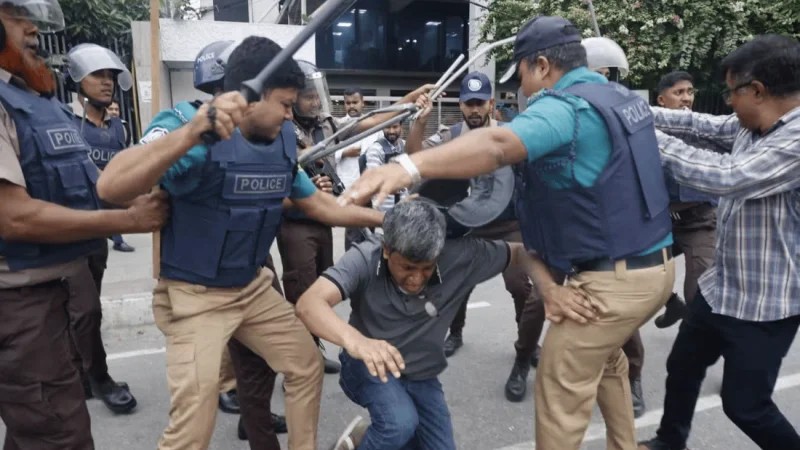
The agreement for the New Mooring Container Terminal (NCT)—which handles almost 50 percent of the port’s container traffic—was signed on Thursday afternoon at the Invest Bangladesh office in Agargaon, Dhaka. Protesters gathered outside the venue as police employed batons to disperse the demonstrators.
The decision represents a notable policy reversal for the Bangladesh Nationalist Party (BNP) government, whose leaders previously resisted transferring the terminal to a foreign operator during the interim administration.
The government maintains that the agreement will modernise port operations, draw investment and boost Bangladesh’s trade competitiveness.
However, workers and opposition groups have raised concerns about the deal’s financial terms, its transparency and the potential impact on national control of strategic infrastructure.
The dispute escalated immediately after the signing, as labour organisations at Chittagong Port announced a day‑long mass hunger strike slated for 12 October. They also warned that further actions could be taken, including measures that might bring port operations to a standstill.
On Thursday, Prime Minister Tarique Rahman met with a DP World delegation led by board chairman Essa Kazim and urged the company to consider further investments in Bangladesh, including the development of free‑trade zones and rail‑based inland container depots.
Under the agreement, DP World will operate and maintain the NCT for a period of 15 years, with the possibility of extending the contract for an additional 15 years if both parties mutually agree.
Shipping Minister Sheikh Rabiul Alam announced that the company will invest $150 million, roughly Tk1,500 crore, to modernise the terminal.
He said Bangladesh would receive a signing fee of Tk600 crore. Under the arrangement, the government will retain 67 percent of the revenue generated.
The minister said that an annual payment of Tk10 crore is made to the port, but the exact link between this payment and the wider revenue‑sharing scheme remains unclear. Further clarification is needed to determine how the payment fits within the overall arrangement.
The terminal, constructed in 2007 at an estimated cost of about Tk2,000 crore, features five jetties and ranks among the nation’s most strategically significant container‑handling facilities.
The government maintains that ownership of the terminal is not being transferred.
Rabiul Alam told journalists that leasing a port and leasing container‑handling operations are distinct matters, adding that those who claim the port is being leased “are unaware of the details of this agreement.”
He said that ownership, security and overall regulatory control would remain vested in the Chittagong Port Authority and the relevant government bodies, including Customs, intelligence and security authorities.
DP World would be responsible for terminal operations, equipment maintenance and technological upgrades.
The government anticipates that the arrangement will boost container‑handling efficiency, cut vessel waiting times and reinforce the country’s import‑export infrastructure.
Police used batons to disperse demonstrators protesting the DP World–NCT agreement. The demonstration took place in Agargaon, Dhaka, on Thursday.
Nevertheless, the full agreement, encompassing detailed financial, operational and security provisions, has not been made available in the source material.
The decision carries particular political significance because the proposal has passed through three successive administrations.
Discussions about appointing an international operator began in 2019 during the Awami League government.
In March 2023, approval in principle was granted to pursue an international operator under a public-private partnership arrangement.
The initiative was revived during the interim government, which sought to finalize an agreement with DP World.
Protests, strikes and resistance by port workers compelled authorities to suspend the process in the run‑up to the national election slated for February 2026.
During that period, leaders of the Bangladesh Nationalist Party (BNP) in Chittagong opposed the proposed agreement, arguing that the interim administration lacked the mandate to make a long‑term decision concerning a strategically important national asset.
After assuming office, however, the BNP government reopened negotiations.
On October 1, the Cabinet Committee on Economic Affairs gave in-principle approval to the proposed 15-year arrangement.
The agreement was finalized just a week later.
When questioned about the government’s shift in stance, Shipping Minister Rabiul Alam said that earlier administrations had failed to negotiate terms sufficiently favourable to Bangladesh.
He said the current government had spent six months negotiating with DP World and securing what it considered better conditions.
In a statement, he said, “We have spent the last six months working on the areas where bargaining was necessary to secure our interests, and we have successfully reached a conclusion. This is an achievement of this elected government.”
The minister contended that the agreement would safeguard Bangladesh’s interests while drawing international expertise and investment to the port.
The signing took place against a backdrop of demonstrations in both Dhaka and Chittagong.
On Thursday afternoon, activists representing the Communist Party of Bangladesh, Bangladesh Samajtantrik Dal and other left‑wing organisations assembled outside the Invest Bangladesh office in Agargaon.
They demanded cancellation of the agreement and raised concerns about foreign management of a strategic national facility.
Police dispersed the demonstrators around 2:45pm, shortly before the signing ceremony.
Protesters claim that police struck them with batons without provocation, wounding several activists, including leaders of the Communist Party of Bangladesh.
CPB President Sazzad Zahir Chandan said the demonstrators had been holding a peaceful program.
“We were holding a peaceful program. At one point, police baton-charged us without any provocation,” he alleged.
He said the parties would continue protesting what they regard as a threat to Bangladesh’s control over its ports and national resources.
Monir Hossain, Officer‑in‑Charge of Sher‑e‑Bangla Nagar Police Station, told UNB that demonstrators had lain down on the road, obstructing traffic.
“Police removed them for the sake of vehicular movement,” he said.
The protesters' claims regarding injuries and the circumstances of the police action could not be independently verified from the accounts that are currently available.
Police used batons to disperse protesters during a demonstration against the DP World‑NCT deal in Agargaon, Dhaka, on Thursday, a scene captured in a Dhaka Tribune photograph.
In Chittagong, labour organisations staged a procession and held a rally in the port area shortly after the agreement was signed.
On 12 October, they announced a day‑long mass hunger strike outside the port building, demanding that the deal be cancelled.
Political leaders warned that larger protests, which could disrupt port operations, would follow if the government does not reconsider its decision.
Humayun Kabir, coordinator of the Chittagong Bandar Rakkha Sangram Parishad, described the NCT as the heart of Chittagong Port.
He argued that a strategically important and functioning terminal should remain under Bangladeshi management.
In an interview with BBC Bangla prior to the signing, he asked whether appointing a foreign operator could raise costs through extra payments and commissions.
He also contended that Bangladesh could modernise the terminal by training its existing workforce rather than handing its operation over to an international company.
Workers have staged demonstrations, hunger strikes and other programs over several months.
The most recent agreement has not resolved the dispute; instead, it has moved the conflict into a new stage, with opponents now calling for the cancellation of the signed contract.
Job security remains one of the principal concerns raised by port employees.
Shipping Minister Rabiul Alam dismissed fears that the agreement would lead to job losses.
“There is no possibility of job losses or harm to workers resulting from this agreement,” he said.
He argued that modernization and additional foreign investment would create employment opportunities and improve workers’ technical skills.
Md Zafar Alam, a former member of the Chittagong Port Authority, said that international management could improve terminal capacity and operational efficiency.
However, he warned that increasing terminal productivity alone would not resolve the wider logistical bottlenecks affecting the port.
He indicated that roughly 70 % of containers were bound for Dhaka, but persistent shortcomings in road and rail infrastructure continued to limit cargo movement.
He said the port also needs to boost container‑unloading performance and cut its reliance on storage charges as a source of revenue.
Zafar Alam stressed that workers’ employment rights should be protected during the transition.
Communist Party of Bangladesh (CPB) activists staged a march in Dhaka to protest the proposed lease of Chittagong Port’s New Mooring Terminal to DP World. The demonstration was photographed by the Dhaka Tribune.
Within hours of the agreement’s signing, Prime Minister Tarique Rahman met with DP World Board Chairman Essa Kazim and his delegation at the Secretariat.
Assistant Press Secretary AKM Nazmul Haque said the meeting addressed the expansion of Bangladesh‑UAE trade and investment, along with matters concerning port management, logistics and infrastructure development.
The prime minister extended an invitation to DP World to explore investment opportunities in free‑trade zones and rail‑linked inland container depots.
The delegation expressed interest in exploring cooperation in those sectors.
The meeting also reviewed the newly signed terminal agreement and opportunities to modernize Bangladesh’s logistics network.
The government says the agreement forms part of a wider strategy to draw international investment and boost the efficiency of the nation’s primary maritime gateway.
Despite the government’s assurances, several important questions remain unanswered.
The complete concession agreement has not been provided in the reporting received, leaving its detailed financial and operational provisions unclear.
The issues under review include the precise revenue‑sharing formula, the nature of the signing fee, performance targets, contractual penalties, worker protections and the arrangements for returning operational responsibility at the concession’s conclusion.
Concerns have also been voiced regarding the selection process, specifically whether the operator was appointed through competitive international tender and whether an independent assessment verified the economic benefits of foreign operation.
Opponents are calling for the full agreement to be made public so that its impact on national security, commercial control and public revenue can be examined.
The government maintains that the port will remain under Bangladeshi ownership, stressing that the arrangement concerns only the operation and maintenance of the terminal.
The administration’s immediate task is to prove that the pledged investment and modernization will yield measurable gains in container handling efficiency, vessel turnaround times and overall trade costs.
For the workers, the agreement has intensified an already prolonged confrontation.
Why it matters
The 15-year DP World concession agreement alters the operational management of Chittagong Port's primary container terminal, directly impacting national trade infrastructure and provoking industrial unrest.