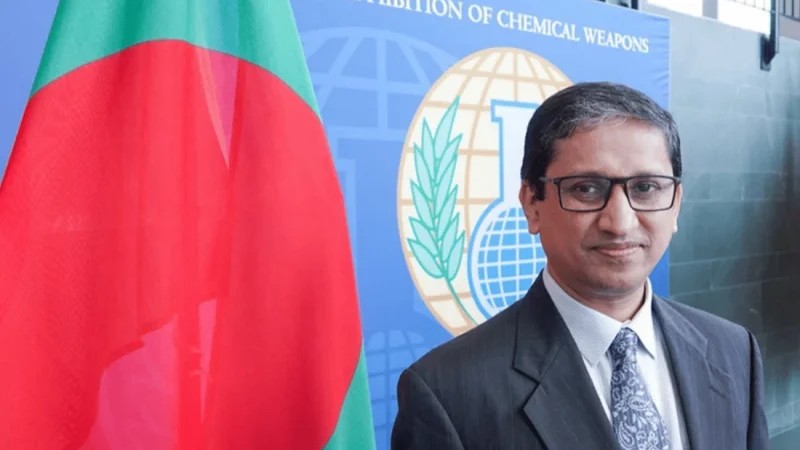
M. Riaz Hamidullah, the outgoing Bangladesh High Commissioner to India, said the Bangladesh‑India relationship is “organic” and rooted in mutual interdependence and shared interests.
In a recent statement, he said, “Very simple – this is a relationship which, on several occasions, I've said is organic … of mutual interdependence. It's a relationship which is in shared interests,” he added.
Bangladesh High Commissioner to India Hamidullah, who assumed the post on 7 April 2025, will leave New Delhi in early May to take up his new appointment as Bangladesh’s Permanent Representative to the United Nations in Geneva, a senior official said.
The diplomat said that differences in views, perspectives and approaches are natural in any close relationship, especially between two nations that share an intimate geography.
“However, we must remain engaged and continue the dialogue, as we need to unpack the interaction between people far more than it is today,” he said in an interview with Indian news agency ANI.
He said that people‑to‑people engagement should extend beyond traditional exchanges, adding that a broader scope of interaction could reach millions of individuals and help strengthen mutual understanding between the two countries.
“That’s an unattended space that remains,” he said, referring to the need for greater engagement at the people-to-people level.
Hamidullah noted that, while dialogue between ministries and governments remains essential, there is a considerably larger opportunity that could be addressed through expanded social and educational engagement.
The envoy noted that, among students, school‑going children and university attendees, greater engagement could reach “millions” of people and would make a “distinct difference” to the relationship between the two countries.
Hamidullah, reflecting on his recent trip to India, said in a post on his verified X account that a visit to Delhi Public School (DPS) Srinagar, where he interacted with students, left a lasting impression on him.
After arriving in Srinagar on 3 September, he toured the school and said he was especially struck by its inclusive, scholarly environment and the vibrant energy of its more than 5,000 students.
The Delhi Public School in Srinagar was established in 2003 by Vijay K. Dhar under the aegis of the D P Dhar Memorial Trust. The Dhar family maintains long‑standing connections with Bangladesh, a link that dates back to the late D P Dhar, who was instrumental in Bangladesh’s formation and its early development.
Hamidullah said that his engagement with students at the school gave him a new perspective on how young people perceive issues such as borders and identity.
A Class XII student, RJ Fatima, introduced herself to him as a radio jockey and invited him to the school's digital radio station. He said the station has been operating since 2019.
Hamidullah recalled that Fatima simply invited him into her radio studio, where they began a conversation. He said the most surprising moment was Fatima’s question: “How do you look at borders?”
He said, “Imagine, sitting in Srinagar, a girl asking this,” adding that he took the question in “absolute candour” and responded to her openly.
Indian High Commissioner to Bangladesh Dinesh Trivedi recently urged that trade, cultural exchanges and people‑to‑people connectivity between Bangladesh and India continue unabated, stating that such matters should not be impeded by political developments.
Speaking to reporters after a cultural program in Dhaka earlier this month, he said the two countries would continue discussing a range of issues, but that matters such as the Maitree Express, the Ganges Water Treaty, trade and cultural exchanges should not be allowed to stall.
The High Commissioner said, “These are the things of ordinary people,” underscoring the importance of keeping citizens at the centre of policy.
The High Commissioner said trade restrictions on both sides have to be eased. Otherwise, he noted, people will suffer.
He said there is no need to rush and that the political process will follow its own timetable. However, Trivedi added that work affecting ordinary people must continue.
On Tuesday, India reaffirmed its intention to advance its relationship with Bangladesh in a positive, constructive and forward‑looking manner, and said it is prepared to discuss all bilateral issues between the two countries.
At a media briefing in New Delhi, Indian Ministry of External Affairs spokesperson Randhir Jaiswal said India “desires a positive, constructive, and forward‑looking relationship with Bangladesh” while answering a question on bilateral ties.
Jaiswal said India is ready to discuss all bilateral issues with Bangladesh through the existing structured mechanisms.
He said, “Our intent is to take this relationship forward in a positive direction, in a constructive direction, in a forward‑looking manner.”
A vibrant “Ilish Fest” celebrating Bangladesh’s national fish, the ilish, was held at the Bangladesh High Commission in New Delhi on Saturday.
The event was convened at the “Maitri” Auditorium of the High Commission.
It gathered leading Indian politicians, diplomats, civil‑society representatives, academics, journalists and cultural personalities.
At the festival, leading Indian figures presented the newly released book *A Fish Called Ilish*, which was published in Dhaka.
The event focused on Ilish, a fish that is deeply embedded in Bengali heritage, culture and culinary traditions. It also served as a platform to showcase Bangladesh’s rich cultural heritage and hospitality, with guests sampling a variety of Ilish preparations alongside other traditional Bangladeshi dishes.
The guests expressed appreciation not only for the distinctive flavor of Bangladeshi ilish but also for the emotions, traditions and cultural values that the fish embodies.
The program was attended by former Indian Minister of State for External Affairs and journalist M. J. Akbar, former diplomat and politician Mani Shankar Aiyar, human‑rights activist and social thinker Syeda Hameed, former Indian ambassador Ronen Sen, eminent sociologist Ashis Nandy, and other distinguished personalities.
The guests praised the taste of Bangladeshi Ilish and the overall organization of the festival.
The ceremony also showcased Bangladesh’s heritage, culture and hospitality. Attendees said they hoped such initiatives would further strengthen the friendly ties between the peoples of Bangladesh and India.
After the book launch, Bangladesh High Commissioner Riaz Hamidullah said the ilish (Hilsa) is closely linked to Bangladesh’s national identity and is deeply woven into the country’s social and economic fabric.
The High Commissioner highlighted that Bangladesh maintains five Ilish sanctuaries and that the government has launched a range of initiatives aimed at boosting Ilish breeding and production. He said these measures have led to greater conservation and higher output of the species.
Why it matters
The remarks underscore the enduring structural interdependence between Bangladesh and India despite political fluctuations, highlighting the role of cultural and educational exchanges in sustaining bilateral goodwill.