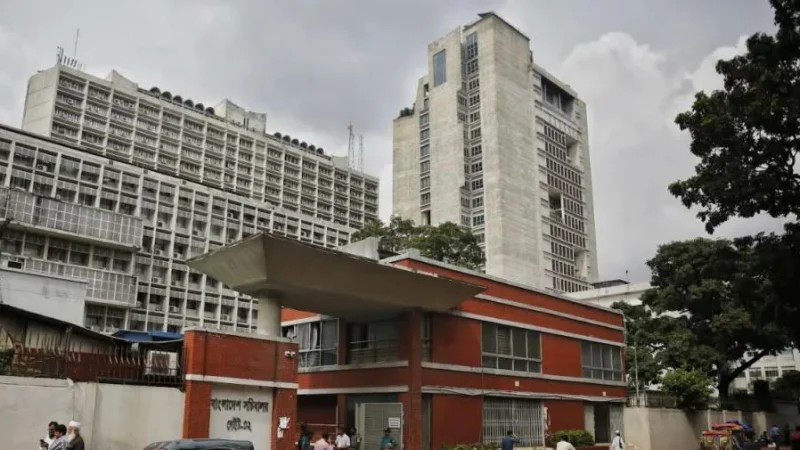
The Cabinet has granted in-principle approval to a proposal to relocate the Bangladesh Secretariat to Sher-e-Bangla Nagar in the capital. The plan involves constructing 14 12-storey buildings on a 31.58-acre site that is currently occupied by the former trade fair ground.
The proposed complex will provide approximately 3.316 million square feet of office space and feature three basement levels, parking capacity for 3,800 vehicles, a mosque, multipurpose halls, a cafeteria, and a post office. Additionally, about 30% of the project area is planned to be set aside for greenery and water bodies.
The Cabinet also approved the draft of a special ordinance on solar power installation, targeting 3,000 to 4,000 megawatts of rooftop solar capacity prior to next summer. During the same meeting, it approved a proposal to rename the Ministry of Women and Children Affairs as the Ministry of Women and Children. Additionally, the Cabinet approved Bangladesh's proposed accession to the Rotterdam Convention on the international trade of hazardous chemicals and pesticides.
The decisions were made during the Cabinet's 25th meeting, which was chaired by Prime Minister Tarique Rahman at the Secretariat on Sunday. Cabinet Secretary Nasimul Gani briefed reporters regarding the decisions following the conclusion of the meeting.
The government had previously made an in-principle decision to relocate the Secretariat during a recent meeting chaired by the prime minister.
According to a Cabinet press release, the existing Secretariat currently has approximately 1.876 million square feet of office space. The release states that more than one million additional square feet are required to satisfy the growing needs of various ministries and to accommodate ministries and divisions that are currently operating outside the Secretariat compound.
To address the shortage, the government has planned a new Secretariat in Sher-e-Bangla Nagar. Following a decision by the Executive Committee of the National Economic Council (ECNEC), the Department of Architecture prepared a conceptual design for the complex at the former trade fair ground, in line with the master plan developed by Louis I Kahn.
Cabinet Secretary Nasimul Gani said the proposed complex would comprise 14 12-storey buildings on approximately 31.58 acres of land. He added that the buildings, which would include three basement levels, would provide a total of about 3.316 million square feet of space.
The design features parking for 3,800 vehicles, including 200 above-ground spaces. Additionally, the complex will house a mosque, a cafeteria, a post office, and two multipurpose halls, each with a capacity of 350 people.
Gani said around 30% of the project area would be allocated to greenery and water bodies.
The extent to which the new complex will ease the existing space shortage will depend on plans for relocating different ministries and divisions and the effective use of the new buildings.
The Cabinet has granted in-principle and final approval to the draft Special Solar Power Installation Ordinance, 2026. The legislation is aimed at reducing dependence on imported fossil fuels, easing the burden of subsidies, and strengthening energy security.
The final approval is subject to vetting by the Legislative and Parliamentary Affairs Division.
Cabinet Secretary Nasimul Gani announced that the government has established a target to install 3,000 to 4,000 megawatts of rooftop solar capacity prior to the upcoming summer. To reach this goal, directives have been issued to set up solar power systems on the rooftops of buildings belonging to government, semi-government, and autonomous bodies, as well as local government institutions and state-owned enterprises.
The proposed framework provides for two financing models: Operational Expenditure (OPEX) and Capital Expenditure (CAPEX).
Under the OPEX model, an investor will install a solar power system using its own funds. Under the CAPEX model, institutions with their own revenue sources will be able to install solar systems based on projected future earnings.
According to a Cabinet press release, existing regulations do not provide sufficiently clear provisions regarding long-term electricity pricing, the use of electricity as payment for rooftop space, or maintenance arrangements when solar systems are installed by service providers under the OPEX model.
Similarly, existing laws lack clear provisions governing the installation of solar systems and the receipt of services under the CAPEX model.
The government has initiated a new ordinance to establish rules governing investment, service delivery, and maintenance in the sector. The proposed framework is expected to clarify investment arrangements and define the responsibilities of the parties involved in rooftop solar projects.
The Cabinet approved a proposal submitted by the Ministry of Women and Children Affairs to rename it the Ministry of Women and Children.
The Cabinet has approved a proposal from the Ministry of Environment, Forest and Climate Change for Bangladesh to join the Rotterdam Convention, which is an international treaty that governs trade in certain hazardous chemicals and pesticides.
The treaty, formally known as the Rotterdam Convention on the Prior Informed Consent Procedure for Certain Hazardous Chemicals and Pesticides in International Trade, was adopted on September 10, 1998, and entered into force on February 24, 2004, according to a Cabinet press release.
According to Cabinet briefing materials, 167 countries have joined the convention. Among the member states of the South Asian Association for Regional Cooperation (SAARC), every country except Bangladesh and Bhutan is a party to the treaty.
Joining the convention is expected to strengthen Bangladesh’s capacity to manage hazardous chemicals, facilitate access to foreign funding for relevant projects, support the development of a chemical information database, and improve the monitoring of chemical substances.
Membership would enable Bangladesh to make prior informed consent-based decisions regarding the import and export of chemicals listed in Annex III of the convention. Additionally, it would strengthen the framework for sharing responsibilities between importing and exporting nations in international trade.
Under Article 14, which addresses information exchange, Bangladesh would be enabled to exchange scientific, technical, economic, and legal information regarding hazardous chemicals and pesticides with other member states.
Article 16 would also provide opportunities for Bangladesh to receive technical assistance from the Rotterdam Convention Secretariat to improve chemical management.
The Cabinet’s approval clears the way for Bangladesh to take the next steps towards joining the international treaty.
Why it matters
The relocation of the Secretariat and the adoption of the rooftop solar ordinance mark major infrastructure and energy policy developments for Bangladesh.