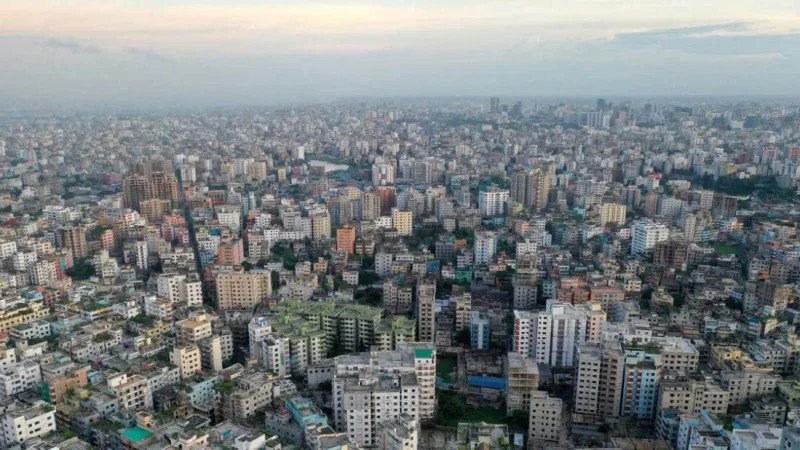
A family has found a cheaper home on the outskirts of Dhaka that looks affordable on paper. However, the father now spends hours commuting to work and a sizeable share of his income on transport, while the children have little space to study. Waterlogging also makes the neighborhood difficult to access during heavy rain, and every rent increase forces the family to reconsider what to cut from their monthly budget among food, healthcare, education, or savings.
As we observe World Habitat Day and reflect on the call for “Adequate Housing for All,” we must ask a fundamental question, as housing is too often discussed in terms of buildings, such as how many apartments have been constructed, how many plots have been developed, or how many families own their homes. However, adequate housing is not simply four walls and a roof, but rather whether a home allows people to live safely, affordably, and with dignity, and whether its location enables them to participate in the city.
For Bangladesh, this distinction is increasingly important. Data from the 2022 Population and Housing Census reveals that while approximately 80.8 percent of households nationally lived in their own homes, that figure dropped to just 55.6 percent in urban areas. Furthermore, about 34.7 percent of urban households consisted of renters who did not own another dwelling elsewhere.
A more recent picture indicates that rental dependence remains significant, with reporting based on Bangladesh Bureau of Statistics data showing that approximately 45 percent of households in Dhaka Division were renting or subletting their dwellings in 2023, compared with about 19 percent nationally. Simultaneously, the House Rent Index has continued to rise, as BBS data indicate a 5.19 percent year-on-year increase in the July-September 2025 quarter, followed by a 5.24 percent increase in October-December 2025.
These figures make the issue very tangible, highlighting that for a large share of urban Bangladesh, housing is fundamentally a rental question rather than an ownership question. Consequently, homeownership cannot serve as the sole measure of housing success. For millions of Bangladeshis—particularly migrants, young workers, students, newly formed households, and low- and middle-income families—rental housing is not merely a temporary arrangement on the path to ownership, but rather their permanent housing reality.
Despite the ongoing heavy focus in housing discourse on land ownership, apartment ownership, and new construction, rental housing deserves far greater policy attention. Better rental-market data, greater tenure security, transparent mechanisms for rent adjustment, and incentives to expand affordable rental housing in well-connected locations are all needed.
This brings us to perhaps the most overlooked dimension of housing affordability: location.
A Tk10,000 home close to employment, public transport, schools, and healthcare may ultimately prove more affordable than a Tk7,000 home that requires several hours and substantial transport expenditure daily. Consequently, housing costs cannot be understood separately from mobility costs.
Decision-makers must stop asking simply, "How much does this house cost?" and instead begin asking, "How much does it cost this household to live here?"
Housing also has consequences that extend far beyond urban planning, functioning as education policy, health policy, and increasingly, climate policy. A child living in an overcrowded home without adequate lighting, ventilation, or a quiet place to study faces disadvantages that improving the school alone cannot remove, as housing conditions influence sleep, health, concentration, and learning opportunities. Furthermore, excessive rent can leave families with less money for education, nutrition, and healthcare.
Climate change adds another layer of urgency. In Bangladesh, flooding, waterlogging, cyclones, river erosion, salinity and extreme heat already affect where and how people live. A dwelling cannot be called adequate if it is affordable today but repeatedly flooded tomorrow, or if poor ventilation makes it dangerously uncomfortable during extreme heat.
Climate-resilient housing demands more than simply constructing stronger buildings. It necessitates risk-sensitive land-use planning, the protection of wetlands and floodplains, improved drainage, heat-sensitive design, energy efficiency, resilient infrastructure, and community-based adaptation.
Resilience, however, should not serve as a justification for displacement. This concern is especially pertinent to informal settlements and historic areas like Puran Dhaka, where the demolition of older housing and its replacement with costly apartments can enhance physical building standards while simultaneously pricing out original residents. Consequently, such efforts may yield superior structures but ultimately foster less inclusive cities.
Where feasible, upgrading existing communities should come before displacement-oriented redevelopment. Enhancements to sanitation, drainage, water supply, waste management, public spaces, structural integrity, and energy efficiency can improve housing conditions while allowing residents to preserve their livelihoods, social networks, and cultural identity. This principle is considered especially important in historic neighborhoods.
Bangladesh ultimately needs to transition from merely counting houses to measuring housing adequacy. A national framework could assess affordability, tenure security, habitability, basic services, accessibility, location, climate resilience, and social and cultural adequacy. These dimensions could also be mapped using GIS to identify neighborhoods where various forms of housing deprivation overlap and where place-specific interventions are required.
This would shift the housing conversation from "How many units have we built?" to a much more meaningful question: "Are people actually able to live well in those homes?"
World Habitat Day should prompt us to ask a different question beyond simply how many houses Bangladesh needs. We must ask whether a family can afford its home without sacrificing food, education, or healthcare, and whether a worker can reach employment without losing hours every day. Additional questions include whether a child can study safely at home, a tenant can live without constant insecurity, an elderly person can reach essential services, and a community can survive both climate risks and redevelopment pressures.
If the answer is no, providing a roof is not enough. For Bangladesh, “Adequate Housing for All” should not remain an annual slogan. It should become a principle that guides how we plan our cities, invest in infrastructure, regulate rental markets, respond to climate risks and measure development itself. Because the real success of housing policy will not ultimately be counted in apartments, plots or buildings. It will be measured by whether those homes allow people to live with security, dignity and opportunity.
Mowtushi Poit is Assistant Professor, Bangladesh Institute of Governance and Management (BIGM).
Why it matters
For millions of Bangladeshis, rental housing is not a temporary step but their long‑term housing reality, underscoring the need for policy focus on affordability, location and climate resilience.