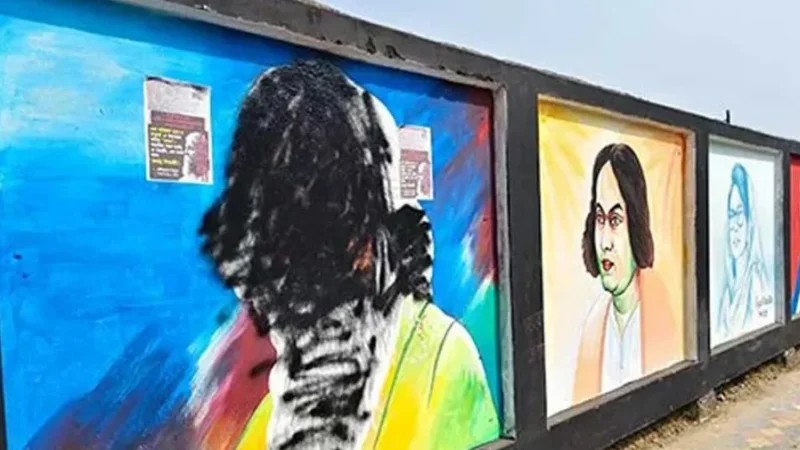
A mural of Nobel laureate Rabindranath Tagore at Khulna Railway Station was defaced with black ink on Friday afternoon, drawing immediate public attention.
Officer‑in‑Charge of Khulna Sadar Police Station Lokman Hossain said police learned of the incident in the afternoon and promptly launched an investigation.
The murals, commissioned by Khulna City Corporation ahead of Prime Minister Tarique Rahman's visit, depict the July uprising, the Sundarbans, the Sixty Dome Mosque, the jute industry and portraits of regional cultural icons such as Rabindranath Tagore, Kazi Nazrul Islam, Fakir Lalon Shah, artist SM Sultan, former Prime Minister Khaleda Zia, former President Ziaur Rahman and poet Michael Madhusudan Dutt.
Only Tagore's portrait was targeted; the other figures remained untouched, suggesting a focused motive.
Two posters were placed beside the mural. One, titled “Opposition to the Establishment of Dhaka University”, contained statements accusing Tagore of hostility toward Muslims and East Bengal and rejecting any glorification of India.
KCC Administrator Nazrul Islam Manju condemned the act, saying the defacement exposed "narrow‑mindedness and sick mentality" and underscored the importance of the murals in fostering free thinking among children and adolescents.
The incident echoes a similar defacement on 10 October, when a Tagore mural in Dhaka was also vandalized with black ink, leading to the detention of four individuals, including Al Nur Mohammad Ayash of the State Dialogue Forum.
Authorities continue to investigate the Khulna case, urging anyone with information to come forward as the community grapples with the cultural and social implications of the attack.
Why it matters
The defacement highlights rising cultural tensions and challenges to heritage preservation in Bangladesh.