When answering journalists’ questions on various serious subjects, State Minister for Foreign Affairs Humayun Kabir often tries to create a little humor with some sarcasm and mockery.
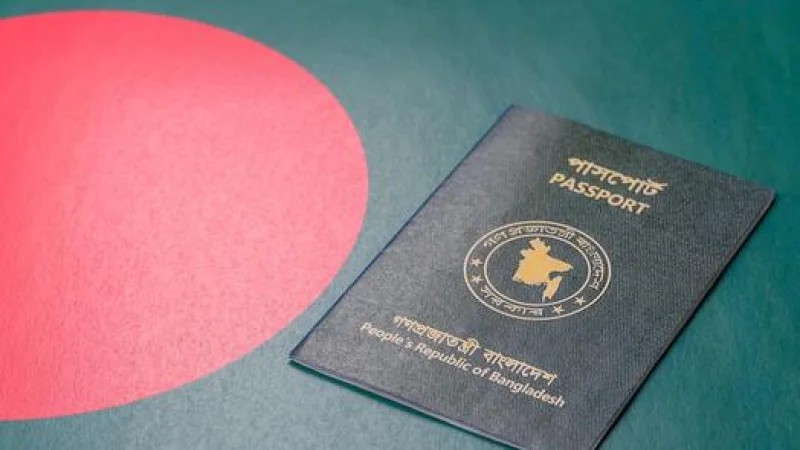
Recently, Kabir was asked whether former Prime Minister Sheikh Hasina had applied for a passport to return to the country. The question cannot be described as entirely reasonable, given that there has been nothing to suggest that Hasina has applied for a passport at all.
The person concerning whom the passport question is being raised has herself made no statement regarding a passport. Furthermore, if a journalist is curious, they will naturally inquire, and a responsible official would be expected to provide an appropriate response.
The state minister stated that he knows nothing regarding a passport. Naturally, he would not, as Sheikh Hasina has said nothing concerning a passport or a travel pass. Kabir, however, did not stop there.
“Is she going to come here to visit her in-laws’ home in Rangpur, that I should give her a passport, and she’ll come with the passport?” he asked, describing the matter as “laughable.” He then laid out the government’s position in his own words.
“Sheikh Hasina is a fugitive terrorist. A dictator, a runaway terrorist,” he said.
Humayun Kabir’s choice of words is quite interesting. As a Britain-based expatriate, Kabir knows well what “terrorist” means in the Western world, where the term mainly means Islamist militants, although in the United States some armed white supremacist groups are designated as domestic terrorist organizations. A suspicion remains here that, by labeling Hasina a “terrorist,” the minister wants to create an image of her in the minds of Westerners.
Regarding bringing Hasina back from India, Kabir maintained his previous stance. "We have an active extradition treaty for catching terrorists, for catching criminals," he stated. "To catch terrorists and criminals, you don't need a passport; they are handed over."
He is right about this, as the very purpose of the extradition treaty between Bangladesh and India is to arrest each other’s “terrorists” and “criminals” and send them back.
The problem lies elsewhere. Does India see Sheikh Hasina as a “terrorist” or “criminal” at all?
Indian High Commissioner Dinesh Trivedi's response to a university student’s question at a recent event makes it clear that the Indian government does not view Sheikh Hasina as a terrorist or criminal, but instead treats her with considerable respect. Throughout his statement, Trivedi referred to the former prime minister as “Hasinaji.” According to Indian social customs, responsible individuals do not add the suffix “ji” to the names of criminals or terrorists.
Trivedi stated that Hasina arrived in India on August 5, 2024, as the prime minister of Bangladesh. He also clarified that the Indian Air Force did not "rescue" her from Ganabhaban, explaining instead that Bangladesh's own military transported her to Delhi for her safety.
If India does not view Hasina as a "terrorist" or "criminal," there is significant doubt regarding whether the extradition treaty, regardless of its active status, would apply to her case.
A second issue arises concerning Humayun Kabir’s statement. A day earlier, the government’s spokesperson and the Prime Minister’s Adviser on Policy and Strategy, Zahed Ur Rahman, expressed a slightly different view.
During his regular press briefing, when he was asked multiple questions on the same subject, he did not directly rule out the possibility of giving Hasina a passport. He stated that he knows Hasina has made no such application and added that the government has no plan sitting ready.
Regarding whether ousted leader Sheikh Hasina has requested a passport, a government representative stated that if she had indeed asked for one, "what the government would do, I think it is better to keep that to answer at that time."
Rahman’s reply also touches lightly upon another aspect of immense importance. He raised the issue of citizenship and referred to “this state,” meaning the state that was founded under the leadership of Hasina’s father.
Leaving the country and returning is the constitutional right of all citizens of "this state," and obtaining the travel document needed for this, a passport, is also their right. However, under Bangladeshi law, a citizen's passport can be canceled in certain cases, they can be barred from leaving the country, and a passport application can likewise be rejected.
However, canceling or rejecting a passport is entirely designed to prevent someone from leaving the country. The issue of returning to the nation from abroad remains somewhat unclear.
Hundreds of cases have been filed against Sheikh Hasina, and one or two have been tried in her absence, with Hasina even receiving a death sentence. Because the government considers Hasina a fugitive, it naturally raises the question of whether the administration would want her to return and face the country's law.
Since Hasina has expressed a wish to return voluntarily in December, that apparently seems the easiest and quickest path. On the other hand, the extradition that Humayun Kabir speaks of, which Zahed Ur Rahman dramatically explains as “we will bring her by catching her,” is a long legal process; nobody can say how many months, or even years, the extradition process might take.
Even after the process concludes, there remains no guarantee that the Indian government will actually hand Sheikh Hasina over to face the death sentence.
Against this background, if the government chooses the long extradition process as the only road, and dismisses the possibility of a quick return with some absurd remark, then only one conclusion can be drawn: the government in fact does not want Sheikh Hasina to return to the country. That means the government does not want the verdict in Hasina's concluded trial to be carried out.
Listening to the state minister, it does not seem that Hasina’s presence in the country is desirable to the government. There could be two reasons.
First, in the current situation, the government possesses neither the political courage nor the strength to execute the verdict against Sheikh Hasina.
Second, the return of Hasina would revive the Awami League while pushing the anger of Jamaat-e-Islami and the NCP to its peak. It is possible that the BNP lacks the confidence to face this two-sided political challenge.
Sabir Mustafa is the former head of BBC Bangla and currently works as a freelance journalist and podcaster. The views expressed are the author's own.
Why it matters
The debate over Sheikh Hasina's potential return and extradition highlights critical diplomatic and legal challenges between Bangladesh and India.