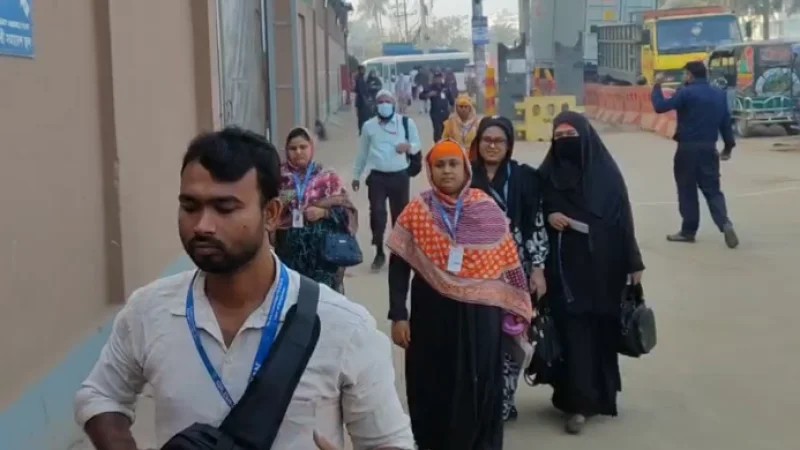
Industrial activity has largely returned to normal in Savar and Ashulia following several days of unrest over garment workers’ demands, which included a minimum monthly wage of Tk30,000 and an end to blacklisting.
Most factories resumed production on Sunday, although authorities declared holidays at 20 factories after workers at several facilities stopped working and remained inside their workplaces.
Following holiday announcements made at approximately 10:30 am, workers from multiple factories positioned themselves on the Abdullahpur-Baipail road, though police subsequently persuaded them to leave the thoroughfare. Speaking at around noon, Mohammad Mominul Islam Bhuiyan, superintendent of police for Ashulia Industrial Police-1, stated that workers were carrying out their duties peacefully at the majority of factories in Savar and Ashulia.
However, workers at several factories had stopped working and remained inside, prompting the authorities to declare holidays at 20 factories. Workers at four factories were still refusing to work, he added.
He said some workers took to the streets, but police persuaded them to move away.
The Savar Upazila administration stated that 11 platoons of Border Guard Bangladesh (BGB), alongside police personnel, were deployed to maintain law and order, keep factories operational, and ensure uninterrupted production.
Speaking around 12:45 pm, Khairul Mamun, legal affairs secretary of the Bangladesh Garments and Sweaters Workers Trade Union Centre, stated that workers at several factories had returned to work.
However, authorities had declared holidays at some factories after workers stopped working and remained inside, while workers at a few others were still refusing to work.
Overall, the situation was satisfactory for the time being, he said, stressing that ensuring workers receive their wages by the 10th of the month should now be the top priority.
Savar Upazila Nirbahi Officer (UNO) Md Saiful Islam stated that the situation in the industrial areas of Savar was currently normal, with workers returning to their workplaces.
He said, however, that the period leading up to the 10th of the month would be crucial for wage payments, and added that the administration was closely monitoring the situation.
Factory owners had been instructed to pay workers within the stipulated deadline.
The UNO added that 11 platoons of the BGB, nine executive magistrates, and members of various law enforcement agencies had been deployed to maintain normalcy in the area.
Why it matters
The normalization of industrial operations in key manufacturing hubs impacts national apparel production and supply chain stability.