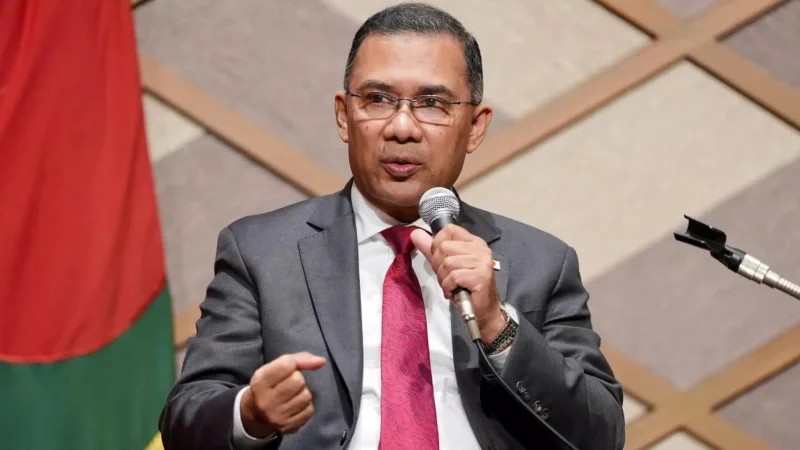
On Wednesday, Prime Minister Tarique Rahman called upon all Bangladeshis, including expatriates living abroad, to contribute to building a developed and better country with improved facilities for its people at home and overseas.
Addressing Bangladeshi expatriates at a hotel in Tokyo during an exchange of views, he stated, “We are all Bangladeshis. Our first priority should be to do something for our country and do something better.”
Tarique stated that a better Bangladesh will benefit its citizens regardless of whether they reside inside the country or overseas.
He stated that the government desires for individuals to collaborate toward the progress of the country, regardless of their position or location.
"So, wherever we are and whatever position we hold, if we believe that any work we do can bring something good for our country and its people, we should try to do it," the prime minister said.
He made the remarks while responding to a question from a Bangladeshi expatriate regarding the government’s plans for overseas Bangladeshis, which include individuals engaged in political activities abroad.
Tarique stated that the Bangladesh Nationalist Party (BNP) received the people’s mandate to govern the country, adding that the government’s primary priority is to work toward the nation's welfare.
Addressing the expatriates, he stated that although they are currently living abroad, they remain Bangladeshis and are welcome to return home one day.
The prime minister urged them to view the country’s development as a shared responsibility and to contribute to it from wherever they are located.
The program was organized by Bangladesh Community, Japan, at a hotel in Tokyo. Prime Minister’s wife Dr Zubaida Rahman was also present.
During the exchange, the prime minister also discussed plans to introduce Japanese and several other foreign languages in schools, expand healthcare services at the upazila level, and improve skills training for Bangladeshis seeking employment abroad.
He said the government plans to introduce Japanese and several other foreign languages in schools starting next year, aiming to equip students with skills for higher education and employment opportunities abroad.
Tarique stated that students will have the option to choose a third language—specifically Japanese, German, or French—as part of a broader initiative aimed at strengthening the country's education system.
Prime Minister Tarique Rahman exchanges views with Bangladeshi expatriates at a hotel in Tokyo on Wednesday, October 28, 2026. Photo: Collected
“We want to build a system where students learn a third language alongside English and their mother tongue,” he said.
Responding to a question from a young expatriate about the growing interest among Bangladeshi students in learning Japanese and pursuing higher education in Japan, the prime minister stated that work on the plan has already begun. The government expects to start introducing the languages in schools next year.
He stated that the government also intends to make sports, arts, and culture compulsory components of education, which will enable students to develop skills in at least one sport and one area of arts or culture. Additionally, vocational education will receive greater emphasis.
Tarique stated that a stronger education system would help prepare young people for future employment and enable them to compete internationally.
Responding to a question regarding cooperation with Japan in the fields of healthcare and technology, the prime minister announced that the government intends to expand healthcare facilities at the upazila level. This initiative aims to enhance access to basic medical services, with a particular focus on women and children.
He said the government aims to upgrade existing 50-bed upazila health complexes to 150-bed hospitals over the next five years.
Tarique stated that the expanded facilities will feature dialysis units, paediatric services, and gynaecology departments designed to address the healthcare needs of rural communities.
He noted that major hospitals are struggling to cope with patient numbers far beyond their capacity, while many people from rural areas have to travel long distances to receive treatment.
The prime minister stated that the government will also concentrate on preventive healthcare and intends to recruit one lakh health workers, with at least 80 percent of those workers being women.
The health workers will visit communities to raise awareness about healthy lifestyles, help prevent diseases such as diabetes and heart conditions, and provide advice on common illnesses, he said.
Tarique stated that improving preventive healthcare will reduce pressure on hospitals and help ensure better treatment for patients who need hospital care.
In response to a further question regarding how to utilize the skills of Bangladeshi nationals who lived in Japan for years before facing visa cancellations or returning home, the prime minister stated that these individuals can contact the Ministry of Education or the Ministry of Expatriates’ Welfare and Overseas Employment to explore potential opportunities.
He stated that the government has encountered difficulties in recruiting Japanese-language teachers despite advertising vacancies, with fewer than 30 individuals reportedly applying for the positions.
Tarique stated that Bangladesh must adequately prepare workers prior to sending them abroad by providing appropriate language and cultural training in order to sustain its position in overseas labour markets.
Why it matters
The prime minister's diaspora engagement in Tokyo outlines concrete policy directives for foreign language education, healthcare expansion, and overseas labour market preparation.