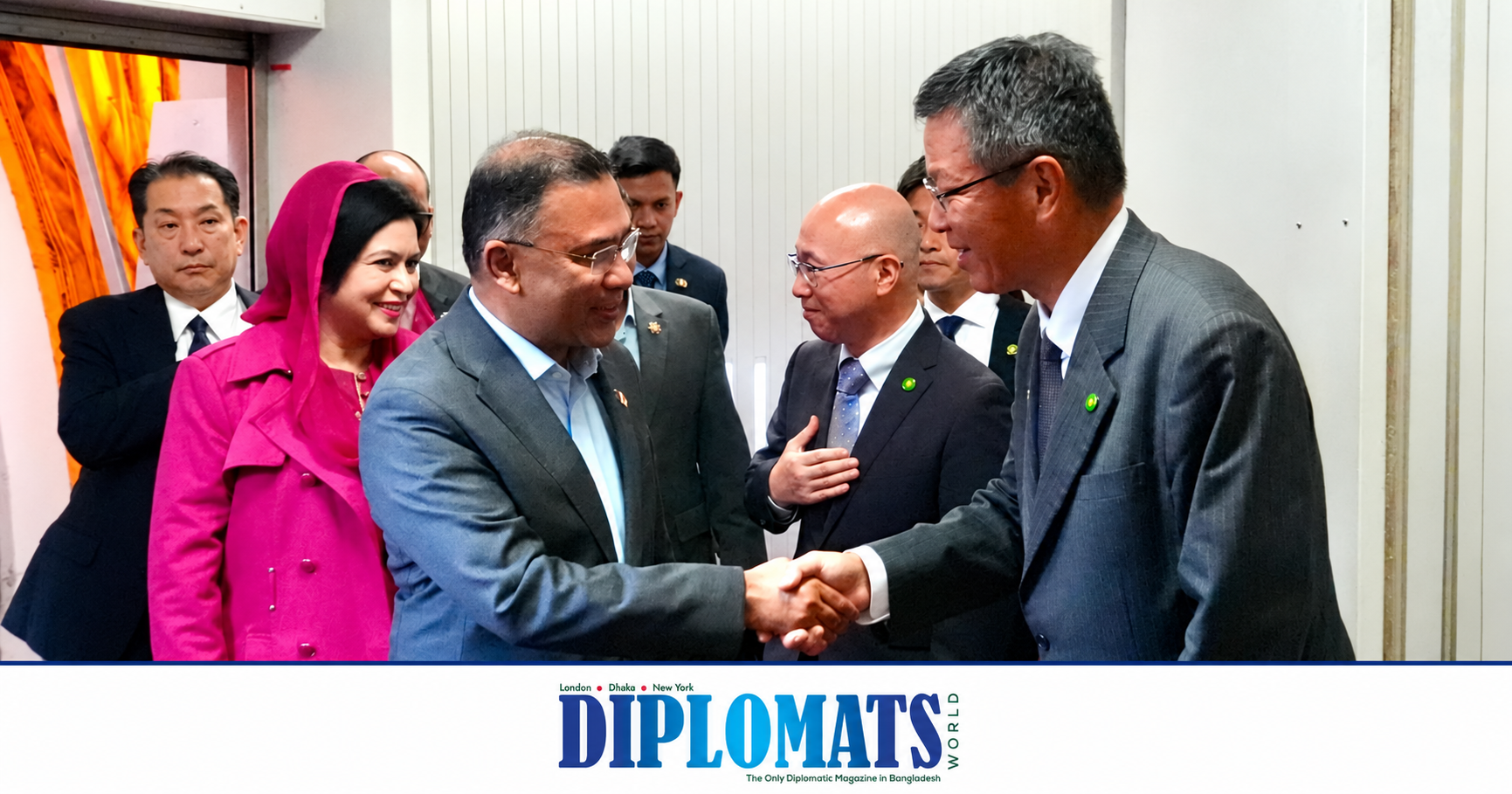
Prime Minister Tarique Rahman arrived in Tokyo this morning, local time, for a four-day official visit following an invitation from Japanese counterpart Sanae Takaichi. The visit is intended to deepen bilateral ties, attract investment, and expand trade and development cooperation.
A Biman Bangladesh Airlines flight carrying the prime minister, his wife Dr Zubaida Rahman, and members of his entourage landed at Narita International Airport at 9:07 am local time.
Japanese State Minister for Foreign Affairs Yasutaka Nakasone received the prime minister at the airport. A motorcade subsequently escorted him to Tokyo's Imperial Hotel, where he will stay during his visit.
Also present were Prime Minister's Adviser for Posts, Telecommunications and Information Technology and Science and Technology Rehan Asif Asad, Special Assistant to the Prime Minister for Foreign Employment in the Asia-Pacific region Dr Md Shakirul Islam Khan, and senior officials of the Bangladesh Embassy in Tokyo.
The prime minister departed from Hazrat Shahjalal International Airport in Dhaka early today, Bangladesh time, bound for Japan and accompanied by a small delegation.
Tarique Rahman is scheduled to hold high-level bilateral talks with the Japanese prime minister at her office on October 27, followed by a joint press announcement and a luncheon hosted by the Japanese premier, according to the Prime Minister's Press Wing.
During the four-day visit, the prime minister will also meet Japanese government officials, development institutions, and business leaders, visit industrial and energy facilities, and deliver the keynote address at the Bangladesh-Japan Economic Forum.
The visit is expected to deepen the existing strategic partnership, attract fresh Japanese investment, expand trade, and accelerate ongoing development projects, Foreign Secretary Asad Alam Siam told journalists on October 20. Speaking at a curtain-raiser media briefing at the Foreign Ministry, he outlined the anticipated outcomes of the diplomatic engagement.
Discussions will focus on the effective implementation of the Bangladesh-Japan Economic Partnership Agreement (EPA), which was signed in February 2026, as well as expanding access for Bangladeshi products to the Japanese market and strengthening business engagement.
The two sides will also explore wider cooperation in renewable energy, agriculture, science and technology, digital transformation, skills development, and human resource development.
His tentative programme includes engagements with the Japan-Bangladesh Parliamentary Friendship League and the chairman of the Japan-Bangladesh Committee for Commercial and Economic Cooperation.
Meetings are also being planned with the president of the Japan International Cooperation Agency (JICA), the governor of the Japan Bank for International Cooperation (JBIC), the president of the Japan External Trade Organization (JETRO) and the chairman of the Sasakawa Peace Foundation, said the foreign secretary.
The proposed itinerary includes visits to an LNG terminal and power plant in Futtsu City, Chiba, as well as the headquarters of UNIQLO and a Toyota factory in Nagoya.
The foreign secretary stated that the two sides were discussing draft memoranda of understanding and cooperation agreements covering agriculture, fisheries, human resource development, skills enhancement, civil aviation, trade, environmental conservation, and local government modernisation.
"We hope that many of these MoUs will be signed during the visit," he said.
Around eight Memorandums of Understanding are currently under discussion, with three to four expected to be signed during the visit. Additionally, separate agreements are being pursued in the fields of education and human resource development.
Detailed discussions are planned on Japanese support for establishing factories in Bangladesh, generating employment and developing human resources in line with the prime minister's priorities.
The two sides are also expected to discuss regional and international peace and stability, a sustainable and peaceful solution to the Rohingya crisis, stronger cooperation in addressing the energy crisis and efforts to end international conflicts.
The visit follows the prime minister's participation in an online meeting in April at the invitation of the Japanese premier, during which Bangladesh welcomed a Japan-led initiative to address energy challenges across Asia.
Japan has been a major development partner of Bangladesh since diplomatic relations were established in 1972. Japanese assistance has supported major infrastructure projects, including the Dhaka metro rail, the third terminal of Hazrat Shahjalal International Airport and infrastructure development in Matarbari.
Shaheed President Ziaur Rahman visited Japan in 1978 and again in 1980.
Former Prime Minister Khaleda Zia later visited Japan in 1994 and again in 2005.
Why it matters
The official visit aims to secure fresh Japanese investment and advance bilateral economic and strategic cooperation between Dhaka and Tokyo.