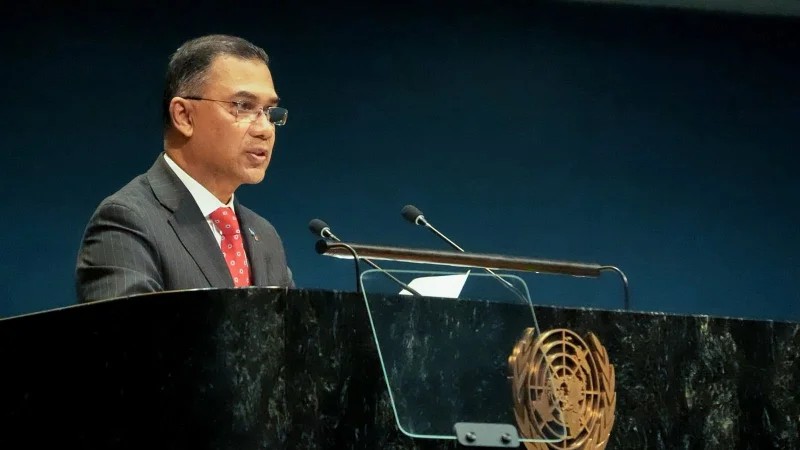
Prime Minister Tarique Rahman used his maiden address to the United Nations General Assembly to present a post-transition vision of Bangladesh built around political and economic empowerment, seeking international partnership to turn the country into a manufacturing hub while declaring: 'Bangladesh First: Bangladesh for All.'
Addressing the 81st UN General Assembly in Bangla in New York on Thursday, Tarique laid out a '3-R' strategy—Recovery, Restoration and Reconstruction—for rebuilding the country following the political upheaval of 2024. The 21-minute address covered topics ranging from Bangladesh’s democratic transition and economic ambitions to the Rohingya crisis, climate change, Palestine, artificial intelligence, migration and global conflicts.
'A state cannot become strong while keeping its citizens disempowered,' Tarique stated, pledging to build a prosperous, self-reliant and democratic welfare state where people could live with equal rights and dignity regardless of political affiliation, religion or ethnicity. In a central economic message, the prime minister said Bangladesh wanted to capitalize on its demographic dividend by transforming its working-age population into skilled human resources, creating large-scale employment and developing the country into a manufacturing hub.
Inviting development partners to join that effort, he noted that $50 million had been allocated in the current fiscal year to support start-ups led by young entrepreneurs, researchers and innovators. Tarique also told the international community that Bangladesh welcomed partnerships, innovation and investment as the government sought to create a safe, stable and business-friendly environment.
On the Rohingya crisis, the prime minister delivered an unequivocal message that the crisis originated in Myanmar and its solution must also be found there. 'The only solution to this problem is the safe repatriation of the displaced Rohingya population to their homeland, Myanmar,' he said, noting that Bangladesh has sheltered more than 1.2 million Rohingyas for over nine years while calling for firm international support and continued life-saving assistance.
The prime minister brought Bangladesh’s domestic political transition before the global forum, describing the previous 15 years as a period of fascist rule and exploitation while emphasizing that Bangladesh was returning to democracy following the 2024 mass uprising and the February 12 national election. He added that his government wanted not only electoral democracy but also the democratization of the economy so that growth reached every family.
Highlighting welfare initiatives, Tarique pointed to Family Cards, Farmers’ Cards, Sports Cards and e-Health Cards, with plans to consolidate them under a Universal Card. Education also featured prominently, with the government planning to gradually raise education spending to 5% of GDP over five years with a focus on technical and practical learning.
On climate change, he sought stronger global action on climate justice, finance and adaptation, highlighting domestic plans to plant 250 million trees, excavate 20,000 kilometers of canals and advance the Teesta Master Plan and Padma Barrage project. He also warned against a new global inequality around artificial intelligence, urging the UN to develop an effective framework to ensure modern technology is accessible to developing countries.
Tarique closed by setting out the broader political message for Bangladesh's next phase: a country where young people could pursue ambitions without fear, women could live with confidence, and every child could realize their potential.
Why it matters
Prime Minister Tarique Rahman's UN address establishes Bangladesh's diplomatic priorities, economic goals, and policy stances on key international issues during its post-transition phase.