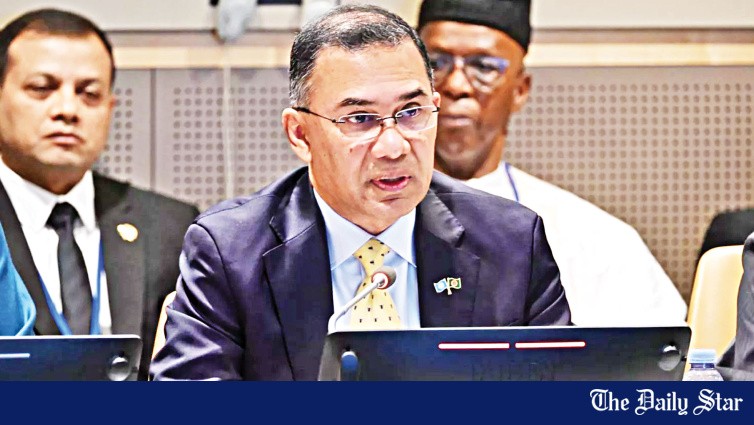
Prime Minister Tarique Rahman yesterday proposed five urgent measures to resolve the Rohingya crisis, urging the international community to address the root causes, resort to action, and end the crisis.
He made the proposals while addressing a high-level side event of the United Nations General Assembly titled “The Rohingya Crisis: A Renewed Call for a Durable Solution from Protracted Displacement, with Justice and Accountability” at the UN Headquarters in New York, reports UNB.
The proposals establish a clear and credible roadmap for the early, safe, voluntary, dignified, and sustainable repatriation of the Rohingyas to Myanmar, while ending violence against civilians, including the Rohingyas, and guaranteeing their fundamental rights and security. They also ensure adequate and predictable humanitarian support for the Rohingyas and host communities, strengthen justice and accountability, and step up regional and international cooperation to combat the narco-economy, human trafficking, digital scams, illegal arms, and other transboundary crimes.
Expanding upon his initial proposal, Tarique urged the international community to back stabilization efforts and leverage its influence to establish conditions within Myanmar that are favorable for the repatriation of refugees.
On the second point, the Prime Minister stated that the fundamental rights and security of the Rohingyas must be guaranteed in their homeland in order to restore their confidence to return.
Third, Tarique urged the international community to ensure adequate and predictable humanitarian support for the Rohingyas and backing for host communities in Bangladesh. He stated that their development aspirations should not be retarded by their generous act of hospitality.
On the fourth, he stressed that justice and accountability are indispensable for sustainable repatriation.
He expressed deep appreciation for The Gambia’s leadership in pursuing accountability before the International Court of Justice and recognised the important role of the International Criminal Court in pursuing individual criminal accountability, alongside other international justice and investigative mechanisms.
“International judicial and investigative mechanisms must receive sustained support,” he stated. “Those responsible for grave crimes must be held accountable.”
Regarding the fifth proposal, Tarique called for enhanced regional and international cooperation to combat the narco-economy, human trafficking, digital scams, illegal arms, and other transboundary crimes that fuel instability in the region.
He said the Rohingyas have faced discrimination, persecution and exclusion in Myanmar for decades.
"Bangladesh experienced several major waves of influx in 1978 and through the 1980s. Some repatriation was organised by the governments led by late president Ziaur Rahman and, subsequently, late prime minister Khaleda Zia. But the overall crisis situation deteriorated following the violence of 2017 in Myanmar," he said.
“Sadly, the situation inside Rakhine State remains deeply concerning,” the PM said.
Bangladesh has shouldered an enormous humanitarian responsibility for over nine years and continues to host over 1.2 million Rohingyas, he said.
“Regrettably, people continue to flee violence in Myanmar. Thousands of babies are born in the camps every year. They add another generation to this prolonged displacement,” Tarique said.
He stated that Bangladesh opened its borders "because humanity demanded it" and is currently providing food and health services to the Rohingyas. However, he noted that the camps are not an ideal place to live for a long period.
The Prime Minister stated that the cost of prolonged displacement is increasing daily for both the Rohingya and the host communities in Cox’s Bazar, while noting that the social, economic, environmental, and security pressures on Bangladesh are immense.
Prolonged uncertainty and desperation are creating new challenges and security risks, including human trafficking, migrant smuggling, drug trafficking, and other transnational crimes, he said.
"Some people are leaving by boat to Malaysia, endangering their lives. A crisis left unresolved in one country can become a security challenge for an entire region," Tarique stated.
He also expressed concern over the decline in humanitarian funding for the Rohingyas.
The Joint Response Plan sought more than $934 million in 2025, while the appeal for 2026 was scaled down to about $710 million, covering only minimum lifesaving needs, the Prime Minister said.
"This trend cannot continue," he said, expressing deep gratitude to international partners that continue to support Bangladesh. "We need their support more than ever."
Tarique stated that humanitarian generosity cannot serve as an excuse for political inaction, nor can Bangladesh be expected to shoulder the responsibility indefinitely.
The premier stated that Bangladesh had fulfilled its responsibility with humanity and urged the international community to bear its responsibility "with conviction".
Bangladesh and The Gambia co-convened the event, with other partners joining as co-sponsors.
President of the 81st session of the UN General Assembly Khalilur Rahman, UN Secretary-General’s Special Envoy on Myanmar Julie Bishop, and The Gambia’s Vice President Mohammed BS Jallow spoke at the event.
UN High Commissioner for Refugees Barham Salih presented the keynote paper at the discussion, which was moderated by Bangladesh’s Permanent Representative to the UN, Irene Khan.
Tarique, who is leading a 35-member delegation to the UNGA, is scheduled to address the General Assembly on September 24 (New York time), marking his first address to the world body as prime minister. He is expected to deliver his speech in Bangla.
Earlier in the day, the Prime Minister held a series of meetings with United Nations officials and other dignitaries on the sidelines of the United Nations General Assembly.
He met Salih at the Hyatt Grand Central New York. Salih appreciated Bangladesh’s humanitarian role in hosting the refugees, reports BSS.
Tarique also sought support from the international community to end the crisis while meeting Julie Bishop, special envoy of the UN secretary general on Myanmar.
Tarique and his wife, Zubaida Rahman, attended a dinner hosted by President Trump and First Lady Melania Trump at the luxury Lotte New York Palace Hotel.
Tarique and Türkiye President Recep Tayyip Erdogan held a high-level meeting at the Turkish House, where they discussed ways to further expand trade and investment ties between the two countries.
During the meeting, the two leaders expressed their firm commitment to explore new areas of future cooperation based on mutual interests and shared priorities, according to the Prime Minister's Assistant Press Secretary, Nazmul Haque.
Tarique also held a breakfast meeting with representatives of international philanthropic and humanitarian organisations at the Bangladesh Permanent Mission to the United Nations.
Representatives of several leading global philanthropic and humanitarian organisations, including the Gates Foundation, Visa Foundation, Rockefeller Foundation, International Rescue Committee (IRC) and Rotary International, attended the meeting.
During a meeting with Gates Foundation Chief Executive Officer Mark Suzman, the Prime Minister discussed public health, child healthcare, vaccination, affordable vaccines, preventive healthcare, and the modernisation of the health system.
Why it matters
Prime Minister Tarique Rahman's five-step roadmap places direct pressure on the international community to share the long-term responsibility of the Rohingya crisis and establish a credible repatriation framework.